
ATARU Black Resin: Revolutionizing Injection Molding with Additive Manufacturing
Can additive manufacturing truly deliver on its promise for injection molding, especially when it comes to small to medium-sized production runs? Traditionally, molds created via 3D printing have faced limitations, often exhibiting short lifespans when subjected to the intense stress, heat, and pressure inherent in the injection molding process. However, Nano Dimension is challenging this long-held perception with the development of ATARU Black, a groundbreaking resin engineered for exceptional thermomechanical durability. This innovative material presents a reliable and repeatable solution for additive tooling, potentially transforming how manufacturers approach short-run injection molding.
To rigorously evaluate and validate the capabilities of ATARU Black, Nano Dimension partnered with SKZ – German Plastics Center, a renowned institution headquartered in Würzburg, Germany. SKZ is a respected leader in research, education, product testing, and process evaluation within the plastics industry. As an independent partner, SKZ conducted comprehensive trials that demonstrated the high suitability of ATARU Black resin as an injection tool insert material. These trials strongly suggest that ATARU Black effectively bridges the gap between rapid prototyping and small to medium-scale production, offering a viable alternative to traditional tooling methods.
The detailed results of the SKZ tests have been compiled by Nano Dimension into a comprehensive case study, showcasing how ATARU Black resin withstands the demanding real-world conditions of injection molding. This case study provides valuable insights into the resin’s performance and its potential to revolutionize short-run injection tooling. If you are interested in learning more about the performance of ATARU Black, you can download the complete case study for free HERE.
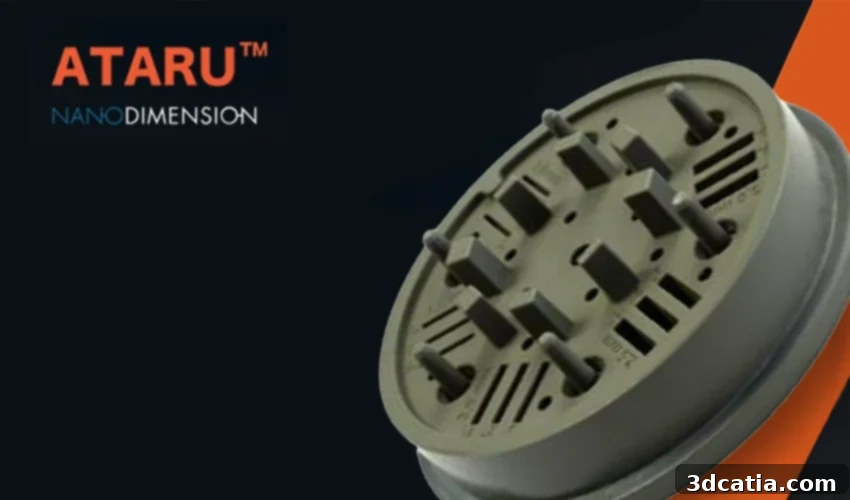
When assessing the suitability of a resin for rapid tooling applications, it’s crucial to evaluate several key factors. These include its printability, its compatibility with various thermoplastic materials, and its stability under the significant thermomechanical loads encountered during the injection molding process. To address these critical considerations, SKZ has utilized the Stonehenge benchmark tool insert since 2017. The Stonehenge benchmark is specifically designed with challenging and delicate geometries, such as intricate pins, cores, and grooves. This design allows for a thorough evaluation of print accuracy, mold durability, and the precision of the molded parts produced using the 3D-printed molds. The molds used in the SKZ trials were manufactured on an industrial Digital Light Processing (DLP) printer, utilizing a 405 nm exposure wavelength. Following the printing process, the molds were meticulously post-processed according to Nano Dimension’s specific recommendations to ensure optimal performance.
During the trials, SKZ employed several commonly used thermoplastic materials for the injection molding process, using the 3D-printed molds to rigorously test their performance and lifespan. These materials included Acrylonitrile Butadiene Styrene (ABS), Polyoxymethylene (POM), and glass fiber-reinforced polypropylene (PPGF30). The 3D-printed molds successfully delivered over 100 parts using ABS and more than 50 parts using POM, without exhibiting any visible signs of damage or abrasion. These results indicate a potentially much longer operational lifespan for molds produced with ATARU Black. Furthermore, when using PPGF30, the mold withstood more than 150 injections without requiring any release agent beyond the initial application at the start of the trial, demonstrating the resin’s exceptional resistance to wear and tear.
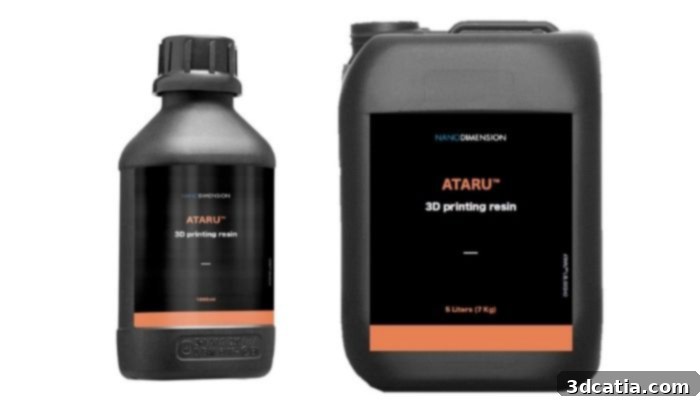
The ATARU Black Resin
What factors enable ATARU Black to outperform other resins in injection molding applications? The key lies in its exceptional material properties. ATARU Black boasts an extremely high glass transition temperature (Tg) exceeding 300°C and a Young’s modulus of 5.7 GPa. Notably, it retains an above-average elongation at break for this class of engineering-grade, ceramic-filled resins. These properties ensure that the mold maintains its precise geometry under the high clamping forces and elevated temperatures of molten thermoplastics, effectively preventing deformation. The high glass transition temperature ensures the material remains rigid even at high temperatures, while the Young’s modulus indicates its stiffness and resistance to deformation under stress. The elongation at break signifies the material’s ability to stretch before fracturing, contributing to its overall durability and resistance to cracking.
The case study further delves into other critical aspects that validate the strength and durability of ATARU Black resin. You will gain access to detailed thermal imaging data of the mold surfaces, providing valuable insights into heat distribution and dissipation during the injection molding process. The study also includes a comprehensive breakdown of the post-processing workflow, outlining the specific steps and parameters used to optimize the resin’s properties. Furthermore, the case study details the injection molding parameters employed for each polymer tested, allowing for a thorough understanding of the resin’s performance under various conditions. By examining the thermal imaging data, manufacturers can understand how the mold heats up and cools down during the injection molding cycle. Understanding the post-processing workflow ensures that users can properly prepare the molds for optimal performance. Detailing the injection molding parameters allows for replication of the successful results obtained in the SKZ trials. Download the full case study HERE to explore the complete findings and evaluate ATARU Black resin as a reliable and cost-effective solution for tool prototyping and small-series manufacturing.
ATARU Black resin represents a significant advancement in additive manufacturing for injection molding tooling. Its high thermal stability, strength, and durability make it a promising alternative to traditional tooling methods, especially for short-run production. The potential benefits include reduced lead times, lower tooling costs, and increased design flexibility. As additive manufacturing technology continues to evolve, materials like ATARU Black will play an increasingly important role in bridging the gap between prototyping and production. This innovative resin opens up new possibilities for manufacturers seeking to optimize their injection molding processes and bring products to market faster and more efficiently.
Beyond its technical specifications, ATARU Black offers several compelling advantages for manufacturers. Its ability to withstand high temperatures and pressures ensures consistent part quality and dimensional accuracy, reducing the risk of defects and scrap. The resin’s durability translates to longer tool life, minimizing downtime and replacement costs. Moreover, the ease of 3D printing complex geometries allows for the creation of molds with intricate features that would be difficult or impossible to produce using traditional machining methods. This design freedom enables manufacturers to innovate and create products with unique and complex shapes, expanding their competitive advantage.
The successful partnership between Nano Dimension and SKZ underscores the importance of rigorous testing and validation in the development of new materials for additive manufacturing. The independent trials conducted by SKZ provide manufacturers with the confidence to adopt ATARU Black for their injection molding applications. The comprehensive case study serves as a valuable resource, offering detailed insights into the resin’s performance and best practices for its use. As the adoption of additive manufacturing continues to grow, collaborative efforts between material developers and research institutions will be crucial for driving innovation and ensuring the reliability and performance of 3D-printed components.
What are your thoughts on ATARU Black and its potential impact on the injection molding industry? Share your insights and opinions in the comments below. We also encourage you to connect with us on our LinkedIn or Facebook pages to join the conversation. Stay up-to-date with the latest 3D printing news and innovations by subscribing to our free weekly Newsletter, delivered directly to your inbox. You can also explore our extensive video library on our YouTube channel for in-depth insights and demonstrations of the latest 3D printing technologies.
*All Photo Credits: Nano Dimension