
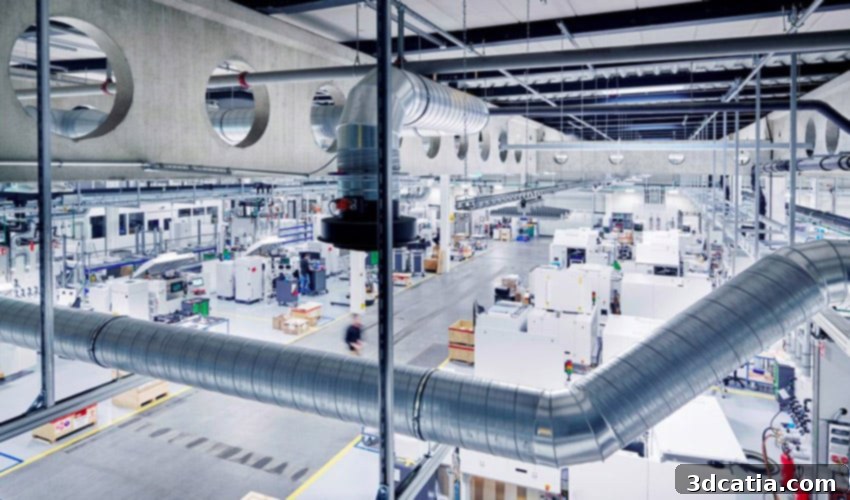
Essentium’s Landmark Research: Powering Mass Production with Industrial Additive Manufacturing
The manufacturing industry is witnessing an unprecedented evolution, with additive manufacturing (AM), commonly known as 3D printing, transitioning rapidly from a prototyping tool to a vital method for full-scale production. This significant paradigm shift was first brought to light in a seminal study conducted by Essentium in March, which revealed a growing trend: users of AM technologies were beginning to invest strategically in 3D printing for mass production initiatives. That initial report was built upon insights from an online survey involving 114 key stakeholders responsible for critical decisions regarding the deployment of 3D printing for production parts, moving beyond rudimentary prototyping stages. Essentium, a pioneering company based in Texas and a leader in industrial additive manufacturing solutions, had previously noted that AM’s potential was historically constrained by scalability limitations. However, the firm identified a pivotal change, observing that both 3D printing technologies and the ecosystem of innovators within the sector were collectively achieving a new, elevated level of maturity. Reinforcing these initial observations, Essentium has recently released fresh findings from a comprehensive, independent global research effort. These new insights unequivocally corroborate its earlier predictions, providing compelling evidence of a dramatic surge in the adoption and application of large-scale additive manufacturing across diverse industries worldwide, solidifying its role in the future of industrial production.
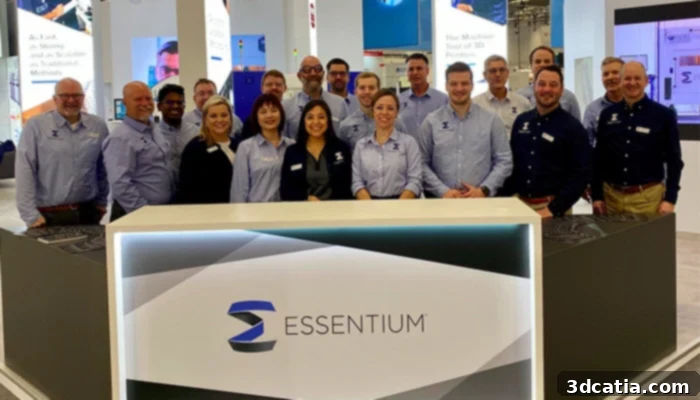
The Essentium team at Formnext 2019 | Credits: Essentium Inc.
The Accelerating Momentum of Industrial-Scale 3D Printing in Production
Essentium’s latest independent research provides an in-depth look into the current state and forward trajectory of industrial-scale 3D printing. This extensive study gathered insights from 162 managers and executives, representing leading manufacturing companies around the world. These decision-makers completed a detailed survey outlining their current experiences, prevalent challenges, and emerging trends concerning the integration of 3D printing into their core production manufacturing processes. The findings are not merely encouraging; they point to a rapid and substantial acceleration in adoption rates. According to the research, the number of manufacturers actively employing 3D printing for full-scale production has astonishingly doubled compared to the previous year, soaring from 21% in 2018 to a remarkable 40% in 2019. This doubling signifies a critical tipping point in how businesses perceive and leverage additive manufacturing. Beyond this headline figure, the study reveals that an impressive two-thirds of the surveyed companies have reported more than doubling their utilization of industrial-scale AM within their manufacturing operations. A particularly compelling statistic underscores this shift: 47% of these companies are now deploying the technology for production runs involving thousands of printed parts, representing a significant 17% jump over 2018 figures. This clearly indicates that 3D printing is no longer confined to small batches or bespoke items but is increasingly a viable solution for genuine mass production.
The surging adoption of additive manufacturing at an industrial scale is driven by a powerful combination of strategic imperatives. While **reduced manufacturing costs** remain a primary incentive for a substantial 58% of manufacturers, the appeal of AM extends far beyond simple cost savings. Additive manufacturing achieves cost reductions through various mechanisms, including material optimization, parts consolidation (reducing assembly needs), and enabling localized production which mitigates global supply chain complexities. Another critical driver, identified by 61% of respondents, is the urgent need to **reduce lead times**. In today’s fast-paced global market, quicker iteration cycles, rapid market entry for new products, and enhanced supply chain resilience are paramount. AM facilitates this by enabling on-demand production and bypassing lengthy tooling processes. Furthermore, the capacity for **mass customization** resonates deeply with 59% of manufacturers, who foresee significant benefits in tailoring products to individual customer needs without incurring prohibitive costs or production delays. This allows for greater product differentiation and responsiveness to consumer demands. Similarly, 59% are focused on increasing **speed-to-part production**, recognizing AM’s ability to rapidly transform digital designs into physical components, accelerating development and deployment. A significant 51% are also striving to achieve **high part performance**, exploiting AM’s unique capability to create complex, optimized internal geometries and utilize advanced, high-performance materials that are often impossible with traditional manufacturing methods. Considering that industrial-scale AM unlocks new capabilities previously beyond the reach of conventional manufacturing, it is understandable that two-thirds of the manufacturing companies surveyed confidently position themselves as leaders and innovators in 3D printing. Despite this palpable optimism and rapid advancement, the industry still faces a set of recognized obstacles, including the high cost of specialized 3D printing materials (cited by 51%); the significant capital expenditure required for advanced 3D printing hardware (38%); and the perception, held by 31% of respondents, that current 3D printing technology, despite its advancements, still struggles with true industrial scalability for all applications.
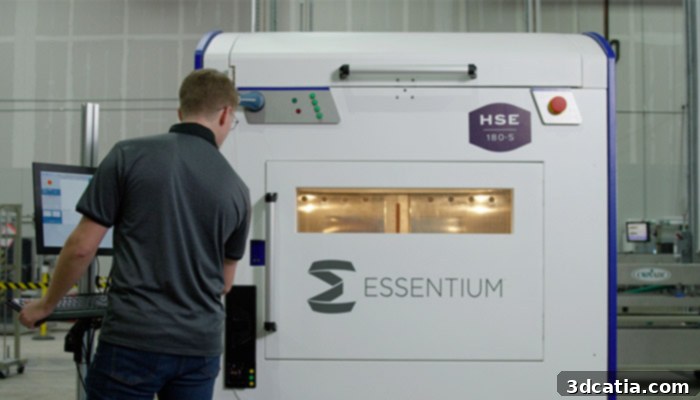
Essentium’s HSE 180 S 3D printing platform brings product strength and production speed together at scale | Credits: Essentium
Essentium’s Vision: Predictions for 2020 and the Emergence of Open Ecosystems
Drawing upon these compelling trends and the robust data collected, Essentium confidently posits that 2020 will be etched into history as the pivotal year when additive manufacturing truly scales and fundamentally reshapes industrial practices across a multitude of critical sectors. This transformative impact is anticipated to resonate profoundly in industries such as aerospace, where the production of lightweight, complex, and high-performance components is essential; automotive, demanding rapid prototyping, customized tooling, and efficient part production; electronics manufacturing services, which require intricate geometries and rapid iterations; and the biomedical field, where personalized medical devices, implants, and prosthetics are revolutionizing patient care. A key element underpinning this transformation, as predicted by Essentium, is the inevitable rise and ultimate prevalence of open ecosystems within the additive manufacturing landscape. This shift towards greater openness is projected to occur as the long-standing technological barriers related to economic viability, industrial scalability, material strength, and production speed continue to diminish and fall away. As AM technologies mature further, both end-users and technology vendors will increasingly champion and demand open ecosystems. This demand is fueled by a collective desire to exert greater control over their innovation cycles, to have a wider and more flexible choice in specialized materials, and critically, to achieve industrial-scale production at significantly reduced costs. Open ecosystems foster healthy competition, accelerate collaborative innovation, and ultimately make advanced manufacturing more accessible, adaptable, and cost-effective for a broader spectrum of businesses, thereby democratizing access to cutting-edge production capabilities.
Elaborating on this forward-thinking perspective, Blake Teipel, CEO and Co-founder of Essentium, shared his profound insights into the industry’s trajectory and Essentium’s strategic role. “From the very beginning, Essentium made a significant and unwavering commitment: to boldly challenge and ultimately smash through the inherent limitations that have historically encircled industrial-scale additive manufacturing,” Teipel asserted. “Our foundational mission has always been to empower our customers, enabling them to fully harness and benefit from the truly transformative impact of this extraordinary technology. The latest independent survey unequivocally validates our strategic vision, providing irrefutable evidence that manufacturers globally are not merely acknowledging but actively embracing this paradigm shift. The report resoundingly demonstrates that additive manufacturing at scale is no longer a distant aspiration but a tangible, present reality. This revolutionary shift is equipping businesses with unprecedented new avenues to dramatically enhance their competitive standing on a global stage, fostering innovation, agility, and efficiency across their operations.” Essentium’s dedication to facilitating this future is tangible in their innovative product offerings, such as the HSE 180 S 3D printing platform, which is meticulously engineered to deliver the robust product strength and rapid production speed essential for demanding industrial-scale applications. The continuous breakthroughs in advanced material science, coupled with increasingly sophisticated hardware and intelligent software solutions, are collectively expanding the horizons of what is achievable with additive manufacturing, firmly establishing its position as a cornerstone for the next generation of global industrial production.
The insights presented by Essentium’s global research serve as a powerful testament to the accelerating maturity and strategic imperative of additive manufacturing. It highlights a fundamental shift in how industries approach product design, manufacturing processes, and intricate supply chain management, steering towards more agile, cost-effective, and highly customized solutions. The journey from additive manufacturing as a niche prototyping tool to an industrial production powerhouse is undeniably in full swing, promising a future where innovation, efficiency, and adaptability define the global manufacturing landscape.
*Cover Image Credits: EOS
What are your thoughts on these groundbreaking predictions and the rapid evolution of industrial 3D printing for mass production? We highly encourage you to share your valuable insights and engage with our vibrant community! Feel free to let us know your perspectives in a comment below, or connect with us and join the conversation on our Facebook and Twitter pages! To stay fully informed and at the cutting edge of all the latest news, emerging trends, and groundbreaking innovations in the dynamic world of 3D printing, don’t forget to sign up for our free weekly Newsletter, delivered directly to your inbox, ensuring you never miss a beat in additive manufacturing.