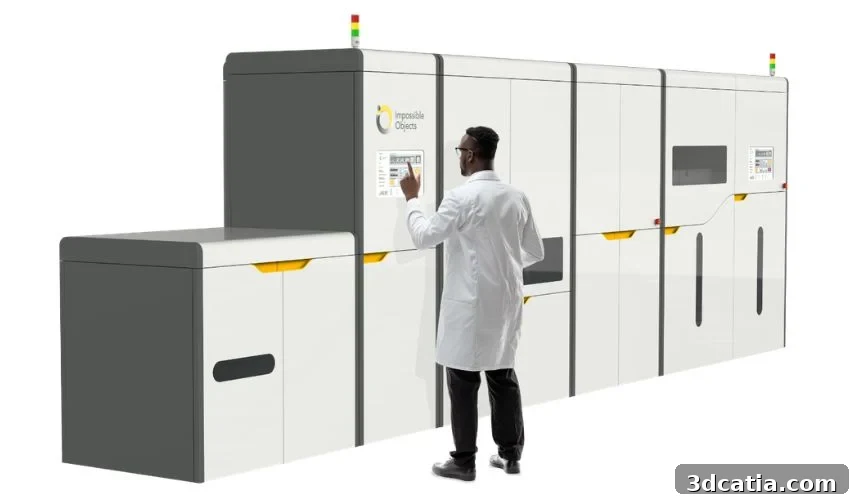
On September 11, 2026, Illinois-based Impossible Objects, Inc., a company specializing in additive manufacturing, announced a $40 million Series B funding round to expand its proprietary Composite-Based Additive Manufacturing (CBAM) technology and meet rising demand from aerospace, defense and industrial customers.
Led by Inflection Equity, the investment round included participation from Aaron Wealth Management, OCA Ventures, Impact Capital and Excell Partners. The new capital will be used to scale production of CBAM systems, accelerate global deployments, and expand sales and field service teams to support customers moving from prototyping to production.
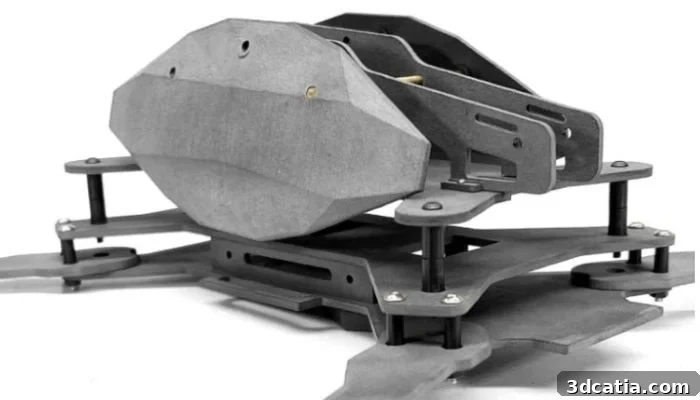
CBAM technology achieves part strength that is suitable for industrial applications.
Moving 3D Printing to Mass Production
For some time, the additive manufacturing industry has aimed to shift from rapid prototyping toward large-scale production. Impossible Objects’ CBAM process brings that vision closer by combining rapid throughput with high-performance composite materials, including continuous carbon fiber and fiberglass. The method produces lightweight, production-ready parts at volumes that can replace traditional CNC machining and injection molding for many end-use applications. By eliminating the need for expensive tooling, CBAM can reduce lead times and upfront costs for manufacturers adopting on-demand production models.
“We’ve created a fundamentally new way to manufacture,” said Robert Swartz, founder and chairman of Impossible Objects. “We live our lives through things, and we have changed how things are made. This is as important as the mill, precision measurement and interchangeable parts. This funding gives us the resources to bring that vision to more customers and make it real at scale.”
CBAM 25 Performance Metrics
Impossible Objects introduced the CBAM 25 system in early 2025 and has since begun delivering units to organizations across aerospace, defense and advanced manufacturing. Initial deployments include research institutions and government facilities that are evaluating the technology for production use. The CBAM 25 is sized and specified to support higher-volume manufacturing runs of structural components, tooling and other end-use parts.
Key Technical Specifications and Advantages
-
Production speed: The system prints up to 25 layers per minute, enabling throughput that the company states is significantly faster than many competing industrial 3D printing methods.
-
Material strength: CBAM produces composite parts with tensile strengths reported up to 200 MPa, delivering material performance that can exceed traditional polymer 3D printed parts and approach that of many conventionally manufactured composite components.
-
Precision: The process maintains structural integrity with minimal thermal shrinkage or warpage, producing parts with consistent geometry and repeatable mechanical properties suitable for demanding applications.
The CBAM 25 has been ordered for use in a variety of programs, including defense and aviation research projects. At some military facilities, the technology is being evaluated for high-volume production of mission-specific hardware such as lightweight airframe components and unmanned aerial vehicle bodies, demonstrating potential to produce thousands of parts per month when scaled.
Focus on National Defense
In addition to private investment, Impossible Objects has secured more than $20 million in U.S. government contracts and SBIR awards to advance its technology. CBAM is noted in a range of defense research roadmaps and is being evaluated at multiple government laboratories for use in applications that demand lightweight, high-strength components and distributed manufacturing capabilities.
Defense research and development efforts are concentrating on long-range unmanned systems, embedded wiring and integrated structures that simplify assembly and reduce weight. These initiatives aim to leverage CBAM’s combination of material performance and production speed to deliver parts faster and closer to the point of need.
“The nature of warfare is changing as new technologies are deployed,” said Stephen Farmen, retired U.S. Army major general. “The defense industrial base needs advanced manufacturing technologies that can deliver robust and flexible distributed production so we can supply drone systems, repair parts and other mission-critical hardware faster and more flexibly.”
The $40 million Series B investment will be used primarily to increase hardware production of industrial CBAM systems, accelerate customer deployments worldwide, and grow support capabilities to ensure systems can be integrated and maintained in operational environments. That combination of capital and government partnerships positions the company to support both commercial and defense customers seeking scalable composite 3D printing solutions.
*All photo credits: Impossible Objects