
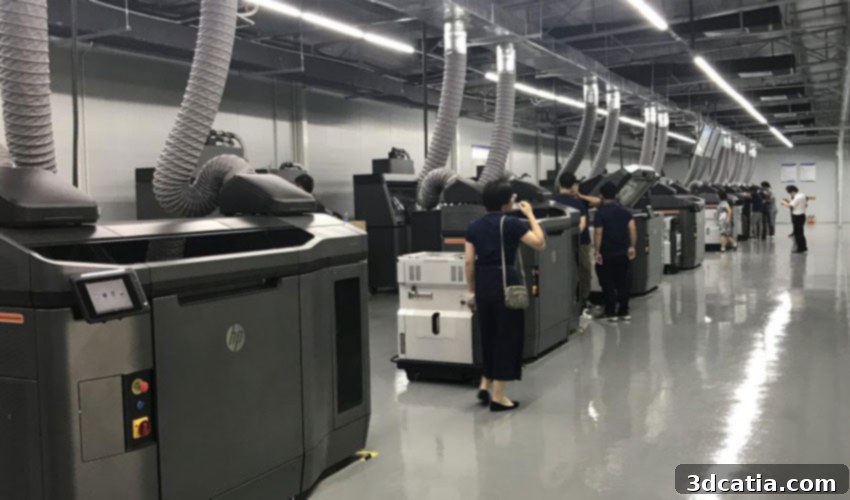
HP Unveils Flagship Multi Jet Fusion 3D Printing Center in Dali, China: Paving the Way for Asia-Pacific Digital Manufacturing
In a significant strategic move reinforcing its commitment to global digital manufacturing transformation, US technology giant HP has officially inaugurated a state-of-the-art 3D printing center in Dali, China. This expansive facility, equipped with ten cutting-edge HP Multi Jet Fusion 3D printers, marks a pivotal moment for HP’s expansion in the burgeoning Asia-Pacific region. The unveiling comes just over a year after HP announced its strategic partnership with Shining 3D, signaling a clear intent to deepen its roots and leadership in the Asian additive manufacturing landscape. Developed in close collaboration with the influential Guangdong Lanwan Intelligence Technology Company, this new center is poised to become a cornerstone digital production platform, not just for China but for the wider region, driving unparalleled innovation and production capabilities.
HP’s continuous growth solidifies its position as one of the world’s leading 3D printer manufacturers. The establishment of this production center in Dali holds particular strategic importance. Dali, situated in China’s manufacturing heartland, is renowned as one of the globe’s largest industrial hubs. This location choice underscores HP’s vision to integrate advanced additive manufacturing directly into a region already synonymous with large-scale production. The sheer scale of the Dali center is remarkable, featuring an unprecedented deployment of ten Multi Jet Fusion 3D printers within a single facility. This concentration of advanced additive manufacturing solutions is not merely for display; these printers are immediately operational, serving the robust demands of Guangdong Lanwan Intelligence Technology Company, a prominent 3D printing service provider dedicated to delivering high-quality, production-grade parts across diverse industries. This move significantly boosts the localized capacity for on-demand manufacturing and rapid prototyping at an industrial scale.
Driving Digital Transformation with HP Multi Jet Fusion Technology
Stephen Nigro, President of HP 3D Printing, articulated the core philosophy behind this strategic expansion, stating, “Everything starts with applications – and digital manufacturing innovators are leading the transformation of the $12 trillion manufacturing sector by producing industrial-grade parts across industries on HP Multi Jet Fusion. We are thrilled that Guangdong (Dali) 3D Printing Collaborative Innovation Platform is deploying HP Multi Jet Fusion technology at factory-scale to drive its business growth and accelerate industry innovation. HP is committed to helping our global digital manufacturing partner community expand and thrive.” Nigro’s remarks highlight HP’s focus on practical, high-value applications and their belief that additive manufacturing is a key driver in revolutionizing traditional manufacturing processes. The deployment of Multi Jet Fusion technology at ‘factory-scale’ signifies a move beyond prototyping to true mass customization and industrial production, enabling businesses to unlock new levels of efficiency, design freedom, and supply chain agility. This collaborative innovation platform exemplifies how strategic partnerships can accelerate the adoption of advanced manufacturing technologies, benefiting both local industries and the broader global economy.
Asia-Pacific’s Largest Hub for Advanced 3D Printing Solutions
The Dali center is not just another facility; it is positioned to become one of the largest and most advanced 3D printing centers in the entire Asia-Pacific region. Officially opened on June 16, this state-of-the-art hub will leverage HP’s robust Multi Jet Fusion solutions to empower Chinese service providers in producing both high-fidelity functional prototypes and end-use industrial parts with unprecedented speed and cost-efficiency. Given China’s dominant position as the world’s largest production market, the strategic imperative for leading 3D printer manufacturers like HP to establish a significant presence there is undeniable. The new center is specifically designed to cater to the diverse needs of high-growth industries, initially focusing on the demanding automotive and dynamic consumer goods sectors. Its operational reach is ambitious, aiming to serve not only the immediate province of Guangdong, a manufacturing powerhouse, but also the broader Greater Bay Area, an economic zone with immense industrial potential and a rapidly expanding technological ecosystem.
Meeting the Exploding Demand for Production-Grade 3D Parts
Luo Jun, Executive Director of the China 3D Printing Technology Industry Alliance and President of Guangdong Lanwan Intelligence Technology, eloquently articulated the surging market demand. “The demand for 3D-printed production-grade parts will grow exponentially over the next few years as we shift from analog to digital manufacturing,” he stated. His perspective underscores a fundamental paradigm shift in global manufacturing, moving away from traditional, often rigid, analog production methods towards more flexible, on-demand, and digitally driven processes. Luo Jun emphasized the critical role of HP’s technology in this transition: “By deploying HP’s Multi Jet Fusion technology in our new digital manufacturing center in China, we can better – and more quickly – deliver cost-effective and production-grade parts to our customers.” This statement highlights the immediate and tangible benefits of the collaboration: enhanced efficiency, reduced lead times, and the ability to produce parts that meet stringent industrial standards, all while optimizing costs. This combination is crucial for businesses looking to gain a competitive edge in a rapidly evolving market, ensuring that they can innovate faster and bring products to market more efficiently.
From left to right: Yang Haidong, Director of the Foshan Institute, Nanhai Guangdong Technology University; Stephen Nigro, President of HP 3D Printing; and Luo Jun, Executive Director of China 3D Printing Technology Industry Alliance and President of Guangdong Lanwan Intelligence Technology, at the opening of the new Dali center.
The Power of Multi Jet Fusion: Speed, Quality, and Versatility
HP’s Multi Jet Fusion (MJF) technology stands at the forefront of industrial 3D printing, offering a unique combination of speed, quality, and material versatility that sets it apart from many other additive manufacturing processes. Unlike traditional methods that build parts layer by layer using lasers or melted filament, MJF employs a proprietary thermal inkjet array to apply fusing and detailing agents across a bed of powdered material. Infrared lamps then fuse these layers, creating fully dense, functional parts with isotropic mechanical properties, meaning they exhibit consistent strength in all directions. This process significantly accelerates production times, making it ideal for the high-volume manufacturing demands of the Dali center. Furthermore, MJF supports a wide range of engineering-grade thermoplastics, including PA 11 and PA 12, opening up numerous applications for complex geometries, durable components, and intricate designs that would be challenging or impossible to achieve with conventional manufacturing. The ability to produce parts with superior surface finish and fine detail directly impacts industries like automotive, where precision and performance are paramount, and consumer goods, where aesthetics and customization are key differentiators. The synergy between HP’s advanced technology and the industrial expertise of Guangdong Lanwan creates a powerful engine for innovation and production in the region.
Economic Impact and Future Prospects for the Greater Bay Area
The establishment of the Dali 3D printing center is expected to have a profound economic impact on the Greater Bay Area and beyond. By localizing advanced manufacturing capabilities, the center will stimulate job creation, attract further investment in high-tech industries, and foster a robust ecosystem for additive manufacturing research and development. This strategic investment by HP not only enhances the region’s manufacturing prowess but also positions it as a global leader in digital production. The ability to rapidly iterate designs, produce on-demand parts, and customize products will empower local businesses to be more agile, responsive to market changes, and globally competitive. Furthermore, the center’s focus on industries like automotive and consumer goods reflects the growing demand for specialized, high-performance components and personalized products, which 3D printing is uniquely capable of addressing. This localized production capability also contributes to greater supply chain resilience, reducing reliance on distant manufacturing hubs and mitigating risks associated with global disruptions. As the world increasingly looks towards sustainable and efficient manufacturing practices, facilities like the Dali center will play a crucial role in shaping the future of industrial production, driving both economic growth and technological advancement.
HP’s investment in the Dali 3D printing center is a clear testament to its long-term vision for additive manufacturing as a cornerstone of the next industrial revolution. By combining innovative Multi Jet Fusion technology with strategic partnerships and a focus on high-growth markets, HP is not just expanding its global footprint; it is actively shaping the future of how products are designed, produced, and delivered worldwide. This center in Dali will undoubtedly serve as a beacon for digital manufacturing, fostering collaboration, accelerating innovation, and enabling a new era of production efficiency and flexibility across the Asia-Pacific region.