
Revolutionizing Space: The DoD’s TACTILE Program Leverages 3D Printing for Advanced Suborbital Rocketry
The United States Department of Defense (DoD) has long been at the forefront of adopting cutting-edge technologies, and additive manufacturing, commonly known as 3D printing, is no exception. This transformative technology has been instrumental in producing a wide array of critical components for defense applications, ranging from sophisticated hypersonic weapons to innovative 3D printed barracks, showcasing its versatility and strategic importance. In a recent significant move this October, the DoD further solidified its commitment by awarding $4.5 million specifically towards the advancement of ceramics 3D printing technology, underscoring its belief in AM’s potential.
Now, the DoD is embarking on an ambitious new initiative named TACTILE, an acronym for the Tactical Launch Effort program. This program is specifically designed to address a growing and critical demand within the defense sector: the need for low-cost, long-range suborbital energetics that can be manufactured and deployed with unprecedented speed. Spearheaded by the Defense Innovation Unit (DIU), an agile unit within the DoD focused on accelerating commercial technology adoption for military use, TACTILE aims to harness the rapid advancements occurring in dual-use commercial technologies. By strategically leveraging additive manufacturing, the program seeks to revolutionize capabilities for suborbital missions, including the testing and deployment of ballistic targets, ensuring the U.S. maintains a technological edge in an evolving global landscape.
To fully appreciate the scope and importance of the TACTILE program, it’s essential to understand what suborbital spaceflight entails. Unlike orbital spaceflight, where a spacecraft achieves sufficient velocity to stably circle the Earth at least once, suborbital spaceflight involves a trajectory where a spacecraft ventures into space but lacks the velocity to complete a full orbital revolution. Instead, after reaching its apex, the spacecraft’s path naturally brings it back down to Earth. While not achieving orbit, suborbital flights are incredibly valuable for a variety of purposes. They offer ideal conditions for scientific experimentation in low-gravity environments, providing unique platforms for research that cannot be replicated on Earth. Furthermore, suborbital flights are crucial for testing new spaceflight technologies and components under real-world conditions before committing them to more complex and costly orbital missions. Beyond scientific and technological advancements, they also serve as a foundational step for commercial space ventures, including burgeoning space tourism. For defense applications, suborbital flights offer critical capabilities for rapid reconnaissance, missile defense testing, and developing agile, responsive launch systems.

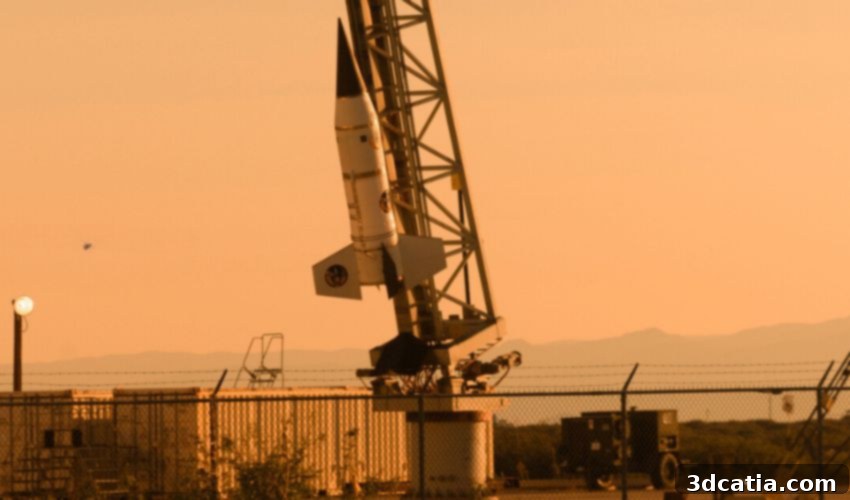
A rocket from X-Bow Systems demonstrating advanced manufactured solid propellant technology (Photo credits: X-Bow Systems)
One of the primary historical challenges in expanding suborbital launch capabilities, particularly for rapid and cost-effective deployment, has been the traditional reliance on liquid and cryogenic rocket fuels. While these fuels are renowned for producing immense amounts of energy, they come with significant logistical and operational drawbacks. Their use necessitates highly complex and extensive ground infrastructure for storage, handling, and fueling, leading to substantial upfront and operational costs. Moreover, the inherent volatility of many liquid and cryogenic propellants introduces considerable safety risks during manufacturing, transport, and launch operations. These challenges severely limit the flexibility, responsiveness, and affordability of traditional rocket systems.
Recognizing these limitations, the TACTILE program is making a strategic pivot towards solid propellants. However, it’s not just any solid propellant; the program is specifically focusing on Advanced Manufactured Solid Propellants (AMSP) created through state-of-the-art additive manufacturing techniques. This approach promises to overcome the complexities associated with liquid fuels by offering propellants that are simpler to store, safer to handle, and significantly faster to produce. The ability to 3D print solid propellants allows for unprecedented design flexibility, enabling the creation of custom propellant geometries that can optimize performance and efficiency for diverse mission profiles. This innovation is central to achieving the program’s goals of low-cost, rapidly producible, and readily deployable suborbital energetics, marking a paradigm shift in rocket propulsion technology.
The TACTILE program has been structured around three ambitious yet clearly defined objectives, each critical to advancing the future of suborbital capabilities:
- Launch a Commercial Prototype Modular Solution: The initial objective is to successfully launch a commercial prototype modular launch solution. This prototype must feature an integrated, advanced manufactured solid propellant (AMSP) first-stage motor that has been produced using 3D printing. This step is crucial for proving the viability of the entire concept, demonstrating that AM can produce flight-ready propulsion systems. The emphasis on a “modular” solution suggests a design philosophy aimed at adaptability and rapid reconfiguration for different mission requirements, leveraging the inherent flexibility of additive manufacturing.
- Demonstrate AMSP in Flight and Evaluate Scalability: Following the initial prototype launch, the program aims to robustly demonstrate an AMSP-printed motor within a relevant flight environment. This objective goes beyond a single test, focusing on rigorous evaluation of the technology’s performance under operational conditions. A key aspect here is assessing the scalability and flexibility of the AMSP technology. This involves understanding how easily the manufacturing process can be scaled up for mass production and how adaptable the propellant formulation and motor design can be to varying thrust requirements and flight profiles.
- Evaluate System Design for Affordability and High Cadence: The final objective is to comprehensively evaluate the overall system design’s capability to support affordable, high-cadence flight applications across a diverse range of mission objectives. This evaluation will utilize commercially available launch services, highlighting the DoD’s strategy to leverage existing commercial infrastructure and expertise. The focus on “affordability” and “high-cadence” underscores the need for solutions that are not only technologically advanced but also economically sustainable and capable of frequent deployment, which is vital for modern defense and rapid response scenarios.
Successful Launch with 3D Printed Rocket Motor Marks a New Era
The TACTILE program reached a monumental milestone on September 12, 2024, when X-Bow Systems, the primary contractor leading this innovative effort, successfully launched a single-stage rocket powered by revolutionary 3D-printed propellant. This pivotal event, featuring the XB-32 rocket, saw the vehicle soar to an impressive altitude of 32,000 feet and achieve a speed of Mach 1.2, all driven by an Advanced Manufactured Solid Propellant (AMSP) motor. This flight was more than just a successful launch; it served as a compelling demonstration of the immense potential that additive manufacturing holds for the future of rocket propulsion. Crucially, it also highlighted the opportunity for significant cost savings compared to traditional manufacturing methods, making advanced propulsion more accessible and efficient. Building on this success, X-Bow Systems continued its streak of achievements, successfully conducting a third flight with the XB-32 motor on October 22, further validating the reliability and performance of their 3D-printed technology.
The success of these launches was a testament to the robust collaboration between the DIU and the Space and Missile Defense Command. This partnership was instrumental in making the test flights possible, allowing for a comprehensive evaluation of how AMSP-printed rocket motors could transform various aspects of space operations. The evaluations specifically focused on several key benefits: significantly reducing labor costs associated with propellant manufacturing and motor assembly, enhancing the safety and ease of transporting and storing rocket fuel, and ultimately boosting overall operational efficiency for future missions. TACTILE stands as a powerful testament to the rapid advancement and maturity of additive manufacturing technology, providing a critical platform for collecting invaluable in-flight performance data that will inform and accelerate the development of next-generation propulsion systems for defense and commercial applications alike.
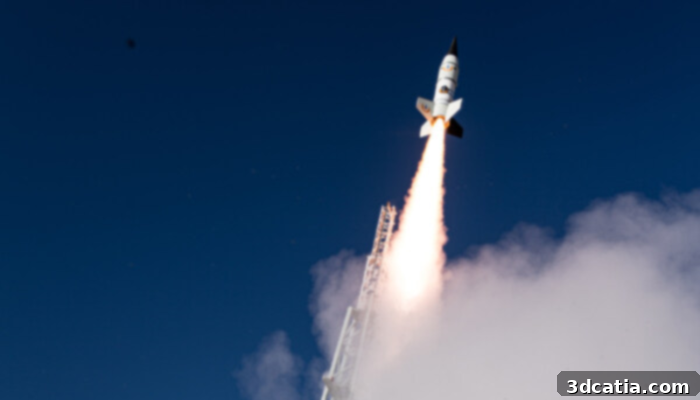
One of X-Bow Systems’ successful rocket launches featuring its 34” Advanced Manufactured Solid Rocket Motor (Photo Credits: United States Army)
“The successful demonstration of 3D-printed propellant through the TACTILE program is a major step forward in delivering low-cost, rapidly deployable suborbital solutions, including in hypersonics,” stated Major General Steve Butow, DIU Space Portfolio Director. His remarks highlight the broader strategic implications of this technological leap. “This achievement showcases the power of additive manufacturing to reduce costs and boost efficiency while underscoring the critical role of collaboration between DIU and commercial partners in driving innovation for future mission success.” This sentiment encapsulates the core philosophy of the DIU – to bridge the gap between commercial innovation and defense needs, accelerating the adoption of transformative technologies.
Thanks to the groundbreaking advancements fostered by the TACTILE program, the DoD is poised to continue its strategic leveraging of commercial innovations like additive manufacturing. This ongoing commitment is paving the way for the development and deployment of more versatile, cost-effective, and rapid-response solutions critical for addressing future defense needs. The ability to quickly iterate designs, customize components, and produce propulsion systems on demand offers an unprecedented advantage in an increasingly dynamic global security environment. TACTILE is not merely about launching rockets; it’s about building a foundation for a more agile, resilient, and technologically superior defense infrastructure. For those interested in delving deeper into the specifics of this pioneering program and its ongoing developments, further information is available on the DIU’s official website, which can be accessed here.
What are your thoughts on the TACTILE program’s innovative use of 3D printed rocket motors for defense and space applications? We invite you to share your insights in a comment below or engage with us on our social media platforms: LinkedIn, Facebook, and Twitter! To stay updated with the very latest developments in the additive manufacturing industry, don’t forget to sign up for our free weekly Newsletter here, delivering all the essential 3D printing news straight to your inbox. You can also explore our comprehensive video content on our dedicated YouTube channel.
*Cover Photo Credit: US Army