
IMPERIAL 3D Printer: Revolutionizing In-Space Manufacturing for Deep Space Exploration
The convergence of 3D printing and the aerospace sector is undeniably profound, particularly within the ambitious domain of space exploration. As humanity sets its sights on more distant horizons, the need for innovative manufacturing solutions becomes paramount. Space agencies like NASA and the European Space Agency (ESA) have vigorously adopted additive manufacturing across a spectrum of space-related projects, signifying a monumental departure from conventional terrestrial production and logistics models. ESA, in particular, has demonstrated a sustained and forward-thinking interest in additive manufacturing technologies for many years, recognizing their potential to unlock unprecedented capabilities beyond Earth.
This vision is brilliantly embodied by the IMPERIAL 3D printer, a groundbreaking development poised to transform in-space manufacturing. Born from a collaborative endeavor involving OHB System AG, Azimut Space, Athlone Institute of Technology, and BEEVERYCREATIVE, this innovative machine is meticulously engineered to overcome a critical limitation of traditional 3D printers: the ability to produce parts that exceed its own build volume. This unique capability is not merely an incremental improvement; it represents a significant leap forward, promising to enable the on-demand fabrication of essential structures, intricate tools, and crucial spare parts. These capabilities are indispensable for supporting future extended space missions, whether to the International Space Station (ISS), lunar outposts, or even Mars. The core objective behind the IMPERIAL project is to dramatically streamline operations for astronauts, ensuring they have swift and efficient access to any necessary components throughout the duration of their demanding missions, thereby boosting self-sufficiency and mission resilience.
The IMPERIAL 3D Printer: Mastering Manufacturing in Microgravity
Designing a 3D printer for the unforgiving environment of space presents a unique set of engineering challenges. The IMPERIAL printer has been specifically tailored to not only meet but exceed the stringent manufacturing requirements of facilities like the International Space Station (ISS), pushing past the current limitations of existing in-space 3D printing technologies. Its most formidable strength lies in its capacity for continuous, uninterrupted printing under microgravity conditions – an environment where traditional manufacturing processes often fail or are severely hampered. This ability to operate flawlessly in near-zero gravity is critical for long-duration missions where consistent performance is non-negotiable.
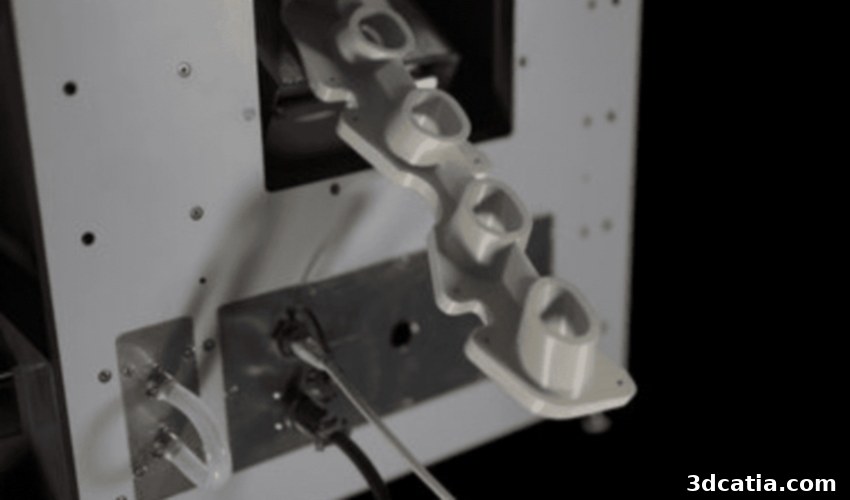
To ensure the seamless and continuous production of parts, especially those extending beyond the printer’s immediate footprint, the IMPERIAL incorporates an ingenious and yet surprisingly elegant innovation: a printing plate configured as a conveyor belt. While the concept of a conveyor belt print bed is not entirely new to terrestrial 3D printing, its application and optimization for microgravity represent a significant engineering feat. This dynamic system continuously moves the printed object along a single axis, effectively creating an infinite build volume in one dimension. This design paradigm effectively eliminates the traditional constraints of fixed-size build plates, dramatically expanding the possibilities for additive manufacturing in a spatial context. It allows astronauts to print much larger components, or even multiple smaller components sequentially, without manual intervention, a crucial advantage in resource-constrained space environments.
Advanced Materials for Extreme Environments
Francesco Caltavituro, a dedicated space and systems engineer at OHB who played a pivotal role in the IMPERIAL project, elaborated on the printer’s remarkable capabilities. “We are able to print functional parts, especially tools, and interface them with counterparts already onboard the ISS,” he explained, highlighting the immediate practical applications. “We can process different materials, such as electrically conductive polymers for small CubeSat components and enclosing, or the structure of very large items, such as telescopes. Now we can print anything which needs to withstand the harsh environment of space.” This ability to use a diverse range of materials, including specialized conductive polymers, opens up new avenues for in-space construction and repair, from delicate electronics to robust structural elements.
Beyond basic functionality, the IMPERIAL printer is specifically designed to excel at printing parts using high-performance polymers, such as Polyether Ether Ketone (PEEK), while rigorously maintaining print quality comparable to that achieved under terrestrial gravity. “It can all be printed, especially if you want to use high-performance thermoplastics (PEI, PEEK and PEKK), this printer can handle them,” Caltavituro further emphasized. These advanced thermoplastics are crucial for space applications due to their exceptional mechanical strength, thermal stability, chemical resistance, and radiation tolerance – properties vital for components exposed to the vacuum, extreme temperatures, and radiation of space. To effectively leverage these materials, which are selected precisely for their superior properties, a sophisticated system was integrated into the printer to maintain a consistent temperature both inside and outside the machine, critically encompassing the conveyor belt mechanism. Equipped with a precisely controlled heating plate, the machine actively promotes uniform printing, meticulously mitigating the common risks of part shrinkage, warping, or deformation that can occur during the cooling phase of the printing process, particularly in variable thermal environments like space. This thermal control ensures the dimensional accuracy and structural integrity of every printed component.
From Earth-Bound Prototype to Orbital Validation
With the successful creation and rigorous testing of the IMPERIAL prototype on Earth, the project is now poised for its next critical phase: validating its performance in the actual microgravity environment of space. The ideal platforms for these crucial tests include the International Space Station (ISS) or similar advanced platforms such as ESA’s uncrewed Space Rider vehicle. While the underlying technology and hardware are currently prepared for these demanding orbital trials, a precise launch or test date remains to be determined. The insights gained from these in-space validation tests will be invaluable, confirming the printer’s ability to operate reliably and produce high-quality parts under the unique challenges of microgravity, paving the way for its broader deployment in future missions. For those interested in delving deeper into the technical specifics and overarching vision of the IMPERIAL project, further information is available by clicking here.
The Broader Impact: Reshaping the Future of Space Exploration
The IMPERIAL 3D printer represents more than just a piece of advanced hardware; it symbolizes a paradigm shift in how humanity will conduct future space missions. By enabling on-demand, in-space manufacturing of a vast array of parts, the IMPERIAL system promises to revolutionize mission planning and execution. Imagine a future where astronauts don’t need to wait months or years for a spare part to be launched from Earth, significantly reducing mission downtime and enhancing safety. The ability to print tools, repair components, and even create entirely new structures on-site radically reduces the payload mass that needs to be launched from Earth, leading to substantial cost savings and opening up more room for scientific instruments or crew supplies. This self-sufficiency is particularly crucial for ambitious long-duration missions to the Moon or Mars, where resupply options are limited, expensive, and time-consuming.
Furthermore, the IMPERIAL’s capacity to handle high-performance polymers like PEEK, PEI, and PEKK means that manufactured components can withstand the extreme conditions of space, from vacuum and radiation to vast temperature fluctuations. This capability is essential for everything from critical life support system components to advanced scientific instruments. The innovative conveyor belt system, allowing for parts larger than the printer itself, unlocks possibilities for constructing large-scale structures in orbit, such as antennas, solar arrays, or even components for future space habitats. This moves beyond simple spare parts, hinting at a future where entire modules or infrastructure could be assembled or built in space, significantly accelerating the pace of off-world development and exploration. The IMPERIAL printer is not just an incremental improvement; it’s a foundational technology that will empower astronauts and engineers to think differently about design, logistics, and sustainability in the final frontier.
What are your thoughts on the IMPERIAL printer and its potential to redefine space manufacturing? Let us know your insights in a comment below or join the discussion on our LinkedIn, Facebook, and Twitter pages! Don’t forget to sign up for our free weekly Newsletter here to receive the latest 3D printing news straight to your inbox! You can also find all our videos and interviews on our YouTube channel for more in-depth content.
*All Photo Credits: The European Space Agency