
Unlocking Industrial Additive Manufacturing: Dyndrite’s Software Innovation at RAPID + TCT 2024
The landscape of additive manufacturing (AM), commonly known as 3D printing, is evolving at an unprecedented pace. Throughout industry-leading events like RAPID + TCT, a consistent and undeniable theme has emerged: the critical importance of the entire AM value chain. It’s no longer just about the 3D printer itself, but the intricate ecosystem of design, simulation, data management, and post-processing that enables true industrial-scale production. Within this ecosystem, software has undeniably taken center stage, recognized as the foundational pillar for advancing the entire 3D printing sector into its next phase of maturity. Among the myriad of innovators showcasing their solutions, Dyndrite has distinguished itself with a remarkable, rocket-like ascent in the field since its inception just five years ago, leaving a significant impression on attendees and experts alike.
The Holistic View: Understanding the Additive Manufacturing Value Chain
To truly harness the power of additive manufacturing, industries must look beyond individual machines and embrace a comprehensive view of the entire value chain. This chain encompasses every step from initial concept and design to final part delivery. It starts with sophisticated CAD (Computer-Aided Design) software, where complex geometries are first imagined. Following this, simulation tools are crucial for validating designs, predicting material behavior, and optimizing part performance before any material is consumed. Next, build preparation and toolpath generation software translate digital models into printable instructions, dictating how a printer deposits material layer by layer. Post-processing, quality control, and even supply chain management complete the cycle. Each link in this chain presents unique challenges, and any weakness can impede the overall efficiency and scalability of AM operations. The integration and seamless flow of data across these stages are paramount, and it is here that advanced software solutions prove indispensable, acting as the connective tissue that binds the entire process together. Without robust software infrastructure, the full potential of additive manufacturing remains largely untapped, limiting its transition from prototyping to widespread industrial application.
Software at the Core: Driving 3D Printing Innovation and Efficiency
The transformative power of software in additive manufacturing cannot be overstated. Traditional manufacturing processes often rely on relatively static toolpaths and geometries, but 3D printing thrives on complexity and customization. This inherent complexity demands a new generation of software capable of handling intricate designs, large data sets, and dynamic process parameters. Advanced AM software enables engineers to design parts with lattice structures, internal channels, and organic forms that are impossible or cost-prohibitive with conventional methods. Beyond design, intelligent software plays a vital role in optimizing print strategies, reducing build times, minimizing material waste, and ensuring part quality and repeatability—factors that are absolutely essential for industrial adoption. Moreover, as additive manufacturing moves towards mass customization and distributed production, software becomes the brain that orchestrates networks of printers, manages production schedules, and integrates with broader Industry 4.0 initiatives such as artificial intelligence and machine learning. This level of computational sophistication is what truly distinguishes modern additive manufacturing from its earlier iterations, empowering manufacturers to push the boundaries of what’s possible and unlock new efficiencies previously unattainable.
The evolution of AM software has been marked by a shift from simple slicing programs to sophisticated platforms that integrate design, simulation, manufacturing execution, and data analytics. Early challenges often revolved around the inability of existing CAD/CAM tools to effectively handle the massive polygon counts and non-manifold geometries common in additively manufactured parts. This led to significant bottlenecks, as designers struggled to prepare files for printing, often encountering errors, corrupted data, or excessively long processing times. The need for a new computational approach became evident—one that could natively understand and manipulate high-fidelity volumetric data, rather than relying on faceted representations. This fundamental requirement paved the way for innovative solutions that could process complex designs with unprecedented speed and accuracy, thereby streamlining workflows and enabling the industrialization of additive manufacturing. Addressing these core challenges has been key to the rapid advancements observed in the sector, allowing for greater design freedom and more reliable production outcomes.
Dyndrite’s Ascent: A Paradigm Shift in AM Software Technology
In the relatively short span of five years, Dyndrite has achieved what many software companies strive for over decades: a reputation for groundbreaking innovation and significant industry impact. Their “rocket-like ascent” is directly attributable to their unique technological foundation—a powerful, GPU-accelerated computational kernel. Unlike conventional software architectures that often struggle with the vast data requirements and complex calculations inherent in advanced additive manufacturing, Dyndrite’s kernel leverages the parallel processing capabilities of modern graphics processing units (GPUs). This innovative approach enables unparalleled speed and precision in generating toolpaths, optimizing builds, and handling extremely large and intricate part geometries. It means that engineers can work with design files that would otherwise overwhelm traditional systems, drastically reducing processing times from hours to minutes, or even seconds. This efficiency translates directly into faster design iterations, quicker production cycles, and the ability to explore design spaces that were previously computationally infeasible, truly democratizing advanced AM capabilities.
Dyndrite’s platform directly addresses some of the most persistent bottlenecks in the AM workflow: the handling of massive datasets and the generation of highly optimized print instructions. By providing an open, programmable environment, Dyndrite empowers manufacturers and developers to create custom applications, integrate their proprietary algorithms, and automate complex processes. This flexibility is crucial for industries requiring highly specific material properties, geometric features, or quality control parameters. For instance, in aerospace, where every gram of weight and millimeter of precision matters, Dyndrite’s ability to precisely control toolpaths and generate lightweight lattice structures is invaluable. Similarly, in the medical field, the creation of patient-specific implants with intricate internal geometries demands the kind of data fidelity and processing power that Dyndrite provides. By tackling these fundamental challenges, Dyndrite is not just offering a new tool; it’s providing a foundational technology that accelerates the transition of additive manufacturing from a niche prototyping method to a robust, industrial-grade production solution capable of meeting stringent industry demands.
Insights from RAPID + TCT 2024: A Candid Conversation with Dennis Barnum
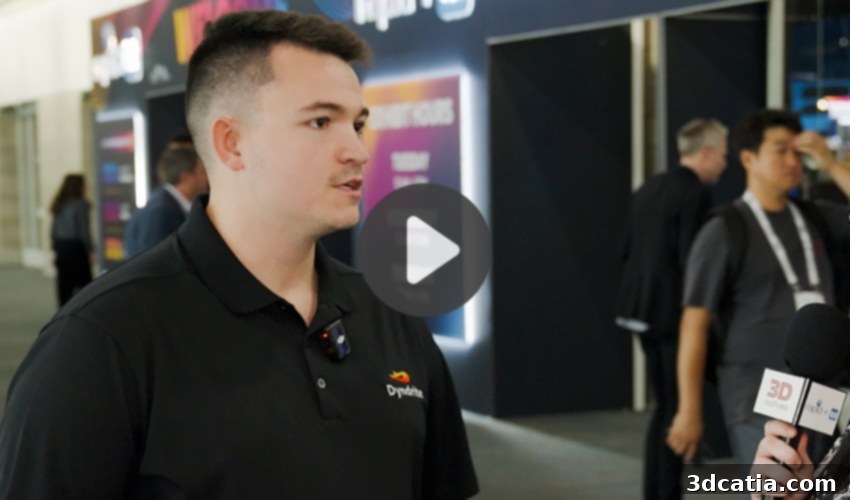
RAPID + TCT is renowned as North America’s most influential additive manufacturing event, serving as a critical forum where the latest innovations, trends, and technologies are unveiled. It’s a place where industry leaders, researchers, and end-users converge to discuss the future of 3D printing. At RAPID + TCT 2024, the 3Dnatives team had the distinct privilege of engaging in an in-depth conversation with Dennis Barnum, a key figure from Dyndrite. This interview provided a unique opportunity to delve deeper into the company’s pioneering vision and to understand how their innovative software solutions are poised to revolutionize the additive manufacturing industry. Barnum’s insights offered a compelling look into the technical intricacies of Dyndrite’s platform, as well as a broader perspective on the strategic direction of the AM sector as a whole. The discussion highlighted not only the power of their technology but also the philosophical approach to problem-solving that has defined Dyndrite’s journey.
Accelerating Workflows and Optimizing Production
During the conversation, Dennis Barnum elaborated on how Dyndrite’s software drastically accelerates AM workflows. He emphasized that the key lies in automating previously manual and time-consuming steps. From sophisticated build preparation that intelligently places and supports parts within a build volume, to generating highly optimized toolpaths that leverage the specific capabilities of various 3D printing technologies (like powder bed fusion or directed energy deposition), Dyndrite’s platform streamlines the entire process. This automation minimizes human error, reduces preparation time, and ensures consistency across multiple builds. Furthermore, the ability to rapidly iterate on designs and process parameters allows engineers to quickly explore optimal solutions, significantly cutting down development cycles. This means companies can bring new products to market faster, respond more agilely to market demands, and scale their additive manufacturing operations more effectively than ever before, marking a significant leap in productivity.
Beyond speed, Dyndrite’s solutions are engineered for profound production optimization. Barnum explained that their software enables a level of control over the additive process that was previously unattainable. This precise control leads to superior part quality, characterized by enhanced mechanical properties, improved surface finish, and greater geometric accuracy. It also translates into reduced material waste, as optimal build strategies minimize failed prints and support structure material. By allowing for granular control over every aspect of the print, from laser power to scan strategy, Dyndrite’s technology empowers manufacturers to push the performance envelope of their parts. This level of optimization is crucial for industries where component failure is not an option, such as aerospace and medical device manufacturing. The result is a more reliable, efficient, and cost-effective additive manufacturing process, moving it squarely into the realm of industrial production.
The Transformative Power and Future Vision for Additive Manufacturing
Dennis Barnum articulated the truly transformative power of Dyndrite’s software, emphasizing its capacity to enable entirely new applications for additive manufacturing. By removing computational barriers, the software allows engineers to design and produce parts with unprecedented complexity and functionality. This includes multi-material components, intricate internal cooling channels for heat exchange, and custom-tuned lattice structures for specific weight and strength requirements. Such capabilities open doors to innovation across various sectors, from lighter, more fuel-efficient aircraft components to highly customized, biocompatible medical implants. Dyndrite is not just making existing processes faster; it’s fundamentally changing what can be designed and manufactured, thereby expanding the very definition of what additive manufacturing can achieve on an industrial scale. This is a crucial step in fulfilling the long-promised potential of 3D printing to revolutionize product development and manufacturing.
Looking to the future, Barnum shared a compelling vision for the additive manufacturing industry, where software plays an increasingly central role. He envisioned a future where AM is seamlessly integrated into mainstream manufacturing, driven by mass customization and highly automated, data-driven processes. In this future, AI and machine learning will work hand-in-hand with advanced computational kernels like Dyndrite’s to predict optimal build parameters, monitor print quality in real-time, and even autonomously adapt to changing conditions. The concept of a “digital thread,” where data flows uninterrupted from design to production to end-use, will become a reality, allowing for unprecedented traceability and quality assurance. Dyndrite aims to be at the forefront of this evolution, providing the robust and flexible software foundation necessary to support these sophisticated, intelligent manufacturing ecosystems. This vision positions software not just as a tool, but as the strategic enabler for the next generation of industrial additive manufacturing, promising a future of unparalleled design freedom, production efficiency, and technological advancement across global industries.
Beyond the Interview: The Broader Impact of Advanced AM Software
The insights from Dyndrite at RAPID + TCT 2024 resonate deeply with the broader challenges and opportunities facing the additive manufacturing industry. The journey from prototyping to full-scale industrial production is fraught with hurdles, including scalability, repeatability, cost-effectiveness, and integration into existing manufacturing ecosystems. Robust software solutions are the unequivocal answer to many of these challenges. By streamlining data flows, automating complex tasks, and providing unprecedented control over the printing process, advanced AM software minimizes risks and maximizes output. It transforms what was once an artisanal craft into a precise, engineering-driven process. The ability to manage vast quantities of geometric data, integrate diverse material parameters, and simulate real-world print conditions empowers manufacturers to move with confidence towards producing critical components for industries like aerospace, automotive, energy, and healthcare, where performance and reliability are non-negotiable.
Furthermore, the strategic importance of open, programmatic platforms like Dyndrite cannot be overstated in fostering an environment of innovation. Proprietary, closed systems can stifle development by limiting interoperability and customization. An open architecture, conversely, encourages a vibrant ecosystem of developers, researchers, and users to build upon the core technology, creating specialized applications and workflows tailored to specific needs. This collaborative approach accelerates the pace of innovation across the entire additive manufacturing spectrum. It facilitates the integration of new materials, advanced sensor technologies, and AI-driven analytics, leading to a truly intelligent and adaptive manufacturing environment. The emphasis on a robust digital thread, from initial design concept through to post-production quality assurance, underscores the commitment to data-driven manufacturing that is essential for the future. As Dyndrite and similar innovators continue to push the boundaries of AM software, the industry moves closer to realizing the vision of fully industrialized, digitally-managed production.
Conclusion: Charting the Course for Industrial Additive Manufacturing
The discussions and innovations showcased at RAPID + TCT 2024, particularly those surrounding Dyndrite, unequivocally highlight the indispensable role of advanced software in the ongoing industrialization of additive manufacturing. It is clear that the future of 3D printing hinges not merely on faster machines or novel materials, but on the intelligent computational tools that orchestrate the entire value chain. Dyndrite, with its unique GPU-accelerated kernel and commitment to an open, programmable platform, stands as a prime example of a company leading this charge. Their focus on accelerating workflows, optimizing production, and empowering transformative applications is directly addressing the core needs of a maturing industry. The vision shared by Dennis Barnum paints a clear picture: a future where additive manufacturing is a fully integrated, automated, and intelligent part of global production, driven by sophisticated software. As the industry continues to evolve, companies that embrace and leverage such innovative software solutions will undoubtedly be at the forefront, shaping the next era of manufacturing excellence.
What were your thoughts on Dyndrite’s presence at RAPID + TCT, or their vision for the future of AM software? We encourage you to share your perspectives in a comment below or engage with us on our LinkedIn, Facebook, and Twitter pages! For the very latest 3D printing news, delivered straight to your inbox every week, don’t forget to sign up for our free weekly newsletter here. You can also explore all our insightful videos and interviews on our YouTube channel. Be sure to watch the full interview with Dennis Barnum below to gain even deeper insights into how next-gen software is playing a critical role not just at RAPID + TCT, but across the entire American additive manufacturing industry.