
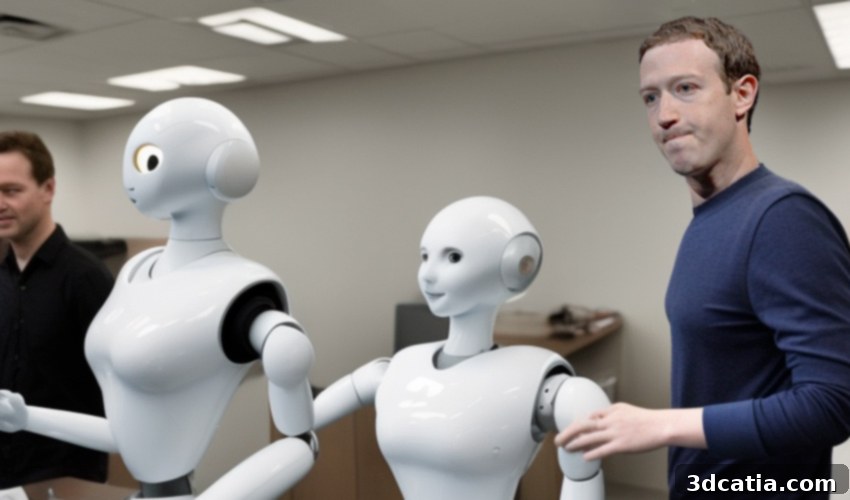
Meta Unleashes AI Future: A 3D-Printed Robot Powered by GPT-5 Joins the Board of Directors
Meta, the tech titan formerly known as Facebook, continues to cement its position as an undisputed leader in cutting-edge technologies. From virtual reality and augmented reality to advanced artificial intelligence and even additive manufacturing, Meta is systematically pushing boundaries and advancing across diverse markets. Its strategic expansion in this realm was notably highlighted a few months ago with the acquisition of Luxexcel, a move that underscored its commitment to integrating advanced manufacturing into its vision. This time, Meta has unveiled an ambitious and, for many, quite astonishing project that synergizes its growing expertise in these disparate fields. Mark Zuckerberg, founder and CEO of Meta, recently announced in an official press release that the company has successfully 3D printed a sophisticated robot, equipped with OpenAI’s groundbreaking GPT-5 system, destined to occupy a seat on its board of directors and provide crucial support in strategic decision-making.
The primary objective behind this unprecedented initiative is to rigorously test the efficacy and relevance of such an advanced humanoid in a high-stakes corporate governance role. Should this pioneering project prove successful, and the robot demonstrate its ability to enhance Meta’s financial performance and strategic outcomes, the group is prepared to seriously consider the wider implementation of similar AI-powered robots across various organizational positions. This revolutionary approach promises significant operational advantages, including substantial savings in recruitment costs, reduced expenditure on training, and a profound increase in overall organizational efficiency. This bold move by Meta blurs the lines between science fiction and present-day reality, unequivocally demonstrating Mark Zuckerberg’s unwavering determination to seamlessly integrate new technologies with superior managerial performance.
This announcement has understandably sent ripples of apprehension throughout the tech world and beyond, raising more profound questions than it provides immediate answers. The prospect of collaborating with, or even being supervised by, robots endowed with artificial intelligence that could potentially surpass human cognitive capabilities sparks an intense and ongoing debate. For years, the question of whether humans will ultimately be replaced by machines in the workforce has loomed large, and Meta’s latest venture seems to indicate a decisive step in this very direction. Plagued by a series of negative financial results over the past few years, the Meta group appears to be seeking radical solutions to its challenges. By strategically fusing the most advanced artificial intelligence—specifically, the latest iteration of OpenAI’s GPT-5 system—with the agile capabilities of additive manufacturing, Meta hopes to forge an innovative path towards significantly reducing operational costs and resolving complex business challenges with unparalleled speed and efficiency. The creation of this 3D-printed robot, powered by OpenAI’s cutting-edge AI, comes despite a widely publicized open letter issued on March 29, which explicitly cautioned against the potential dangers inherent in such advanced intelligence. Mike Catfish, Director of Technical Operations at Meta, confidently commented, “We believe that the GPT-5 system can truly revolutionize the way we do business today. Despite the understandable misgivings expressed by some, we are steadfastly continuing our developments with OpenAI and remain entirely confident in the profound positive impact our robot will be able to have on Meta’s strategic direction and overall performance.”
A Robot Endowed With Human-Like Intelligence for Strategic Leadership
The decision to leverage 3D printing for the fabrication of this groundbreaking robot was a strategic one for Meta. This advanced manufacturing method provided the invaluable flexibility to iterate through multiple prototypes swiftly and cost-effectively, enabling the design and refinement of a robot that is both highly customizable and remarkably lifelike in its form and function. The robot’s core structure was initially manufactured using precise CNC machining, providing a robust and intricate framework. This foundation was then meticulously covered with a fully 3D printed shell, engineered for optimal strength and minimal weight. To achieve this, Meta’s engineers opted for a carbon fiber reinforcement within the shell, ensuring exceptional durability without compromising agility. The completed shell was then finished with a striking white dye. While Meta confirmed the use of an extrusion process for the 3D printing, specific details regarding the particular machine or technology employed were not disclosed, maintaining a level of proprietary secrecy around their advanced manufacturing techniques.
The efficiency of additive manufacturing allowed Meta’s dedicated teams to rapidly develop and test an initial prototype within an astonishingly short timeframe—just a few days—accelerating the project’s progression significantly. Susan Jester, Meta’s Recruitment Manager, elaborated on the profound implications for human resources: “Integrating robots into the company’s fabric holds the potential to alleviate some of the most pressing challenges we currently face in recruitment. The global job market is becoming increasingly competitive and specialized, making it exceptionally difficult to identify and secure the right talent with the precise skills at the opportune moment. With such advanced robots, this problem could be largely circumvented. We could program them with the exact competencies required for any given role. They would be pre-trained, eliminate onboarding time, and capable of operating with peak efficiency from day one. And, beyond their intrinsic capabilities, consider the immense benefit of essentially free labor!” This perspective highlights Meta’s drive towards a highly automated and optimized workforce model.
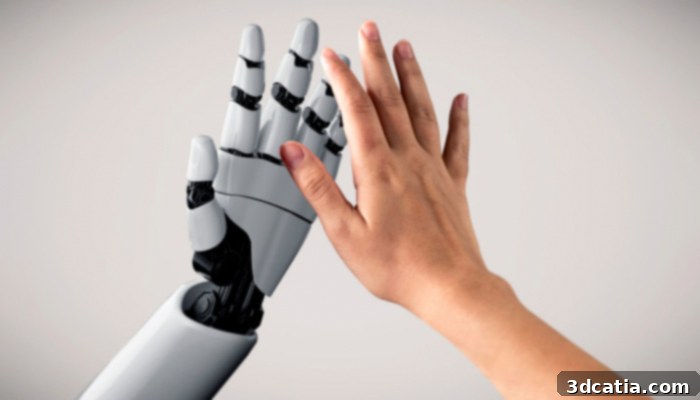
GPT-5 is an artificial intelligence capable of sophisticated human-like analysis and strategic thought (photo credits: Adobe)
The integration of OpenAI’s GPT-5 system is poised to furnish the robot with an unparalleled capacity to analyze complex data, interpret nuanced situations, and ultimately assume control over strategic decisions and operational scenarios that are presently managed by Meta’s human employees. The company boldly asserts that this advanced machine has the potential not only to augment human roles but, in many instances, to completely replace them. Furthermore, in a more distant and perhaps even more startling future, Meta envisions this robot serving as a direct strategic partner, or even a co-manager, alongside Mark Zuckerberg himself, guiding the company through its intricate challenges and opportunities.
The precise behavioral patterns and decision-making frameworks of the robot remain subjects of intense speculation, yet Meta has confirmed an initial six-month probationary period during which its performance will be rigorously evaluated against predefined metrics. This trial phase is crucial for assessing its effectiveness and integration into Meta’s high-level strategic operations. Already, whispers and rumors circulate within the tech community, suggesting that if this initial trial proves exceptionally successful, the possibility of this type of robot eventually ascending to the position of Meta’s CEO is not entirely out of the question. This unfolding scenario presents a truly alarming outlook for the traditional job market, prompting widespread discussions about the fundamental future of work. We commit to keeping our readers thoroughly informed on the developments of this profound and potentially transformative situation.
At 3Dnatives, we embrace the spirit of April Fools’ Day with enthusiasm! Therefore, we must confess that this entire article was crafted as a lighthearted jest for the occasion. To the best of our knowledge, Meta has no current plans to install a 3D-printed robot onto its Board of Directors. We hope you enjoyed the ride!
Did you fall for our April Fool’s joke? We’d love to hear your reactions! Let us know in a comment below or connect with us on ourLinkedIn,Facebook, andTwitter pages! To ensure you never miss out on the latest advancements and news in the dynamic world of 3D printing, don’t forget to sign up for our free weeklyNewsletter here, delivering fresh updates straight to your inbox! You can also explore all our insightful videos and compelling content on our dedicatedYouTube channel.