

How General Motors is Revolutionizing Car Manufacturing with Advanced 3D Printing
The automotive industry is undergoing a profound transformation, with leading manufacturers worldwide embracing cutting-edge technologies to enhance their production processes, accelerate innovation, and deliver superior vehicles. From luxury marques like Ferrari, BMW, Rolls-Royce, and Lamborghini, to mass-market leaders such as Audi and Volvo, the integration of 3D printing, also known as additive manufacturing, has become a strategic imperative. In the United States, companies like Ford have openly championed 3D technologies for a wide array of applications, even extending to crucial end-use parts. Now, another titan of American industry, General Motors (GM), is making significant strides in showcasing its deep commitment and appreciation for additive manufacturing, leveraging it across its diverse operations.
General Motors, or GM, is an American multinational automotive manufacturing corporation that holds a storied place in industrial history. Not only has it consistently been one of the largest automakers in the US, but it also held the title of the world’s largest until 2008. With an iconic portfolio of brands including Chevrolet, Buick, GMC, and Cadillac, GM has always been driven by a relentless pursuit of innovation to maintain its competitive edge and push the boundaries of automotive excellence. This enduring commitment to being at the forefront of technological advancement is precisely why additive manufacturing has become an indispensable tool in its modern manufacturing strategy.
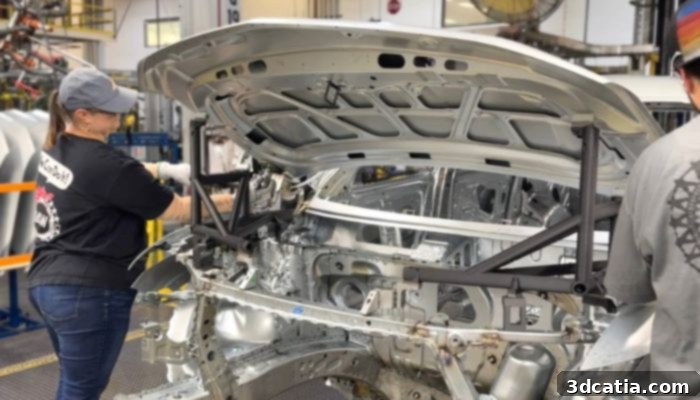
Lansing Delta Township team member Kayla Dubois uses a 3D printed hood fixture, exemplifying GM’s practical application of additive manufacturing on the assembly line.
While GM’s recent public statements have underscored its growing reliance on 3D printing, the company’s engagement with additive manufacturing is far from new. Indeed, industry observers have been aware of GM’s utilization of 3D printing for a considerable period. A notable example is the Cadillac CELESTIQ, an ultra-luxury electric vehicle, which remarkably integrated 115 unique 3D printed components, encompassing both metal and polymer materials. These parts ranged from intricate aesthetic elements to functional structural pieces, showcasing the technology’s versatility. Beyond specific vehicle models, GM has applied 3D printing to a broad spectrum of applications, from producing custom seals and complex tooling to various other essential parts across its operations. In a testament to its long-term vision, GM actually installed its very first 3D printer, a stereolithography solution, all the way back in 1989. This early adoption highlights a deep-seated recognition of additive manufacturing’s potential. Now, GM has formally reaffirmed and expanded upon the critical importance of additive manufacturing within its global network of plants, driving efficiency and innovation in the production of its diverse range of vehicles.
The Strategic Integration of Additive Manufacturing Across General Motors’ Operations
In a recent press release, General Motors articulated its unwavering commitment to constantly pursuing “more efficient processes, cost-effective designs and safer practices.” This strategic ambition is being significantly propelled by the widespread adoption of additive manufacturing. The technology is being leveraged across virtually every facet of GM’s business, from intricate pre-production stages and rapid prototyping to the demanding world of motorsports, where speed and precision are paramount. The company further emphasizes that 3D printing has proven itself to be an indispensable asset in critical areas such as design validation, advanced product and materials engineering, streamlined vehicle manufacturing, and comprehensive after-sales support for products ranging from body hardware and electrical components to interior systems and beyond. This comprehensive integration underscores a holistic approach to utilizing additive manufacturing as a core driver of operational excellence.
Diving deeper into its specific applications, GM details that it is currently employing additive manufacturing for a multitude of purposes. These include the creation of early-stage part prototypes, which serve to powerfully supplement and validate virtual designs, dramatically accelerating the development cycle. Additionally, the technology is instrumental in the simplification and optimization of various tools and fixtures used throughout the assembly line. Crucially, 3D printing is also enhancing operator assists in manufacturing plants, improving ergonomics and efficiency for the workforce. Finally, it enables the production of cost-effective and durable production components, directly impacting the final vehicle. One of the most compelling and innovative ways additive manufacturing is being implemented is to significantly improve in-plant processes for the dedicated team members working directly on the assembly line. A standout example provided by the company comes from its Lansing Delta Township Assembly plant, a key facility responsible for manufacturing popular models like the Buick Enclave, Chevrolet Traverse, and GMC Acadia.
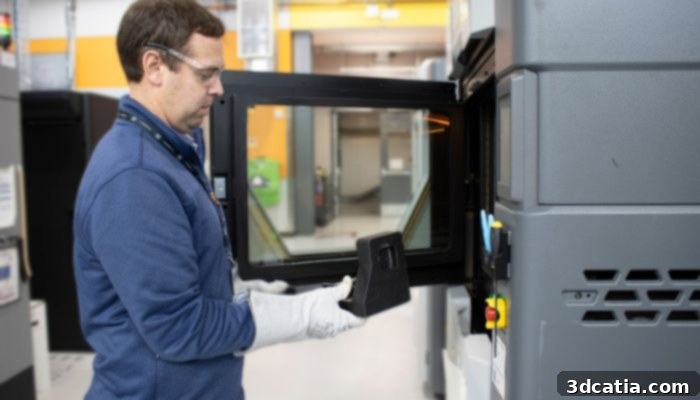
GM AM technical specialist Paul Wolcott removes a finished part from a 3D printer at the Warren Technical Center campus, illustrating the hands-on involvement in additive manufacturing.
Enhancing Production Line Efficiency and Ergonomics with 3D Printed Tools
At the Lansing Delta Township facility, GM’s visionary team members are actively leveraging additive manufacturing to make the intricate process of vehicle assembly demonstrably easier and safer. Their focus turned to optimizing a specific metal fixture, a critical tool used to prop open vehicle hoods before they are meticulously attached to their hinges on the assembly line. The existing solution presented a significant ergonomic challenge: these fixtures, traditionally crafted from heavy-duty titanium and steel, each weighed approximately 14 pounds. This weight exceeded the recommended 10-pound limit for a one-hand lift, posing a potential strain and safety concern for assembly line workers who had to repeatedly handle them throughout their shifts. Recognizing this limitation, GM’s experts turned to the transformative capabilities of 3D printing to find a much-needed solution.
Additive manufacturing proved to be the ideal catalyst for innovation in this scenario. Not only did the technology empower GM’s engineers and workers to conceptualize and develop an entirely new, significantly lighter design for the hood fixture, but it also enabled the direct production of these optimized parts using advanced 3D printing processes. This dual benefit—design freedom combined with direct manufacturing—resulted in a dramatic reduction in the weight of the fixture. The implications of this seemingly small change are profound for worker well-being and overall operational efficiency. Paul Wolcott, a respected GM technical specialist, succinctly summarized the pervasive impact, stating, “Additive manufacturing continues to enable us to build our vehicles safer and quicker. From accelerated lead times for tools to addressing ergonomic issues with lightweight solutions, we keep seeing growth in applications the more we implement it.” This sentiment underscores the multifaceted advantages of integrating 3D printing into daily manufacturing practices.
The success stories at plants like Lansing Delta Township are not isolated incidents but rather representative of a broader, systemic shift within General Motors. The sheer scale of GM’s commitment is evident in its ambitious targets and past achievements. For instance, in 2024 alone, GM undertook and successfully completed over 5,400 new additive manufacturing projects. This staggering number encompasses a wide array of applications, from jigs and fixtures to prototypes and even some end-use components. This impressive volume is not merely a plateau but a foundation for even greater expansion, with an even larger number of applications and projects anticipated to commence and conclude in 2025. Such consistent and aggressive growth serves as an undeniable and potent sign of additive manufacturing’s permanent and increasingly pivotal place within the highly competitive and rapidly evolving automotive sector. It signifies a future where customized, lightweight, and rapidly produced parts become the norm, enhancing every aspect of vehicle production and performance.
General Motors’ strategic embrace of additive manufacturing extends beyond immediate production benefits. It represents a forward-thinking approach to supply chain resilience, enabling on-demand production of critical parts and reducing reliance on traditional, sometimes fragile, global supply chains. Furthermore, the design freedom offered by 3D printing allows for unprecedented levels of part consolidation, reducing assembly complexity and potentially improving overall vehicle performance and safety. As the automotive industry continues its pivot towards electric vehicles and autonomous driving, the ability to rapidly prototype, iterate, and produce complex, lightweight components will be paramount. GM is positioning itself at the forefront of this evolution, ensuring its vehicles are not only built more efficiently but also designed for the future.
What are your thoughts on General Motors’ expansive and innovative use of additive manufacturing? Which specific applications utilizing 3D printing would you most like to see implemented or expanded upon by this pioneering automaker? We invite you to share your insights and comments below, or connect with us on our vibrant social media channels: LinkedIn, Facebook, and Twitter! Don’t miss out on the latest advancements and news from the world of 3D printing – be sure to sign up for our free weekly Newsletter here, delivering the most pertinent updates straight to your inbox! Additionally, you can explore a wealth of informative videos on our dedicated YouTube channel.
*All Photo Credits: General Motors (GM)