
Navigating the Dynamic Landscape: Key Trends and Future Outlook of the Global 3D Printer Industry
The global 3D printer industry is undergoing a period of profound transformation, characterized by revolutionary technological advancements, shifting market dynamics, and intense competitive pressures. A recent comprehensive study by CONTEXT reveals a complex tapestry of results from the latest quarter, painting a picture of both significant challenges and remarkable opportunities. While headlines were dominated by ambitious billion-dollar merger attempts, the sector grappled with the pervasive impact of inflation, evolving consumer and industrial demands, and considerable fluctuations in unit sales across various segments. From the impressive ascent of high-end metal additive manufacturing systems to the enduring resilience and widespread utility of polymer-based machines, the industry’s trajectory forward is undeniably marked by a blend of uncertainty and immense untapped potential that promises to reshape manufacturing paradigms.
During the period analyzed, the study highlighted a fascinating dichotomy: industrial 3D printer revenues experienced a significant boost, primarily driven by inflationary pressures contributing to higher average selling prices and a robust demand for sophisticated, high-end systems. Paradoxically, this revenue growth occurred even as global unit sales of these industrial machines saw an overall decline. This trend suggests a strategic shift towards higher-value, more specialized solutions, where companies are investing in capabilities rather than sheer volume. Market intelligence firm CONTEXT further underscored the fervent ambition within the industry, noting that numerous companies were aggressively vying to establish themselves as the first $1 billion+ 3D printing powerhouse. This intense strategic race saw key players like Stratasys, 3D Systems, and Desktop Metal frequently making headlines, with the high-stakes competition surrounding potential mergers or acquisitions involving Stratasys becoming a central focus of industry attention and speculation.
What Are the Key Global Trends in 3D Printing?
The first quarter of 2023 presented a compelling and somewhat contradictory set of trends concerning global 3D printer shipments across different categories. While the Industrial and Professional printer segments faced notable year-on-year declines of 15% and 30% respectively, indicating a period of recalibration for high-investment machinery, other categories demonstrated remarkable vitality. The Midrange, Personal, and Kit&Hobby segments collectively showcased significant growth, with shipment increases of 18%, 34%, and 29% respectively. These contrasting performances highlight a bifurcation in the market, where professional and industrial users are either delaying capital expenditure or opting for more specialized, higher-value systems, while accessible and consumer-oriented machines are experiencing booming demand. Despite these variations in unit sales, the overall system revenues across the entire 3D printing market exhibited a healthy positive growth of 15% compared to the previous year, underscoring the industry’s ability to generate value even amidst shifting demand patterns for specific machine types.
The primary factor contributing to the decline in global shipments of Industrial systems, which traditionally account for the lion’s share of total system revenues, was a noticeable weakening in sales of polymer-based systems. This specific downturn was particularly pronounced in certain sub-segments. However, it’s crucial to note that despite this, the overall Industrial segment still managed an impressive 11% year-on-year increase in system revenues. This growth was predominantly fueled by the surging demand for more efficient, advanced metal additive manufacturing machines, which command higher price points and offer unparalleled capabilities for specialized industrial applications. Within the Industrial polymer printer segment, vat photopolymerization machines experienced the most significant decline. For instance, North America saw a slump in sales to specific dental markets, as consumers adjusted their discretionary spending priorities in response to persistent inflation. Similarly, China reported weak sales of higher-end vat photopolymer systems across a diverse range of industrial sectors, indicating broader economic pressures affecting capital expenditure decisions for these types of machines.
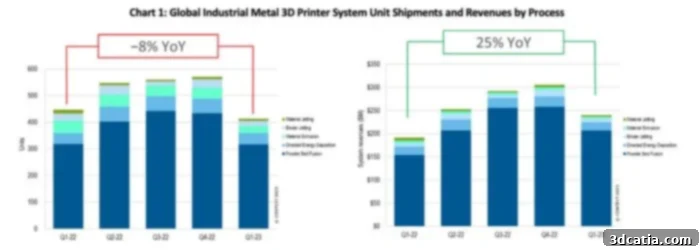
Conversely, revenues generated from Industrial metal 3D printers demonstrated a remarkable performance, experiencing a noteworthy 25% year-on-year increase in Q1 2023. This significant revenue surge occurred despite an 8% decline in the number of unit sales, reinforcing the trend of higher-value machines driving market growth. The majority of these pivotal metal system shipments were attributed to powder bed fusion (PBF) printers, a technology renowned for its precision and ability to produce complex geometries from various metal alloys. Although the absolute number of sales presented challenges, the escalating demand for more productive, larger-format, and technologically advanced metal PBF systems played a crucial role, contributing to an outstanding revenue growth of 34% specifically for Industrial PBF systems. This highlights a clear market preference for high-performance metal additive manufacturing solutions capable of meeting rigorous industrial requirements. In the Midrange category, which is predominantly characterized by polymer machines offering a balance of performance and accessibility, there was a robust 18% year-on-year growth in unit shipments. This growth can be largely attributed to successful new product launches that resonated with the market and strong domestic demand, particularly evident in China. Notably, Formlabs achieved remarkable success in this segment by effectively tapping into new demand niches and significantly increasing its shipments of polymer PBF (SLA/DLP) machines, showcasing the potential for innovation and market expansion even in competitive environments.
The Professional 3D printer shipments segment faced a substantial year-on-year drop of 30%, signaling a period of market contraction for this particular category. However, despite this considerable decline in units, revenues for professional systems remained relatively stable, falling by a more modest 15%. This suggests that while fewer units were sold, the average selling price per unit either increased or the mix shifted towards higher-priced professional models. UltiMaker, a formidable presence in the desktop and professional 3D printing space, maintained its leadership position in combination with MakerBot, excelling in both unit shipments and overall system revenues within this category. This resilience underscores the strength of their brand and product offerings. While vendors like Formlabs initially introduced new products in this professional category with some degree of success, there appears to be a perceptible shift in demand towards slightly more advanced or specialized products, possibly blurring the lines between professional and entry-level industrial systems. This evolving preference among professional users for more sophisticated capabilities contributed to the overall decline in traditional professional printer shipments as defined by the study.
In stark contrast to the industrial and professional segments, the Personal and Kit&Hobby categories experienced exceptionally strong sales, particularly for lower-end, consumer-centric printers. This impressive growth was primarily driven by significant improvements in global supply-chain logistics, which ensured better availability and reduced delivery times for these popular machines. The increased accessibility and affordability of these printers have opened up additive manufacturing to a broader audience, fostering innovation among hobbyists, small businesses, and educational institutions. Among the key players in this burgeoning market, Bambu Lab stood out as a remarkable success story. The company adeptly transitioned from a highly successful crowdfunding campaign to achieving mainstream commercialization, demonstrating the immense potential when innovative products meet robust supply chains and a receptive consumer base. The rise of companies like Bambu Lab highlights a democratization of 3D printing technology, making it more accessible and user-friendly for everyday applications and creative endeavors.
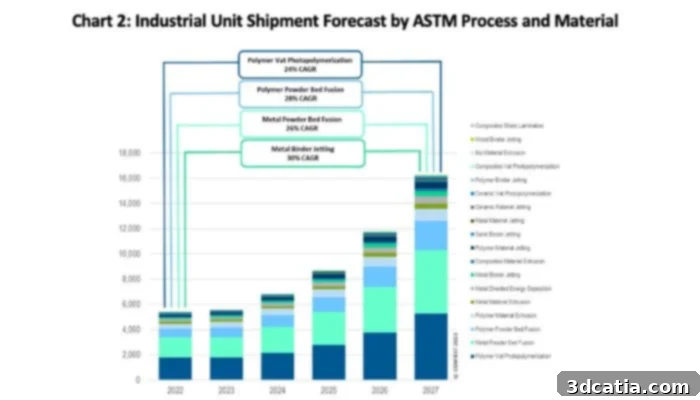
As the 3D printing industry looks ahead, while sector consolidation efforts have undeniably captured significant attention and sparked strategic maneuvers among major players, the overarching growth prospects for additive manufacturing remain overwhelmingly positive and robust. The demand for 3D printing continues to expand exponentially, driven by its unparalleled advantages, particularly in areas such as rapid prototyping, mass customization of products, and the efficient low-volume production of complex parts that would be challenging or impossible to create with traditional manufacturing methods. The volume mass production sector, in particular, holds immense growth potential in the coming years, signaling a shift from niche applications to more mainstream industrial integration. This expansion is particularly promising for established technologies like vat photopolymerization and powder bed fusion (PBF) when applied to polymers, and for PBF and binder jetting technologies in metal additive manufacturing. These processes are proving their scalability and cost-effectiveness for larger production runs. Despite the observed fluctuations in unit sales across different segments, the 3D printer industry demonstrates an unwavering commitment to evolution, continuously propelled by groundbreaking advancements in technology and an accelerating potential for widespread expansion into mainstream manufacturing workflows. To delve deeper into these fascinating market insights and trends, we encourage you to visit the original source HERE for comprehensive reports and analyses.
What are your thoughts on the dynamic global 3D printer industry and its future trajectory? We invite you to share your perspectives and insights in a comment below or join the conversation on our LinkedIn, Facebook, and Twitter pages! Don’t forget to sign up for our free weekly Newsletter here to receive the latest 3D printing news, breakthroughs, and market updates directly to your inbox! You can also find all our engaging videos and tutorials on our YouTube channel, offering visual insights into the world of additive manufacturing.
*All Photo Credits: CONTEXT