
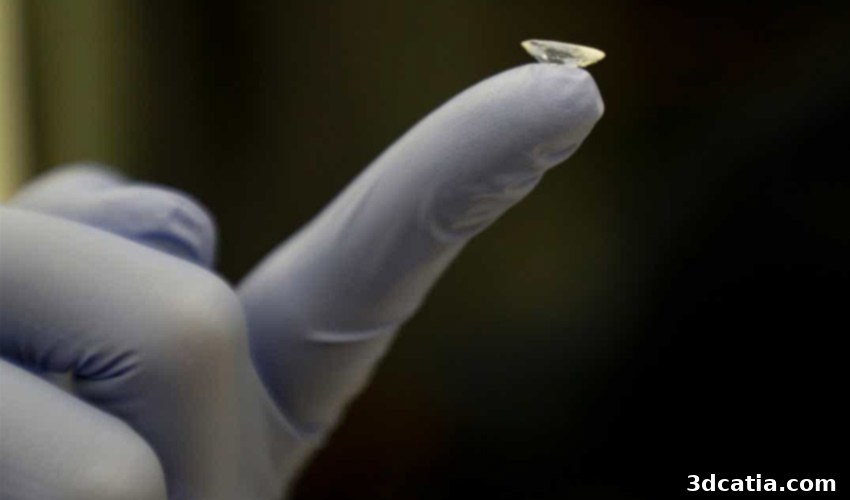
Revolutionizing Ophthalmology: High-Throughput 3D Bioprinting of Human Corneas at FAMU
In a significant leap forward for regenerative medicine and ophthalmology, a dedicated team of researchers at Florida A&M University (FAMU) has achieved a groundbreaking milestone in corneal 3D printing. This rapidly evolving application within the bioprinting market has seen FAMU scientists successfully develop the first high-throughput method for 3D printing human cells to create corneal structures. This innovative approach addresses one of the major bottlenecks in tissue engineering: the speed and efficiency of production. The team’s research is distinguished by its focus on accelerating the printing process, resulting in a novel method capable of fabricating multiple corneas in mere minutes using a bioprinted scaffold derived entirely from human cells – an unprecedented feat in this critical sector.
The concept of corneal 3D printing may already be familiar to many, given the extensive research and development in this area worldwide. Visionaries and scientists across the globe have been exploring solutions to corneal diseases and visual impairment for years. Notable efforts include those at the University of Newcastle in England, where researchers have made strides in developing bio-inks for corneal structures, and in India, with startups like Pandorum Technologies also contributing to this exciting field. The overarching goal of these diverse projects remains consistent: to provide more effective and personalized corneal transplant solutions for visually impaired individuals, ultimately improving their quality of life. However, despite these advancements, 3D bioprinting technologies, particularly for complex tissues like the cornea, still face inherent limitations. The process is far from perfect, and it is widely acknowledged that several more years of intensive research, development, and rigorous testing will be required before 3D printed corneas become a viable and widely available option for clinical application.
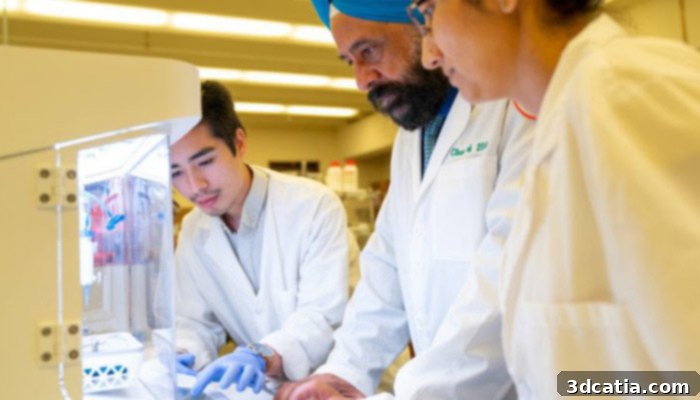
From left to right: Paul Dinh, Research Assistant; Professor Mandip Sachdeva and PhD student Shallu Kutlehria
Addressing the Global Challenge of Corneal Blindness
Corneal diseases, which encompass a range of conditions from infections and injuries to degenerative disorders, are a leading cause of blindness and severe visual impairment globally. Millions of people suffer from irreversible corneal damage, profoundly impacting their daily lives and societal participation. The primary treatment for severe corneal damage has traditionally been corneal transplantation, also known as keratoplasty. While highly effective, this procedure is plagued by significant challenges. One of the most critical issues is the severe shortage of donor corneas. The demand consistently outstrips the supply, leading to lengthy waiting lists and, tragically, preventable blindness in many parts of the world. Moreover, like any organ transplant, corneal grafts carry the risk of immunological rejection, requiring patients to undergo lifelong immunosuppressive therapy. Surgical complexities, potential complications, and the high cost associated with these procedures further underscore the urgent need for alternative, more accessible, and personalized solutions. The promise of 3D bioprinting lies in its potential to overcome these limitations by offering an inexhaustible supply of custom-made, biologically compatible corneal tissues.
The Promise of 3D Bioprinting for Ocular Health
3D bioprinting represents a paradigm shift in regenerative medicine. It involves the precise layer-by-layer deposition of biological materials, known as bio-inks, which typically contain living cells, growth factors, and biocompatible polymers, to create functional tissues and organs. For the eye, this technology holds immense potential. Beyond providing an alternative to donor corneas, 3D bioprinting could allow for the creation of patient-specific tissues, virtually eliminating the risk of immune rejection. This personalized approach to medicine is at the forefront of modern healthcare innovation. Furthermore, the ability to control the cellular architecture and composition with high precision allows researchers to mimic the intricate biological and structural properties of native tissues, which is crucial for the delicate and complex function of the cornea. As the field advances, bioprinting is envisioned not only for corneas but also for other ocular structures, and indeed, for a wide array of tissues and organs, promising a future where organ shortages could become a thing of the past.
FAMU’s Groundbreaking High-Throughput Method
The work undertaken by the American researchers at FAMU is particularly promising and signifies a critical advancement in the field. The project, which commenced in early 2018, initially concentrated on meticulously replicating the complex collagen matrix of the human cornea. This was achieved through precise 3D printing techniques using stromal cells, also known as keratocytes. These specialized cells are paramount to corneal health; they play a fundamental role in the development and maintenance of the cornea’s normal structure and its crucial transparency. Moreover, keratocytes are instrumental in facilitating tissue repair processes following injury or disease, making them ideal candidates for bioprinting applications aimed at functional corneal regeneration.
Under the expert leadership of Professor Mandip Sachdeva, the FAMU team has gone beyond mere replication. Their innovative focus has been on significantly enhancing the efficiency and speed of the bioprinting process, thereby increasing the rate of cornea creation. To achieve this ambitious goal, they engineered a specialized mold designed to facilitate the simultaneous bioprinting of not just one, but multiple corneas. This ingenious approach dramatically streamlines production. According to the team, the entire process has been simplified to accurately capture the precise diameter and dimensions of a human cornea directly within the 3D printer’s parameters. This optimized system allows the printer to create a batch of six corneas, utilizing a sophisticated material that integrates viable human cells, in approximately just ten minutes. This rapid production capability is a game-changer, addressing the scalability issues that have historically hindered the clinical translation of bioprinted tissues. The ability to produce multiple functional corneal structures in such a short timeframe marks a significant step towards making these life-changing technologies accessible to a broader patient population in the future.
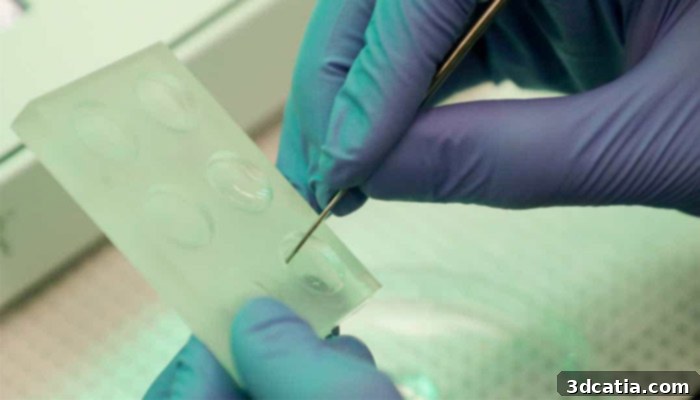
Paul Dinh cuts a 3D printed cornea from its mold | Credits: Tori Schneider/Tallahassee Democrat
Revolutionizing Drug Discovery and Testing
The implications of FAMU’s high-throughput corneal 3D printing extend far beyond direct transplantation. Professor Sachdeva emphasizes a crucial immediate application: “We simulate the human system. The cornea will have several of the cells lined up and you can study how much drug is going through and what’s happening in a much more efficient manner and minimize animal testing.” This highlights the transformative potential of these bioprinted corneas as advanced in vitro models for pharmaceutical research and development. Traditional drug testing often relies on animal models or two-dimensional cell cultures, which frequently fail to accurately mimic the complex physiological responses of human tissues. Animal testing, in particular, raises ethical concerns and often yields results that do not translate effectively to human patients due to species-specific biological differences.
By providing a physiologically accurate, three-dimensional human corneal model, researchers can conduct more reliable and ethically sound studies on drug penetration, efficacy, and toxicity. This means new ophthalmic drugs can be screened and evaluated in a highly controlled environment that closely replicates the human eye’s biology. Such models can accelerate the drug discovery process, reduce development costs, and significantly minimize the reliance on animal testing, aligning with modern scientific and ethical standards. For instance, pharmaceutical companies can test various formulations of eye drops or systemic medications to understand their absorption kinetics and metabolic pathways within a human-like corneal tissue, offering insights that were previously difficult to obtain without extensive in vivo trials. This capacity to create robust, reproducible human tissue models for drug screening is a critical step towards precision medicine, enabling the development of safer and more effective treatments for a multitude of ocular conditions.
The Path Forward: From Lab to Clinic
On the application side, the long-term objective of 3D corneal printing is indeed to have a significant impact on corneal transplants, fundamentally changing how corneal damage is treated. The high-throughput capability developed at FAMU brings this future closer by addressing the scalability issues that have historically plagued tissue engineering efforts. Imagine a world where corneal blindness could be alleviated by a readily available, custom-printed cornea, reducing immense suffering and global health disparities. While this vision is still some years away, the current advancements lay crucial groundwork. The immediate future for this research lies in refining the bioprinting process, ensuring the long-term viability and functionality of the printed tissues, and navigating the rigorous regulatory pathways required for clinical approval. Researchers will need to demonstrate that these bioprinted corneas can integrate seamlessly with host tissues, maintain transparency, resist infection, and endure the mechanical stresses of the eye over extended periods.
The work by Professor Sachdeva and his team offers a compelling glimpse into the future of regenerative ophthalmology. By tackling both the speed of production and the accuracy of tissue modeling, they are not only paving the way for eventual corneal transplants but also providing invaluable tools for understanding ocular diseases and developing novel therapies. This innovative research underscores the immense potential of advanced manufacturing technologies like 3D bioprinting to address some of the most pressing challenges in global health. Continued investment in this field, collaborative efforts between academia, industry, and regulatory bodies, and public awareness will be crucial in translating these remarkable laboratory breakthroughs into tangible clinical benefits that impact millions of lives worldwide. You can find more information HERE.
*Cover Photo Credits: Tori Schneider/Tallahassee Democrat
What are your thoughts on this exciting new research in corneal 3D printing? Share your insights and comments below, or engage with us on our Facebook and Twitter page! Don’t forget to sign up for our free weekly Newsletter to receive all the latest news and innovations in 3D printing delivered straight to your inbox!