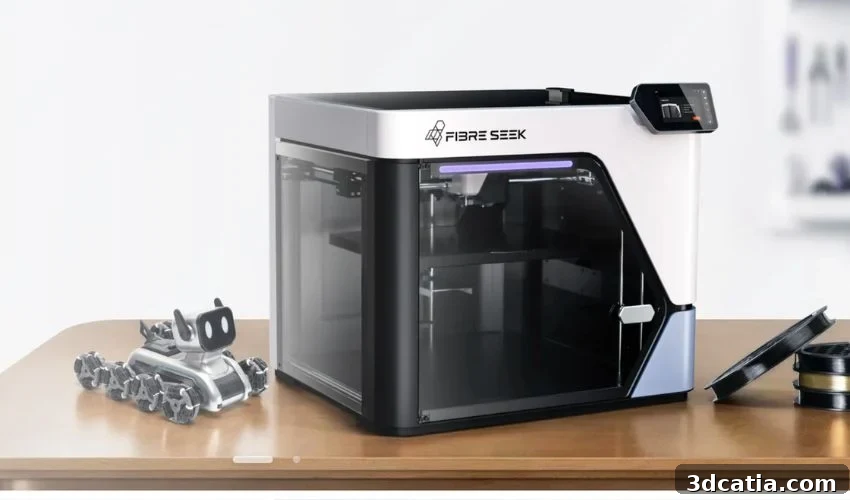
Continuous fiber 3D printing has long been used in industry to produce parts with strength levels that can replace machined metal. Historically, however, the cost, specialized materials, and technical know‑how required for carbon fiber reinforcement have limited its use to large manufacturers and aerospace suppliers.
After a successful crowdfunding campaign that raised over $4.6 million from more than 1,500 backers, FibreSeek is now offering a limited global pre‑sale of the FibreSeeker 3. This desktop system is presented as one of the first machines to make continuous fiber reinforcement accessible outside industrial settings.
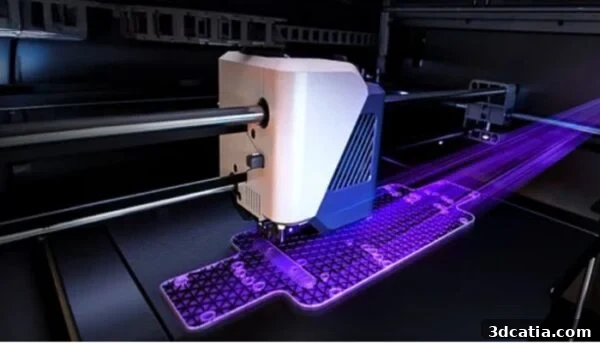
FibreSeek’s proprietary CFC technology allows users to print parts strong enough to replace some metal components.
The FibreSeeker 3 uses Composite Fiber Co‑Extrusion (CFC) to embed uninterrupted continuous carbon fiber directly into the polymer as the part is built—similar in concept to how rebar reinforces concrete. This approach produces lightweight, load‑bearing components that can serve as practical replacements for certain machined metal parts.

Who this is for and common applications
FibreSeek is aiming the FibreSeeker 3 at engineers, makers, prototyping shops, and small engineering teams that need functional, load‑bearing parts produced in‑house. Typical use cases include lightweight structural components, custom tooling, robotics parts, and drone components. By combining continuous fiber reinforcement with desktop accessibility, the system targets applications that previously required outsourcing to specialized composite suppliers or machine shops.
How the FibreSeeker 3 operates
At the heart of the system is the Composite Fiber Co‑Extrusion process. Dry continuous reinforcing fiber is impregnated in real time with a liquid polymer to create a pre‑impregnated strand. That strand is then co‑extruded with a thermoplastic filament to form composite paths within each layer. The in‑situ impregnation is designed to reduce internal voids and maximize fiber volume fraction so that fibers can carry loads along engineered trajectories inside the part.
The printer is paired with FibreSeek’s Rocket Slicer software, intended to streamline composite print setup for both newcomers and experienced users. The slicer helps determine reinforcement strategies, reducing trial‑and‑error during preparation. It provides three application‑focused print modes:
- Speedy — optimized for fast turnaround and rapid prototyping,
- Reinforced — balances structural strength with material use,
- Fortified — maximizes fiber content and structural performance for the strongest parts.
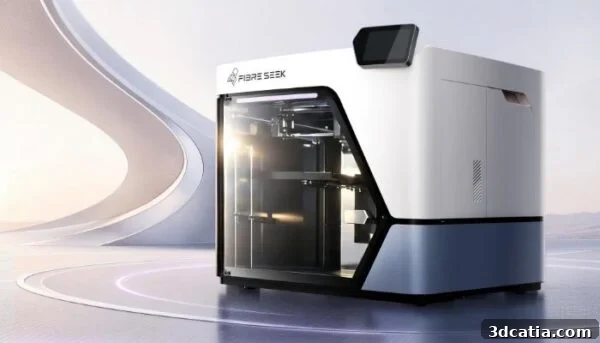
Key specifications cited for the FibreSeeker 3 include a build volume of 300 × 300 × 245 mm and top print speeds up to 500 mm/s. The machine also incorporates a patented dual‑nozzle assembly, a 65°C active heated chamber to improve interlayer bonding, automatic bed leveling and calibration, an integrated camera for print monitoring, and compatibility with multiple filament types.
Industrial and aerospace roots
The technology behind FibreSeek draws on industrial continuous fiber expertise and aerospace engineering practices. The company’s founders—scientists, engineers, and product designers—repackaged that knowledge into a desktop hardware and software solution intended to broaden access to continuous fiber printing.
FibreSeek is led by founder and CEO Ryan Liu, who previously worked on industrial continuous fiber systems and was recognized in Forbes China’s 30 Under 30. The team says community feedback played a central role in the product’s development. During crowdfunding, input from backers guided an upgrade from an initial design to a revised Version 2.0, a change the company accepted despite added supply‑chain complexity and delivery adjustments to prioritize long‑term product quality.
Pre‑sale and availability
FibreSeek has opened a global pre‑sale for a limited run of 500 units. The launch is staggered by region, with the initial rollouts scheduled for selected markets in September. Early‑bird pricing is being offered in regional currencies and includes a limited discount from planned retail pricing. Because allocation is small, the company is managing demand through pre‑order lists and regional reservation systems.
The FibreSeeker 3 aims to make continuous fiber reinforcement more accessible to smaller teams and workshop environments, enabling the production of stronger, lighter functional parts without outsourcing. Readers interested in purchasing or learning more should follow official FibreSeek channels or authorized distributors for up‑to‑date pre‑sale details and availability in their region.
*All photo credits: FibreSeek
