
Exploring the Future: Europe’s Largest 3D-Printed Office, Medical Advances, and Design Innovations in Additive Manufacturing
This week, we delve into the transformative world of 3D printing, exploring groundbreaking achievements and innovative applications across various sectors. Our journey begins in Austria, where Europe’s largest 3D-printed office space stands as a testament to collaborative innovation in construction. We’ll then transport you to the vibrant heart of Paris, recounting our team’s firsthand experience at the inaugural 3D Print Paris expo, gathering unique perspectives from industry leaders and enthusiasts alike. Furthermore, we shed light on how 3D printing is revolutionizing interior design, enabling bespoke creations that push aesthetic boundaries. Finally, we venture into the critical medical sector, gaining valuable insights from an industry expert at Trumpf on the pivotal role of additive manufacturing in healthcare. Prepare to discover how these advancements are shaping our present and paving the way for a more efficient, customized, and sustainable future.
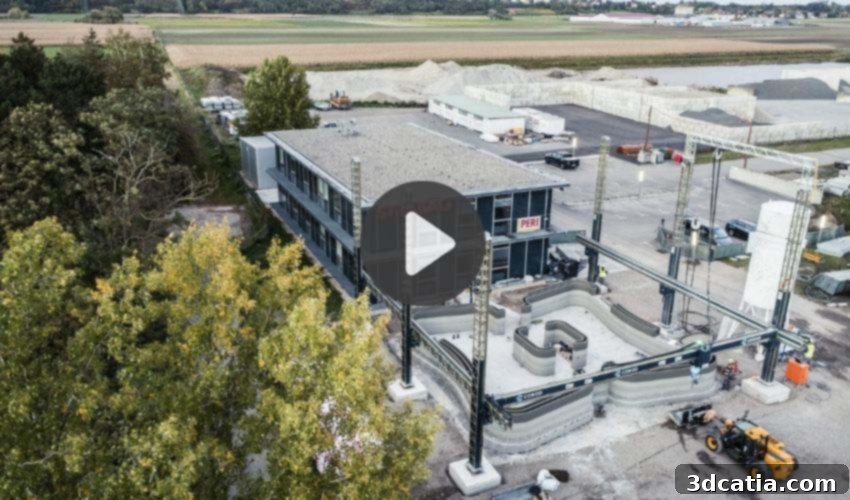
Top 1: The Largest 3D-Printed Office Space in Europe Redefines Construction
Additive manufacturing continues to redefine possibilities in the construction industry, and this groundbreaking project in Austria serves as a powerful illustration. Marking a significant milestone, this new construction proudly holds the title of Europe’s largest 3D-printed office space. This ambitious endeavor is the remarkable outcome of a strategic collaboration between three prominent entities: the construction and architecture leaders PERI and STRABAG, alongside the cutting-edge 3D construction printing technology provider COBOD. Their combined expertise has culminated in a structure that not only showcases the immense potential of large-scale 3D printing but also sets a new benchmark for speed, efficiency, and design flexibility in commercial real estate.
COBOD, a pioneer in the field of construction 3D printing, has repeatedly demonstrated its prowess through various impressive building projects utilizing their advanced BOD2 machines. This latest achievement in Austria, however, represents a new zenith. The companies leveraged COBOD’s state-of-the-art BOD2 printer to create this expansive office facility. The BOD2 system is renowned for its gantry-based architecture, allowing for rapid and precise deposition of concrete and other printable materials, layer by layer, directly on site. This method drastically reduces construction time, minimizes material waste, and offers unprecedented architectural freedom compared to traditional building techniques, paving the way for more sustainable and cost-effective building solutions.
The partnership between PERI, a global leader in formwork, scaffolding, and 3D construction printing, and STRABAG, one of Europe’s largest construction technology groups, with COBOD’s innovative technology, exemplifies a forward-thinking approach to modern construction challenges. This collaborative model demonstrates how established construction giants can integrate disruptive technologies to achieve what was once considered impossible. The completion of Europe’s largest 3D-printed office space not only provides functional, modern workspaces but also serves as a visible beacon for the future of sustainable and digitally driven construction practices, inspiring similar projects worldwide and signaling a paradigm shift in how we envision and build our architectural landscape. This development signifies a major leap in integrating additive manufacturing into mainstream construction, highlighting its potential for scalability and broader adoption across various building types.
Top 2: 3D Printing Powers Art Exhibition for Children’s Mental Health Awareness
Beyond its industrial applications, 3D printing is increasingly being harnessed for social good, breathing life into poignant awareness campaigns. This segment highlights a compelling social awareness project brought to fruition through the versatility of 3D printing technology. In a powerful collaboration, UNICEF France and national data transmitters partnered with the Spanish additive manufacturing specialist BCN3D to conceptualize and execute a striking art exhibition that captivated audiences on the streets of Paris. The overarching objective of this unique initiative was clear and crucial: to raise public awareness about the pressing issue of children’s mental health, a concern exacerbated by recent global health crises.
The exhibition featured a series of intricately designed 3D-printed busts, strategically placed across various public spaces in the French capital. These artistic installations served as powerful visual metaphors, designed to spark conversation and encourage empathy regarding the emotional and psychological challenges children are grappling with today. By presenting these tangible representations, the project aimed to break down stigmas surrounding mental health and foster an open dialogue among parents, educators, and the wider community. The use of 3D printing proved instrumental in this endeavor, allowing for the rapid production of multiple, detailed, and consistent sculptural pieces. This efficiency made it an ideal technology for a widespread public art intervention, ensuring the message reached a broad audience effectively and with visual consistency.
BCN3D’s expertise in additive manufacturing enabled the creation of these impactful busts with precision and efficiency. Their technology allowed for meticulous detailing and consistent quality across all printed pieces, crucial for conveying a unified and powerful message. The ability to prototype quickly and iterate designs was instrumental in developing sculptures that effectively communicated the project’s sensitive message while ensuring artistic integrity. This collaboration underscores how innovative technologies, when paired with compassionate objectives, can yield profound results in social advocacy. The exhibition not only drew attention to a vital cause but also showcased the artistic and communicative power of 3D printing, demonstrating its capacity to move beyond purely technical applications into the realm of profound social commentary and public engagement. Discover all the compelling details of this thoughtful project in the video provided below, which elaborates on the design process and public reaction.
Top 3: A Glimpse Inside the Inaugural ‘3D Print Paris’ Expo
A few weeks prior, the French capital played host to a landmark event for the additive manufacturing community: the first-ever ‘3D Print Paris’ exhibition. This physical gathering served as a dynamic showcase, dedicated to unveiling the vast and evolving possibilities of 3D printing technology to a broad audience, from industry professionals to curious newcomers. Held from October 20 to 21, the expo transformed Paris into a central hub for innovation, collaboration, and knowledge exchange within the additive manufacturing sector. The 3Dnatives team was on the ground, immersing ourselves in the vibrant atmosphere and engaging with both attendees and exhibitors to capture the true pulse of the event and its significance for the future of French and European manufacturing.
Our team embarked on a mission to conduct a series of unique and engaging interviews, moving beyond conventional questions to uncover genuine insights and personal perspectives. We asked attendees some peculiar yet thought-provoking questions, such as how they would encapsulate the essence of 3D printing in just three words, what their ideal 3D printer would look like, and what ambitious projects they dream of bringing to life using this transformative technology. These candid conversations offered a refreshing and authentic snapshot of the community’s passion, creativity, and vision for the future of additive manufacturing, highlighting diverse viewpoints from seasoned experts to enthusiastic hobbyists.
The ‘3D Print Paris’ expo was more than just a display of new technologies; it was a vibrant forum where ideas converged, partnerships were forged, and the future of manufacturing was actively discussed. Exhibitors showcased their latest innovations, from advanced industrial machines capable of printing with exotic materials to user-friendly desktop models making 3D printing accessible to a wider demographic. The energy was palpable, reflecting the rapid growth and increasing adoption of additive manufacturing across various industries, including aerospace, automotive, consumer goods, and medical applications. The event underscored the importance of face-to-face interactions in fostering community and accelerating technological progress. Don’t miss out on what the participants shared with us – their insights provide a fascinating window into the current state and future aspirations of the 3D printing world. We invite you to discover these memorable #In3DSnaps below, offering a compelling recap of the event’s highlights and the unique voices that shaped it, truly capturing the essence of this inaugural gathering.
Top 4: 3D Printing & Interior Decoration: Crafting Bespoke Spaces
The intersection of 3D printing and interior design is flourishing, making it increasingly common for this advanced technology to be employed in crafting unique and personalized decor. Whether enhancing the ambiance of homes, transforming restaurants, or outfitting modern offices, additive manufacturing offers an unprecedented array of design possibilities. This technology empowers designers and artists to transcend conventional limitations, creating complex geometries, intricate patterns, and custom pieces that would be challenging, if not impossible, to produce using traditional manufacturing methods. The ability to rapidly prototype and iterate designs also allows for greater creative freedom and client satisfaction, ensuring that every piece perfectly matches the aesthetic and functional requirements of the space.
One remarkable example of this fusion is Studio Artefact, a Montreal, Canada-based design firm that has fully embraced large-format 3D printing to create breathtaking and unique decorative elements. The studio harnesses the power of six BigRep ONE 3D printers, renowned for their ability to produce sizable objects with exceptional detail and consistency. This industrial-scale setup allows Studio Artefact to tackle ambitious projects, turning innovative concepts into physical realities for various commercial and residential spaces. Their work exemplifies how 3D printing can revolutionize the aesthetic and functional aspects of interior environments, offering bespoke solutions that elevate design to new heights and push the boundaries of artistic expression.
Recently, Studio Artefact garnered significant attention for an innovative project involving the 3D printing of several translucent trees. These aren’t merely static decorations; they were ingeniously transformed into dynamic 360-degree screens, blurring the lines between art, technology, and immersive experience. This demonstrates the incredible versatility of 3D printing—not just for creating shapes, but for building components that can integrate advanced functionalities like embedded lighting and projection surfaces. Such applications open doors to interactive installations, smart decor, and personalized environments that respond to user needs and preferences, offering a glimpse into the future of spatial design. The possibilities are truly boundless, from custom furniture and lighting fixtures to intricate wall panels and artistic sculptures, all tailored to precise specifications and creative visions, proving 3D printing’s invaluable role in modern interior aesthetics.
Top 5: Advancing Healthcare with Metal 3D Printing in the Medical Sector
Additive manufacturing stands at the forefront of medical innovation, offering unprecedented capabilities for creating patient-specific products that can significantly improve treatment outcomes and quality of life. While 3D printing intrinsically enables highly personalized adaptations, such as the ingeniously designed 3D-printed prosthetic arm developed by student Lorenzo Spreafico, without the prohibitive cost increases typically associated with customization, these bespoke medical products still represent a minority within the broader landscape of additive manufacturing applications in the medical sector. The potential for truly individualized healthcare solutions is vast, yet the industry often prioritizes standard, high-volume production due to regulatory complexities and established manufacturing protocols that favor consistency and proven safety over individualized designs.
To gain a deeper understanding of the dynamics and prevailing trends of additive manufacturing in the medical sector, we turn to an expert in the field: Laura Kastenmayer, Industry Manager for Medical Technology at Trumpf. In this insightful video, she elucidates the current state and future trajectory of metal 3D printing in healthcare. Specifically, Kastenmayer sheds light on a critical aspect of medical AM: why standard products, such as acetabular cups (hip joint components), are printed far more frequently than highly customized, patient-specific devices. This phenomenon can be attributed to several factors, including the well-defined regulatory pathways for standardized components, established material certifications (e.g., titanium alloys), and the proven economic benefits of producing complex geometries in volume through additive methods, which optimize both cost and performance.
The precision, strength, and biocompatibility offered by metal 3D printing, particularly with materials like titanium, make it ideal for implants and surgical instruments. For standardized components like acetabular cups, AM allows for the creation of intricate lattice structures that promote bone ingrowth, leading to better patient outcomes and faster recovery times. These structures, impossible to achieve with traditional manufacturing, provide a superior interface between the implant and the bone. While the vision of fully personalized medicine is actively pursued and promises revolutionary advancements, the current market for metal AM in healthcare is largely driven by these standardized, yet highly technical, products that leverage additive manufacturing’s advantages in design freedom and material efficiency at scale. Laura Kastenmayer’s expertise provides invaluable context, highlighting the practical realities, regulatory challenges, and strategic priorities that influence the adoption and growth of metal 3D printing in this critical industry, ensuring that innovations are both impactful and scalable for widespread medical benefit.
This week’s exploration into the world of 3D printing has showcased its remarkable versatility and profound impact across diverse industries. From setting new records in sustainable construction and fostering vital social awareness through art, to revitalizing interior design with bespoke creations and driving precision in medical technology, additive manufacturing continues to push the boundaries of innovation. We trust this comprehensive compilation has provided valuable insights into the exciting advancements shaping our future and demonstrated the ever-expanding capabilities of this transformative technology.
What are your thoughts on this week’s comprehensive video compilation and the incredible strides being made in 3D printing? We’d love to hear your perspectives! Share your comments below or engage with us on our vibrant social media channels: LinkedIn, Facebook, and Twitter. To ensure you never miss out on the latest advancements and breaking news in the additive manufacturing world, don’t forget to sign up for our free weekly Newsletter here, delivered straight to your inbox. You can also explore our extensive library of insightful videos and captivating content on our official YouTube channel. Stay connected and stay informed with 3Dnatives!