

Protolabs Report: Unpacking the Future and Exponential Growth of Additive Manufacturing
The landscape of modern manufacturing is undergoing a profound transformation, spearheaded by the relentless innovation in additive manufacturing (AM). A recent comprehensive report released by Protolabs, a leading global digital manufacturing company, provides an illuminating look into the latest trends, critical innovations, and key statistics shaping the additive manufacturing market. This insightful analysis reveals a sector on the cusp of unprecedented expansion, projecting the global 3D printing market to ascend to an impressive $28.07 billion by 2024 and further surge to a staggering $57.1 billion by 2028. These projections not only signify robust growth but also surpass previous estimations by a significant 10.5%, signaling a period of accelerated development and widespread adoption. This accelerated growth is particularly welcome news for an industry that has navigated its share of economic challenges and technological hurdles in recent times, demonstrating resilience and adaptability. Furthermore, the Protolabs study emphatically underscores the increasing prevalence and acceptance of mass production methodologies employing 3D printing technologies—a paradigm shift that, while anticipated, is now visibly gaining traction across diverse industries. Among the array of emerging trends highlighted in the report, advancements in artificial intelligence (AI), the development of novel materials tailored for specific applications, and the strategic integration of additive and subtractive manufacturing techniques stand out as pivotal drivers of this evolution.
While the manufacturing sector as a whole has experienced periods of fluctuation and occasional downturns of late, the additive manufacturing segment appears to be charting a consistently positive growth trajectory. This sustained momentum is largely propelled by dynamic vertical markets that are ripe with opportunities and actively embracing the transformative potential of 3D technologies. The medical sector, for instance, stands out as a prime example of this vitality. According to the compelling findings of the Protolabs study, a substantial 77% of respondents unequivocally identify the medical sector as holding the greatest potential impact within the broader additive manufacturing market. This high perception is rooted in the unique ability of 3D printing to create highly customized, complex, and biocompatible medical devices, prosthetics, and anatomical models. Within this critical sector, SLA (Stereolithography) 3D printing technology predominates, favored for its exceptional capability to produce intricate, high-fidelity details with remarkable precision and smooth surface finishes, crucial for medical applications. Beyond healthcare, another noteworthy trend is the considerable surge in additive manufacturing utilization within the agriculture sector, primarily leveraging FDM (Fused Deposition Modeling) technology. FDM’s affordability, versatility, and ability to use robust materials make it ideal for creating custom tools, replacement parts for machinery, and specialized components that enhance efficiency in agricultural operations. Moreover, the transportation sector, encompassing automotive, aerospace, and marine industries, emerges as the leading producer of 3D printed finished parts, underscoring its pivotal role in driving the industrial application of additive manufacturing for end-use components.
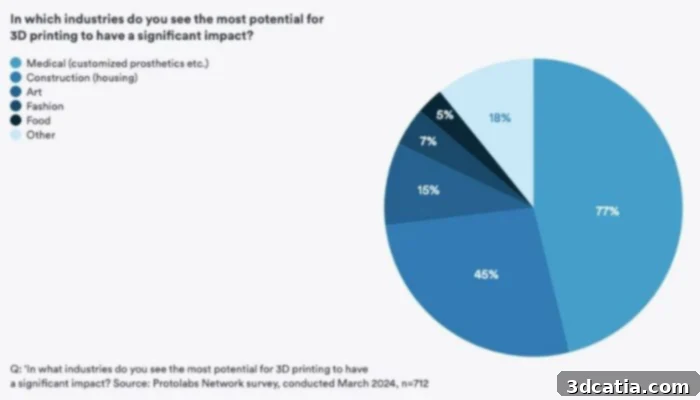
Industries where additive manufacturing is expected to have the greatest impact (Photo Credits: Protolabs)
Shifting our focus from market sectors to the specific applications of additive manufacturing, the Protolabs report provides clear and compelling evidence: the overarching trend is unequivocally moving towards the creation of finished parts in significantly higher volumes. While prototyping—the traditional stronghold of 3D printing—remains a robust application, cited by a high 67% of participants, its dominance is being challenged by the accelerating adoption of additive manufacturing for end-use components. A striking 76% of participants in the study reported having 3D printed more than 10 parts, a figure that represents a monumental increase from a mere 36% in 2020. This dramatic shift highlights a growing confidence in the reliability and scalability of additive manufacturing processes for producing production-grade components. The study emphatically demonstrates that an increasing number of professionals are actively turning to additive manufacturing, regardless of the specific printing process, to create parts in volume. This marks a significant departure from historical preferences, where conventional methods like injection molding were almost exclusively favored for volume production. This evolution is driven by several factors, including the increasing sophistication of 3D printers, the expanding range of engineering-grade materials, and the ability of additive manufacturing to produce complex geometries and customized parts more efficiently and economically for certain batch sizes.
The decision-making process concerning the optimal manufacturing method for a given product or component is undoubtedly influenced by a myriad of intricate factors. Key considerations that naturally come to the forefront include specific post-processing requirements, the capabilities of available software, and adherence to stringent certification and standardization protocols. The latter aspect, in particular, proves to be exceptionally stringent and critically important within highly regulated industries such as aerospace, medical, and automotive sectors, where safety, reliability, and performance are paramount. For example, in aerospace, parts must meet rigorous flight safety standards, while medical implants demand biocompatibility and absolute precision. In the automotive industry, components need to withstand extreme conditions and long lifespans. However, amidst these inherent challenges and demanding requirements, a discernible and encouraging shift is occurring across the industry. There is a growing inclination within the market toward standardizing processes, materials, quality control procedures, and other pertinent elements to the greatest extent possible. This drive towards standardization is essential for fostering broader adoption, instilling greater confidence among manufacturers, and paving the way for additive manufacturing to become an even more integral part of global supply chains. Standardized practices lead to improved consistency, predictability, and ultimately, greater industrial viability.
Key Additive Manufacturing Market Trends Driving Future Innovation
A substantial portion of Protolabs’ insightful report is dedicated to exploring the pivotal trends currently shaping the additive manufacturing sector and the various groundbreaking developments poised to redefine its future. One of the most significant points highlighted is the intensive and ongoing work dedicated to developing advanced materials for 3D printing. The sheer range of materials available to manufacturers has expanded considerably in recent years, moving beyond basic plastics to encompass sophisticated engineering polymers, high-performance metals, ceramics, and even composites. These new material solutions are specifically engineered to meet highly specific constraints and performance requirements, often tailored by target market or application. Adam Hecht of design studio 3DP DIVE encapsulates this trend perfectly, stating, “Companies are designing blends tailored for 3D printing, creating materials geared for very specific applications within 3D printing, whether that’s conventional thermoplastics that have been re-engineered for 3D printing, or resins that aren’t just for prototyping, but for very specialized, high-temperature, high-elasticity types of applications.” This emphasis on application-specific materials means that designers and engineers are no longer limited by the material properties but can select or even create materials that impart the desired functionality, durability, and aesthetic qualities to the final part. The material selection is a central and increasingly critical element in the entire additive manufacturing workflow, directly influencing part performance and feasibility. This evolution is undoubtedly a primary driver that will see impressive growth in the sector over the next few years. It is no coincidence that the demand and development of multi-material 3D printing technologies are growing at such a rapid pace, promising even greater functional integration and design freedom.
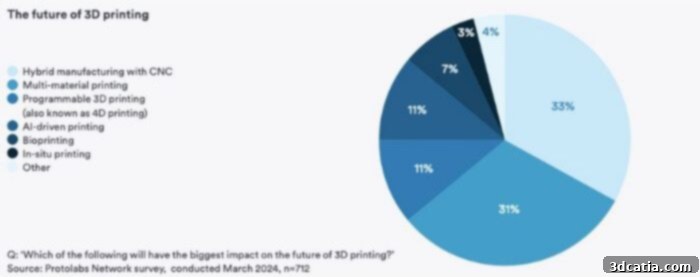
Main trends identified (photo credits: Protolabs)
Another transformative trend reshaping the additive manufacturing landscape is the growing integration of artificial intelligence (AI). The fundamental question driving this integration is: how can we harness the power of AI to automate our processes, optimize designs, collect and analyze vast amounts of data, and ultimately achieve higher levels of productivity? AI holds immense potential to revolutionize various stages of the 3D printing workflow. For instance, AI algorithms can assist users in fine-tuning their 3D printers by predicting optimal print parameters for different materials and geometries, leading to enhanced part quality and reduced failure rates. Beyond machine optimization, AI can significantly improve design processes through generative design, where algorithms explore numerous design iterations based on specified constraints, often leading to lighter, stronger, and more efficient parts that human designers might not conceive. Moreover, AI-powered systems can meticulously monitor prints in real-time, detecting potential errors or anomalies before they escalate, thereby preventing costly material waste and time. The ability of AI to process and learn from complex data sets—including sensor data from printers, material properties, and environmental conditions—means continuous improvement and increasingly intelligent manufacturing processes, pushing the boundaries of what’s possible with additive technology.
Finally, the Protolabs report highlights that hybrid manufacturing is poised to play an increasingly important and strategic role in the global market. This innovative approach aims to seamlessly combine all the inherent advantages of additive manufacturing with those of traditional subtractive processes, thereby enabling more intelligent, efficient, and versatile production methodologies. Additive manufacturing excels at creating intricate internal geometries, complex designs, and highly customized parts, often reducing material waste. However, subtractive methods, such as CNC machining, are unparalleled for achieving extremely tight tolerances, superior surface finishes, and working with very hard materials. By integrating these two powerful techniques, manufacturers can leverage the best of both worlds. For example, a part might be initially 3D printed to achieve a complex internal structure and then precisely machined to ensure critical external dimensions and surface quality. Some advanced manufacturing machines have been specifically developed along these lines, featuring multiple tool heads that can switch between additive deposition and subtractive material removal within a single setup, eliminating the need for part transfers and reducing setup times. This emerging trend promises to significantly alter our production methods, offering unprecedented flexibility, material efficiency, and the ability to produce parts with characteristics previously unattainable, thereby fostering innovation across various industries.
In conclusion, the latest report from Protolabs presents a remarkably encouraging outlook for the additive manufacturing sector, painting a vivid picture of sustained growth, exponential innovation, and transformative potential. With market projections indicating substantial expansion and a clear shift towards higher volume production of finished parts, the industry is demonstrating its maturation beyond its prototyping roots. The strategic integration of cutting-edge technologies like artificial intelligence, the relentless development of advanced application-specific materials, and the rise of versatile hybrid manufacturing techniques are collectively driving this evolution. These innovations are not merely incremental improvements but represent fundamental shifts that are making 3D printing an indispensable tool for advanced manufacturing across an ever-widening array of industries, from medical and aerospace to agriculture and transportation. The future of additive manufacturing is undoubtedly bright, holding the promise of even more pleasant surprises, groundbreaking applications, and continued advancements that will redefine manufacturing capabilities globally. For those eager to delve deeper into these trends and statistics, the full Protolabs report is available for download HERE.
We invite you to share your insights: What do you perceive as the most significant additive manufacturing trends poised to impact the sector in the coming years? Your perspectives are invaluable as we collectively navigate this exciting technological frontier. Don’t forget to sign up for our free weekly newsletter here for the latest 3D printing news straight to your inbox! You can also find all our videos on our YouTube channel, offering visual insights into the world of additive manufacturing.