
Revolutionizing Metal 3D Printing: Cambridge Breakthrough Outperforms Traditional ‘Heating and Beating’ Method
The landscape of modern manufacturing is continually evolving, with metal 3D printing emerging as a transformative technology. Its unparalleled ability to fabricate highly intricate and customized metal components has made it indispensable across diverse sectors, including aerospace, automotive, medical, and defense. This additive manufacturing technique offers design freedoms impossible or cost-prohibitive with conventional methods, driving innovation in product development. However, despite its remarkable capabilities and growing adoption, significant hurdles persist. One of the most prominent challenges revolves around the inherently high production costs, often exacerbated by the necessity for extensive post-processing. These crucial post-manufacturing steps are typically required to enhance the mechanical properties, surface finish, and overall integrity of the final printed part. Such processes, which can include heat treatments, surface finishing, and material removal, directly contribute to both the expense and time involved in the overall production cycle. Addressing these limitations is paramount for metal additive manufacturing to fully realize its potential and achieve widespread industrial applicability.
Fortunately, a groundbreaking development from the University of Cambridge promises to reshape this paradigm for metal additive manufacturing. Researchers at the prestigious institution have successfully engineered a novel metal 3D printing process, rigorously tested and validated on steel, which they assert delivers superior results compared to traditional methods like ‘heating and beating.’ This innovative approach could drastically reduce the need for subsequent processing steps, thereby lowering production costs and significantly accelerating manufacturing timelines. By offering a more efficient and cost-effective pathway, this breakthrough makes metal 3D printing a more viable and sustainable option for a broader range of industrial applications. More than just an economic advantage, this development provides a sophisticated method to unlock enhanced material properties directly during the additive manufacturing phase, paving the way for advanced metal components with tailored performance characteristics.
To truly appreciate the significance of this advancement, it’s beneficial to understand the ‘heating and beating’ process it aims to supersede. As its evocative name suggests, this centuries-old metallurgical technique involves two primary actions: hardening a material, typically metal, through repeated mechanical deformation (e.g., hammering), followed by softening and stress relief through controlled application of heat (e.g., fire). Visualize the quintessential image of traditional blacksmiths, a craft steeped in history and often depicted in historical reenactments. These skilled artisans diligently shaped and strengthened metal, expertly wielding hammers to forge raw materials like iron or steel into durable tools, formidable weapons such as swords, or essential everyday items like horseshoes. This method allowed craftsmen to refine the internal grain structure of the metal, imparting desirable macroscopic properties like increased strength, toughness, and ductility. Yet, despite its historical efficacy and enduring legacy, ‘heating and beating’ possesses inherent limitations when viewed through the lens of modern industrial production. It is an inherently labor-intensive and time-consuming process, making it far less efficient than contemporary manufacturing techniques, including advanced methods like metal 3D printing. Furthermore, its manual and somewhat imprecise nature makes it ill-suited for the exact production of particularly intricate or complex parts, a domain where digital additive manufacturing truly excels.
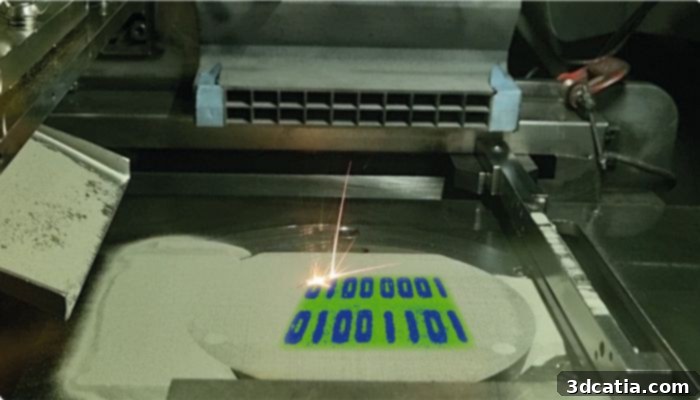
A conceptual illustration from the research team showing how these processing strategies could be used in laser powder bed fusion to control material properties during printing.
Despite the stark contrast between traditional forging and sophisticated digital manufacturing, there’s a profound metallurgical reason why these time-honored processes have persisted for millennia. Dr. Matteo Seita, the lead researcher on this pivotal project from Cambridge’s Department of Engineering, eloquently articulates this fundamental truth about material science: “The reason why heating and beating is so effective is because it changes the internal structure of the material, allowing control over its properties. That’s why it’s still in use after thousands of years.” This insightful observation underscores a critical challenge that modern metal additive manufacturing has historically struggled with: achieving comparable granular control over the material’s microstructure directly during the printing phase. Current additive manufacturing methods often result in material properties that can be anisotropic (direction-dependent), exhibit residual stresses, or contain microstructural inconsistencies like porosity. These factors necessitate extensive and often costly subsequent treatments, such as post-print heat treatments, to bring the parts up to the required performance standards for demanding engineering applications. The ability to manipulate the internal structure at a microscopic level during fabrication is the key to unlocking superior material performance and consistency.
Indeed, for too long, one of the major drawbacks of advanced metal 3D printing techniques has been this inherent inability to precisely control the internal microstructure and resulting material properties in the same nuanced way that traditional forging or blacksmithing allowed. This limitation is precisely why extensive post-processing steps, particularly various forms of heat treatment, are almost invariably necessary with metal additive manufacturing. These post-treatments are critical for several reasons: relieving internal stresses accumulated during the rapid heating and cooling cycles of printing, improving ductility, refining undesirable grain structures, and ultimately enhancing the overall mechanical performance, fatigue resistance, and reliability of the printed parts. However, these additional steps add considerable time, energy consumption, and significant cost to the overall production process, often negating some of the efficiency and geometric freedom advantages offered by 3D printing itself. The innovative concept developed by the Cambridge team directly confronts this challenge head-on. By devising a method to restore this critical structure engineering capability – essentially gaining fine-grained control over the metal’s microstructure – without resorting to the laborious and energy-intensive traditional ‘heating and beating’ techniques, they open the door to monumental advancements. As Dr. Seita highlights, this approach would not only lead to a substantial reduction in overall production costs but the ability to precisely control material properties during printing would also make it considerably easier to leverage the inherent greener aspects of 3D printing, such as material efficiency, reduced waste, and localized manufacturing, thereby fostering a truly sustainable manufacturing ecosystem.
Creating a New Metal 3D Printing Process Superior to ‘Heating and Beating’
The overarching goal of the Cambridge researchers, alongside their international collaborators, is to propel metal 3D printing into an even more compelling and economically attractive position within the vast global metal manufacturing industry. This pivotal research was a truly collaborative effort, involving esteemed teams from a consortium of world-leading institutions, including Nanyang Technological University, the Agency for Science, Technology and Research (A*STAR), the Paul Scherrer Institute, VTT Technical Research Centre of Finland, and the Australian Nuclear Science & Technology Organisation. Together, this powerful international team successfully developed what they refer to as a specific ‘recipe’ for 3D printing metal. This groundbreaking ‘recipe’ goes far beyond merely fabricating parts; it empowers manufacturers with an unprecedented degree of control over the internal microstructure of the printed material, a level of precision previously achievable only through traditional, often labor-intensive, methods or extensive, costly post-processing. This direct control at the point of manufacture – embedding desirable material properties during the additive process itself – is what fundamentally differentiates their approach and unlocks new possibilities for advanced material design and superior component performance across various engineering sectors.
To achieve this unprecedented control over the internal material structure, Dr. Seita and his dedicated team ingeniously harnessed the sophisticated capabilities of lasers, which are central to many metal 3D printing technologies like laser powder bed fusion. Their method centers on precisely manipulating the laser during the additive manufacturing process. By carefully melting the metal powder with a laser, they then gain critical control over two key aspects that dictate material properties: firstly, the specific manner in which the molten material solidifies after melting, and secondly, the precise amount of heat generated and subsequently dissipated throughout the entire process. This dual control mechanism allows the researchers to effectively “program” the desired properties directly into the end material as it is being formed layer by layer. Dr. Seita elaborated on this sophisticated technique, explaining, “We found that the laser can be used as a ‘microscopic hammer’ to harden the metal during 3D printing. However, melting the metal a second time with the same laser relaxes the metal’s structure, allowing the structural reconfiguration to take place when the part is placed in the furnace.” This intricate dance of targeted laser application – an initial hardening followed by a controlled relaxation using the same laser – represents a significant paradigm shift. It allows for the fine-tuning of microstructure in a way that mimics and potentially surpasses traditional methods, but within the highly precise, repeatable, and automated environment of a modern 3D printer.
What is the remarkable result of this innovative approach? The outcome is 3D printed parts that are not merely inherently strong – a property often achievable with current metal additive manufacturing methods – but are also inherently tough, effectively overcoming the pervasive issue of brittleness that commonly plagues additively manufactured metal components. Traditional metal 3D printing frequently struggles to achieve a harmonious balance between high strength and sufficient toughness; parts might exhibit impressive tensile strength but be prone to catastrophic failure due to a lack of ductility or fracture resistance. This new process, however, grants unprecedented and full control over both strength and toughness simultaneously, allowing engineers to design parts that are robust and reliable under demanding conditions. It achieves this winning combination by synergistically integrating conventional laser-based 3D printing technologies, such as direct metal laser sintering (DMLS) or laser powder bed fusion (LPBF), with a subsequent, relatively low-temperature furnace treatment. This two-step approach is far less intensive, energy-consuming, and costly than traditional, full-scale heat treatments typically required for AM parts, yet it yields superior material characteristics. Initial experiments have already provided compelling evidence, demonstrating that the 3D printed steel produced via this method exhibits a performance profile entirely comparable, and in some aspects even superior, to steel manufactured through the laborious and significantly less efficient ‘heating and beating’ process. This marks a profound leap forward in creating high-performance, reliable metal components with additive manufacturing, expanding its potential applications dramatically.
Looking to the future, Dr. Seita is highly optimistic about the far-reaching implications and transformative potential of their discovery for the entire metal manufacturing industry. He concluded, “We think this method could help reduce the costs of metal 3D printing, which could in turn improve the sustainability of the metal manufacturing industry. In the near future, we also hope to be able to bypass the low-temperature treatment in the furnace, further reducing the number of steps required before using 3D printed parts in engineering applications.” This ambitious vision points towards a future where metal additive manufacturing is not only more affordable and accessible but also significantly more environmentally friendly and streamlined. Eliminating or minimizing post-processing steps directly translates to less energy consumption, reduced material waste, and faster lead times, making high-performance metal components readily available for an even wider array of critical engineering applications. The comprehensive details of this groundbreaking research have been meticulously published in the prestigious scientific journal Nature Communications, and interested readers are encouraged to delve deeper into the study by following the link provided HERE.
This innovative research from the University of Cambridge represents a crucial and transformative step forward in addressing some of the most persistent challenges facing metal additive manufacturing today. By integrating structural control directly into the 3D printing process, the team has not only reduced the reliance on costly and time-consuming post-processing but has also demonstrated the remarkable ability to produce parts with exceptional strength and toughness simultaneously. This development could fundamentally alter the trajectory of metal 3D printing, paving the way for a new era of more efficient, economical, and sustainable metal production, ultimately broadening the adoption of additive manufacturing across critical industrial sectors. The implications for advanced material science and engineering are profound, promising stronger, lighter, and more complex components for future innovations ranging from next-generation aircraft to personalized medical implants. What do you think about this revolutionary research into using a process inspired by or superior to the traditional ‘heating and beating’ method to significantly improve 3D printing for steel and other metal alloys? We invite you to share your thoughts, insights, and predictions for the future of metal additive manufacturing! Let us know in a comment below or connect with us on our LinkedIn, Facebook, and Twitter pages! Don’t forget to sign up for our free weekly Newsletter here, delivering the latest 3D printing news straight to your inbox! You can also find all our compelling videos and interviews on our dedicated YouTube channel.