
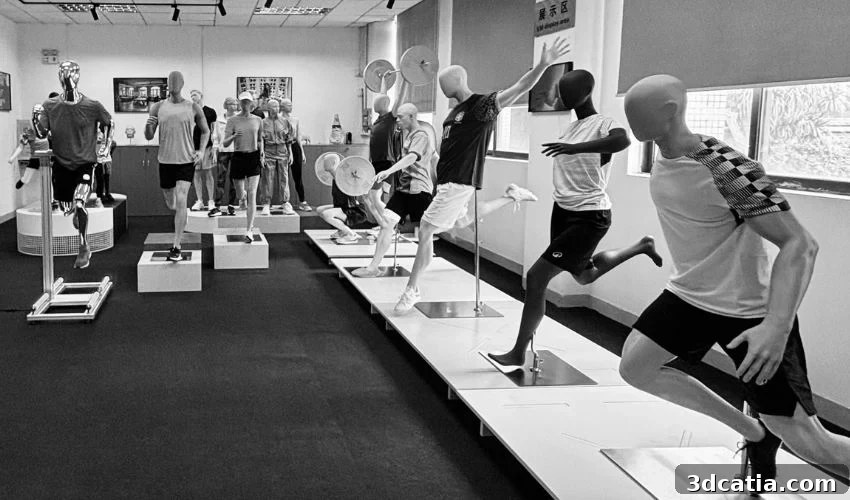
3D printing’s route to industrial-scale production has been guided by aerospace tolerances, medical implants, and automotive lightweighting. It has also, less visibly, traveled through the mannequin and visual merchandising industries.
The need for faster collections, smaller production runs, and more sustainable display solutions led one company to push fused deposition modeling (FDM) beyond its usual limits. In doing so, the company developed a production infrastructure that evolved into a broader digital manufacturing platform serving brands such as adidas, The North Face, and Atomic.
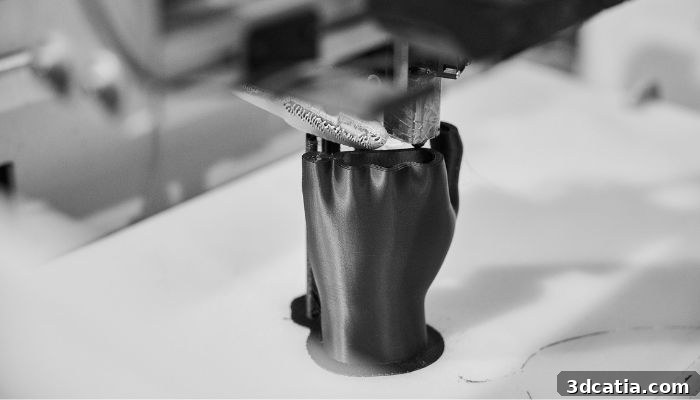
Vertex Group began by using FDM for 3D printing mannequins and props.
That company is Vertex Group, and the platform that emerged is L3AD: a digital factory service launched in 2025 that gives industrial customers access to a distributed network of over 800 printers across China and Europe—without requiring capital investment in equipment. To understand L3AD, it helps to revisit 2020, when Vertex set a new benchmark by scaling up 3D-printed mannequins and props for commercial production.
A Mannequin Industry at a Crossroads
Mannequin manufacturing historically depended on high-volume runs of standardized models produced with molds. As brands shifted toward more frequent collections, increased customization, and stronger sustainability commitments, the traditional model revealed three major shortcomings:
- Cost inefficiency for small batches: mold-based production becomes uneconomical as volumes shrink.
- Environmental concerns: brands demanded more sustainable materials and processes.
- Speed and flexibility: retailers expected faster turnaround and greater design variety.
In 2020, Vertex owner Christoph Grebe, Director Thomas Wadle, and General Manager Francesco Spinoglio began searching for alternatives. Despite prevailing doubts about scalability, they focused on 3D printing as a potential solution.
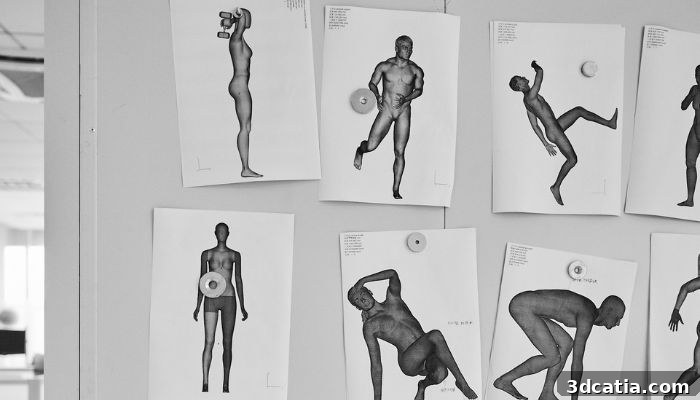
Vertex uses 3D printing to create small batches of specialized mannequins.
Adopting AM for Scaled Production
Vertex selected FDM as its primary manufacturing method because it supports large-format parts, minimizes material waste, and can remove finishing steps like varnishing from the process chain.
“This transition was far from easy,” Spinoglio recalls. “We came from a different manufacturing background and had to establish a dedicated 3D printing department—machines, materials, processes, and quality standards. It required months of trial and error, long nights, and constant iteration before we achieved reliable batch production.”
Material choice became the biggest technical hurdle. At the time, PLA was commonly used for prototyping but proved brittle for serial display production. Existing attempts to manufacture mannequins from PLA at scale failed because the material lacked long-term durability and impact resistance. With no suitable off-the-shelf option available, Vertex invested in developing its own material solution.
The PP Breakthrough
Vertex spent more than a year developing a proprietary polypropylene (PP) filament tailored for large-format FDM. The program covered raw material selection, formulation tuning, printer calibration, and production validation. The resulting PP delivers several advantages:
- Durability and flexibility needed for repeated handling and transport,
- Improved impact resistance compared with PLA and many standard ABS grades,
- Scalability for large-format parts,
- Reliable recyclability that aligns with brand sustainability goals.
PP’s recyclability and absence of styrene made it an attractive alternative to ABS for brands prioritizing circularity, giving Vertex a commercial edge as sustainability requirements tightened.
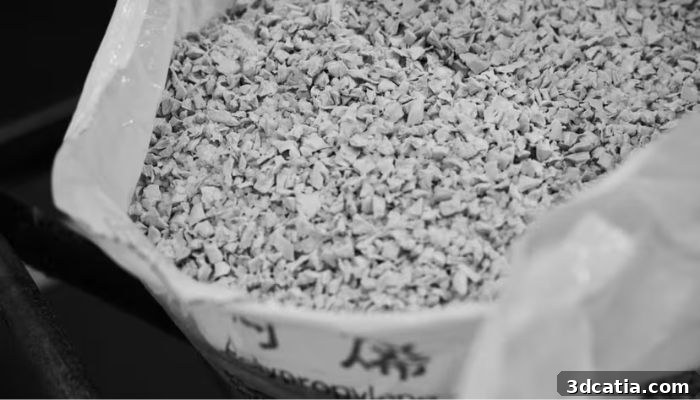
L3AD’s proprietary PP formulation is made from PCR (Post-Consumer Recycled) content.
From a Few Machines to Industrial Infrastructure
With a validated material and repeatable processes, Vertex focused on scale. Early scrap rates of roughly 45% were driven down to below 10% through iterative process improvements and tighter quality control. What began as a single-material, single-finish offering expanded to multiple materials and surface options, including matte and satin finishes. Production capacity increased more than tenfold as the printer fleet grew from a handful to hundreds of machines.
Vertex also developed TPU formulations, moved filament manufacturing in-house, optimized hardware and printing systems where necessary, and formalized production workflows. The result was an industrialized additive manufacturing operation capable of repeatable batch production with predictable quality and throughput.
Patrick Tristscher, Retail & In-Store Manager at Atomic, praised Vertex’s efficiency: “The design of the figures and desired poses were understood quickly, and the initial mockups were very close to the final result. The finished installations met our expectations and set a new benchmark for ski-action mannequins in sports retail.”
Beyond mannequins, Vertex expanded into props and display elements using selective laser sintering (SLS) and stereolithography (SLA) where those technologies offered advantages for detail or surface finish.
The Question That Created L3AD
By 2025, Vertex had proprietary materials, hundreds of printers, and standardized production and quality systems. The team asked a natural question: if these capabilities worked for mannequins, why not offer them to other industries? That idea led to L3AD, with Spinoglio appointed General Manager.
“L3AD is the natural evolution of what we built at Vertex,” Spinoglio explains. “Our mission is to turn 3D printing from a prototyping method into a scalable, industrial manufacturing solution accessible to multiple sectors.”
L3AD combines FDM, SLA, and SLS capabilities with the materials expertise and process knowledge Vertex developed over years of production. Customers interact with the platform through a centralized digital interface: they upload files to the cloud, choose materials and process parameters, track production in real time, and manage logistics and warehousing. L3AD also offers design support to reduce weight, improve structural performance, lower cost, and optimize parts for printability and aesthetics.
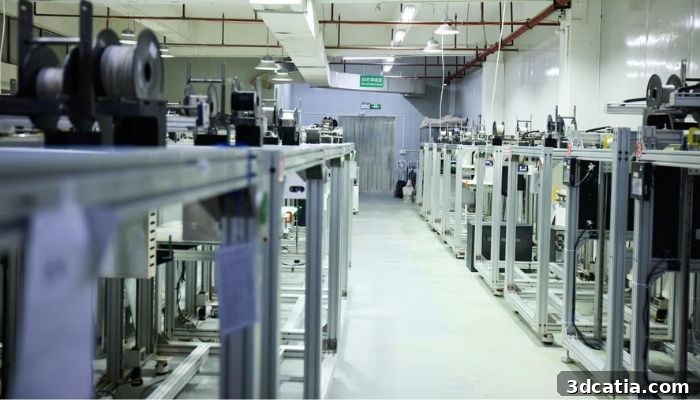
L3AD has hundreds of 3D printers across Europe and China.
An AI-driven instant quotation tool streamlines pricing and shortens the journey from design to production order. The network’s footprint in China provides direct access to raw materials, components, machinery, and skilled manufacturing talent, delivering cost and flexibility benefits that a Europe-only operation would find difficult to match.
“Our vertical integration sets L3AD apart,” Spinoglio adds. “Controlling the value chain from raw materials to finished parts allows us to deliver consistency, speed, and cost-efficiency at scale.”
The mannequin origin story remains a core proof-of-concept for L3AD: demonstrating that additive manufacturing can be structured, repeatable, and production-ready. “Our goal is to make additive manufacturing behave like a real factory—scalable, reliable, and application-driven,” Spinoglio says.
*All Photo Credits: L3AD / Vertex