

Navigating Intellectual Property Law in 3D Printing: A Comprehensive Guide to Copyright, Patents, and Future Reforms
The rapid advancements in additive manufacturing, commonly known as 3D printing, have brought unprecedented innovation across various sectors, from aerospace and healthcare to consumer goods and hobbyist communities. However, this dynamic industry also presents a complex landscape of intellectual property (IP) law considerations at every level. These range from individual 3D printing enthusiasts sharing file designs online, who must understand and respect copyright principles, to multinational corporations rigorously protecting their groundbreaking scientific discoveries with patents and their brand identities with trademarks.
The impact of these legal frameworks is not uniform. Entities with a significant stake, whether monetary or otherwise, in their intellectual creations face substantial repercussions if they fail to comply with regulations. There’s a persistent debate within the industry: many individuals and smaller organizations argue that current IP laws sometimes disproportionately favor large companies, potentially hindering innovation and access for smaller players and independent creators. This perception fuels calls for reform aimed at creating a more equitable and just industry landscape. This article will delve into the various perspectives surrounding these concerns, examining the roles of individuals, institutions, and the legal mechanisms involved in this evolving debate.
To thoroughly understand intellectual property’s intricate relationship with 3D printing, it’s essential to first establish clear definitions of the key terms. The World Trade Organization (WTO) succinctly defines intellectual property as “the rights given to persons over the creations of their minds.” This broad definition encompasses two primary categories: copyright, which grants ownership rights to original artistic, literary, and design creations (applicable to individuals or companies where the creation is part of an employment role), and industrial intellectual property, which covers vital elements such as trademarks, patents, and trade secrets. Let’s explore each of these in more detail to grasp their specific meanings and applications within the 3D printing ecosystem.

Photo credit: Getty
An Overview Of Key Intellectual Property Terms in 3D Printing
What is Copyright?
The origins of modern copyright law can be traced back to 16th-century Britain, with significant standardization efforts emerging from the Berne Convention, ratified in 1887. This international treaty saw 10 signatory states agree to automatically protect original creative works for a period of 50 years after the author’s death. More recently, regions like the European Union have extended this protection, offering copyright for 70 years post-mortem auctoris, granting both economic rights (control over the work’s use and remuneration) and moral rights (the right to attribution and the right to integrity of the work). Similarly, in the United States, works created after 1978 with a known author are typically protected under copyright for 70 years from the author’s death, often referred to as “life + 70.”
Crucially, these copyright laws directly apply to 3D printed designs and their underlying digital files. Copyright protection safeguards the aesthetic or artistic aspects of a design, such as the unique shape of a decorative figurine, a sculpture, or an intricate pattern. However, it’s important to distinguish that copyright generally does not protect functional objects or the purely utilitarian components of objects. These “useful” aspects are typically the domain of other intellectual property forms, such as patents and trade secrets, which provide protection for inventions and manufacturing processes. This distinction is particularly vital in 3D printing, where designs often blend aesthetic appeal with practical functionality.
Industrial Production: Patents
Beyond creative works, intellectual property law extensively covers industrial production through patents. A patent is a powerful form of protection granted for inventions that are novel, non-obvious, adequately described, and clearly claimed by the inventor. These inventions can include machines, manufacturing processes, chemical compositions, and even certain software. The concept of modern patents can be traced back to a grant in Florence in 1421. Today, patents are ubiquitous across manufacturing industries, playing a particularly critical role in the rapidly advancing field of 3D printing.
Once a patent application is approved by the relevant overseeing organization, the inventor gains exclusive rights for typically 20 years from the filing date. During this period, others must obtain a license from the patent holder to make, use, or sell the invention. This significant protection is granted in exchange for the invention’s public disclosure. This disclosure requirement ensures that new knowledge enters the public domain, fostering further innovation once the patent expires.
Patents are designed to be mutually beneficial. They provide a strong monetary incentive for creators and companies to invest in research and development, knowing their innovations will be protected. Simultaneously, the obligatory publication of patent details allows external researchers and developers to build upon existing knowledge, preventing the need to “reinvent the wheel,” as articulated by the World Intellectual Property Organization (WIPO). While national patents are specific to a country, parties seeking broader international protection can file a single application under the Patent Cooperation Treaty (PCT), administered by WIPO. This streamlined application applies to over 150 Contracting States, including major economies like the US, Canada, most of Europe, and China – a key player in the global 3D printing market.
Organizations like WIPO and its European counterpart, the European Patent Office (EPO), were established in the 1980s to simplify and harmonize the patent process globally. Many leading 3D printing firms today leverage the PCT to secure patent protection across multiple countries. This includes solution manufacturers such as Stratasys and General Electric, as well as companies that integrate these solutions into their products, like Boeing and Airbus, all benefiting from robust patent portfolios to safeguard their technological advantages.
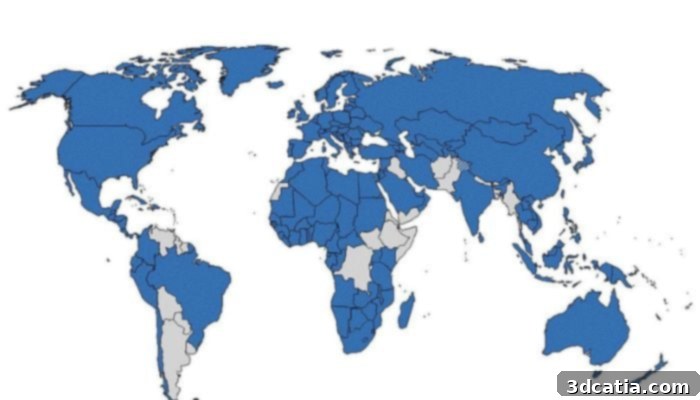
WIPO Patent Cooperation Treaty member states as of 2021. (Photo credit: WIPO)
Trade Secrets
For companies looking to protect innovations that may not qualify for patent protection, or those that are best kept confidential indefinitely, trade secrets offer an alternative. A trade secret refers to any confidential business information that provides an enterprise with a competitive edge. This can include formulas, practices, designs, instruments, patterns, commercial methods, or compilations of information. Unlike patents, which require public disclosure, trade secrets rely on secrecy. They can be legally protected through robust contracts such as Non-Disclosure Agreements (NDAs), which bind parties to maintain confidentiality.
Trade secrets hold several advantages over patents: they are cost-free as no registration is required, and their protection can theoretically last indefinitely, as long as the information remains secret and reasonable steps are taken to protect it. A classic example outside of 3D printing is the Coca-Cola recipe, which has remained a closely guarded secret since 1891. Within the 3D printing industry, NDAs are commonly employed by service bureaus, which often handle proprietary designs and sensitive manufacturing processes for their clients. These agreements are crucial for ensuring that client innovations remain confidential, preventing unauthorized disclosure or use of valuable intellectual property.
Trademarks
Another crucial aspect of intellectual property law is trademarks. A trademark is a distinctive sign, design, or expression that identifies products or services originating from a specific source, differentiating them from those of other entities. Trademarks are typically owned by the company that uses the mark and serve to protect brand identity, build customer recognition, and prevent consumer confusion. They can be words, logos, slogans, or even sounds or colors.
A well-known example in the 3D printing field illustrates the power and longevity of trademarks: FDM (Fused Deposition Modeling). While FDM is now colloquially used to describe a popular 3D printing technology, the term was actually registered as a trademark by Stratasys in 1991, following its development by co-founder Scott Crump. Despite the core patent for FDM expiring in 2009, the trademark remains active. This means that, technically, other firms should avoid using “FDM” and instead opt for generic terms like “FFF” (Fused Filament Fabrication) or “extrusion” to describe similar technologies, to prevent trademark infringement. Should such infringement occur, the trademark owner (the plaintiff) can file a lawsuit seeking monetary damages and injunctions to cease unauthorized use. This scenario underscores how trademarks continue to protect brand equity and influence market terminology long after patents have expired.
Copyright Law and its Impact on 3D Printing Creators
Copyright law frequently intersects with the activities of individual makers and designers in the 3D printing world. This is particularly evident on popular design file hosting sites such as Thingiverse, Cults, MyMiniFactory, and Printables. These platforms have experienced a significant surge in popularity in recent years; for instance, Thingiverse saw its user base grow from 2.3 million to 6.2 million between 2018 and 2022, demonstrating the widespread adoption of 3D printing among the general public.
On these sites, creators often offer their digital design files under various licenses, with Creative Commons (CC) being a prominent choice. Creative Commons licenses are a suite of public copyright licenses managed by a non-profit organization of the same name and are recognized globally. These six standardized licenses provide creators with a flexible way to explicitly define the legal rights others have to use their work, allowing them to share their creations while retaining control. For the context of 3D printing websites, these licenses dictate how mesh files, from which physical prints can be made, can be used, shared, and adapted.
Creators can specify whether to permit commercial use of their designs, allow adaptations (or “derivatives”), and under what conditions. Creative Commons Australia even offers an interactive flowchart to help copyright holders select the most appropriate license based on their sharing preferences. This empowers individuals to tailor their IP protection to their specific needs and goals.
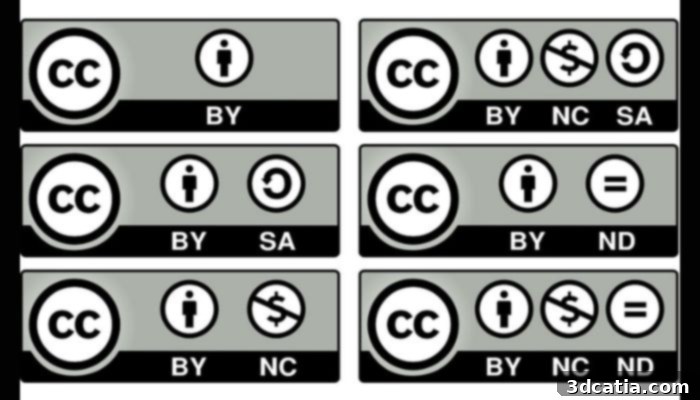
Creative Commons licenses. (Photo credit: Systeme D/Creative Commons)
It’s crucial to consider the broader context: millions of individuals utilize these 3D printing file websites, and in the vast majority of cases, copyright laws are respected without incident. We spoke to Andrew Stockton of Titancraft, a 3D modeling site and one of Thingiverse’s top creators in terms of downloaded files. He explained his approach to choosing Creative Commons licenses: “If I made the object for fun, I use CC0 or Attribution license. If I’m not planning on making money from it, I figure let people do what they want with them. If it’s related to my business (gaming miniatures) I use the No Commercial license.” This highlights how personal or commercial motivations directly influence licensing choices.
As Mr. Stockton’s insight illustrates, intellectual property laws impact individuals in 3D printing differently based on their specific niche and objectives. For him, whose gaming miniatures are valued more for customization potential than the intrinsic value of the raw file, unauthorized use without attribution is less impactful. However, for a business model centered on selling exclusive design files, copyright infringement becomes a far more significant threat. The degree of one’s investment and reliance on their designs directly correlates with the perceived gravity of IP violations.
Conversely, the user of a 3D design file may face varying levels of concern depending on the entity that originally created it. Users are likely to exercise far greater caution and seek explicit licensing when utilizing material from a large corporation compared to an individual creator. This dichotomy is frequently observed: in 2017, Disney garnered significant attention after demanding the removal of Star Wars-related files from Thingiverse, and in 2022, Honda made a similar request to 3D printer manufacturer Prusa concerning files bearing Honda’s brand. Nevertheless, a casual browse of Thingiverse today still reveals numerous files featuring trademarked logos, suggesting that the enforcement and application of IP law may not always be uniform across all users and situations.
When Copyright Infringement Allegations Led to Legal Action
As the popularity of 3D printing design platforms has grown, so too have intellectual property concerns. While most everyday file usage occurs without incident, there have been high-profile situations involving complex legal battles centered on copyright law within the 3D printing community. A significant scandal erupted in 2017 when a company named Just 3D Print downloaded multiple STL files from Thingiverse and subsequently uploaded them as listings on eBay for commercial sale. When the original creators of these files requested their removal, Just 3D Print controversially asserted that the designs were now in the public domain.
This contentious situation escalated into a series of lawsuits filed by Just 3D Print against various media outlets and industry players, including Stratasys, 3DR Holdings, and TechCrunch. Just 3D Print accused these entities of defamation, arguing that their coverage of the controversy, which described Just 3D Print’s actions as copyright infringement, had caused substantial financial harm. Specifically, Just 3D Print alleged that articles by TechCrunch and Stratasys led to the loss of a product line that would have generated an estimated $2,000,000 per month. Ultimately, these defamation lawsuits were largely decided against Just 3D Print, with the exception of the case against Stratasys, which saw a different outcome.
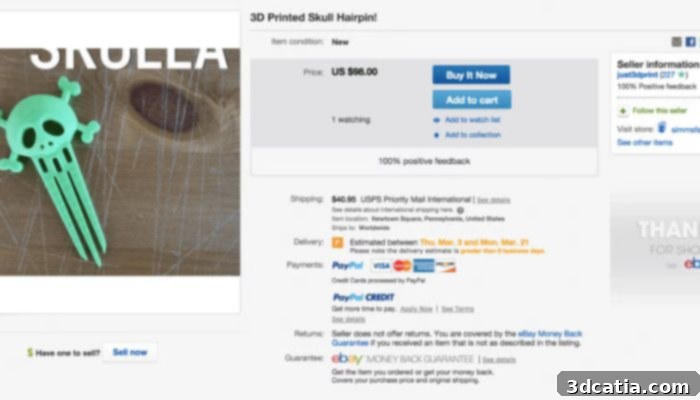
One of Just 3D Print’s ebay listings
According to Michael Weinberg, a former lawyer for Shapeways and Vice President of PK Thinks from the Public Knowledge foundation, these particular cases were not directly adjudicated on the fundamental question of whether Just 3D Print had infringed on copyright. In the case against TechCrunch, the defense successfully argued that their coverage constituted protected opinions, not defamation, and also raised statute of limitations issues. For 3DR Holdings, the court found no defamation, and even if there were, their actions were deemed “unrelated” to any harm experienced by Just 3D Print. This complex legal saga clearly demonstrates that even beyond intellectual property disputes, firms can face legal challenges based on statements of opinion. It also illustrates how swiftly a situation can spiral from accusations of potential copyright infringement into protracted and costly allegations of defamation, highlighting the multifaceted nature of digital age legal conflicts.
The State of Patent Law in the 3D Printing Industry
As previously discussed, patent law constitutes a cornerstone of innovation within industrial 3D printing. The industry’s foundational patent was granted in 1984 to Chuck Hull of 3D Systems Corporation for his Stereolithography Apparatus (SLA) technique, which marked the birth of commercial 3D printing. Since this pioneering moment, the number of patents in the additive manufacturing sector has escalated dramatically, as companies fiercely seek to protect their cutting-edge innovations and emerging technologies.
The growth in 3D printing patents underscores the sector’s intense research and development. Between 2015 and 2018, additive manufacturing patent applications surged at an average annual rate of 36%, a pace more than ten times faster than the average yearly growth of patent applications at the European Patent Office (EPO) during the same period (3.5%). By 2020, over 800 AM-related patents were filed, signifying sustained innovation. Historically, between 2010 and 2018, patent applications were most concentrated in the health sector, with 907 applications in 2018, followed by energy and transportation, with 436 and 278 applications respectively in the same year. These statistics highlight the diverse applications and strategic importance of 3D printing across critical industries.
This robust patent landscape is shaped by the contributions of numerous firms, with General Electric, United Technologies, and Siemens consistently ranking among the top three in terms of patent filings globally. In the USA specifically, the leading businesses for patent applications in 2020 included Hewlett Packard Development (HP) with 470 filings, General Electric (GE) with 331, and Kinpo Electronics with 273. These figures demonstrate the substantial investment and strategic focus that major industrial players place on securing their innovations within the highly competitive 3D printing market.

Chuck Hull, the inventor of the first 3D printer. (Photo Credit: National Innovators Hall of Fame/3D Systems)
How Does Patent Law Affect Businesses in 3D Printing?
With the continuous emergence of new 3D printer manufacturers and startups developing novel technologies, patent law remains a significant force within the industry, yet its profound effects on businesses are often underestimated. Unlike automatic protections such as copyright, patents must be actively applied for – a process that incurs substantial costs. Legal resource BitLaw estimates the cost of obtaining a US patent to be between $15,000 and $20,000. Essential fees within this process include the cost of conducting thorough searches of patent databases to ensure the invention’s true originality (identifying “prior art” that might invalidate a claim). Additionally, administrative fees are an inherent part of securing official patent registration. These sometimes prohibitive costs mean that, in theory, only truly groundbreaking and economically worthwhile inventions will pursue patent protection. However, this also creates a significant barrier for smaller firms and startups, making it challenging for them to protect their innovations using formal intellectual property laws.
One of the most widely recognized cases of patent infringement allegations in the 3D printing industry was the 2012 dispute between 3D Systems and Formlabs. 3D Systems, a pioneer in the field, accused Formlabs of infringing on several of its patents, notably a stereolithography patent granted to 3D Systems in 1997. This high-stakes legal battle ultimately concluded with a comprehensive settlement agreement. Under the terms, 3D Systems granted Formlabs a license, allowing them to manufacture and sell Formlabs products under the disputed 3D Systems patents. In exchange, Formlabs agreed to pay a royalty of 8.0% of the net sales of its products for the duration that the license remained active. This resolution highlights how licensing agreements are often a pragmatic outcome in complex patent disputes, allowing innovation to continue while compensating the original patent holder.
What Steps Do Firms Take To Protect Their Inventions?
Beyond direct patent litigation, firms in the 3D printing sector employ various strategies to safeguard their intellectual property. According to US-based 3D printer manufacturer Desktop Metal, asserting patent rights carries the inherent risk of third-party lawsuits. If such a legal challenge goes against the firm, it could result in enormous costs and, crucially, enable competitors to freely use the firm’s proprietary technology. Consequently, some companies turn to alternatives or complementary strategies to patents, including carefully managing their production locations and supply chains to protect classified information. Desktop Metal’s annual report for the fiscal year 2020 explicitly stated: “Key consumables used in various print processes, such as proprietary resins and binders, are developed and produced either in-house or with core partners to ensure protection of intellectual property and production that meets our formula and specifications.” This illustrates a proactive approach to IP protection through operational control and strategic partnerships.
Firms also exercise extreme caution when entrusting their trade secrets to external service providers. We spoke to Christina Perla, co-founder of MakeLab, a prominent 3D printing service bureau in New York. She explained that while being a service provider typically doesn’t create complications concerning copyright – as the original creators retain rights to their files regardless of MakeLab’s manufacturing role – a significant portion of the files MakeLab handles are considered highly confidential trade secrets. To mitigate the risk of defrauding or unauthorized disclosure, MakeLab implements stringent measures, including requiring Non-Disclosure Agreements (NDAs) where necessary. Furthermore, these sensitive files are shared only with relevant, authorized employees, reinforcing the importance of internal controls. The extensive lengths to which these 3D printing firms go to protect their intellectual property underscore the critical value placed on secrecy and trade secrets as an unofficial yet potent method of safeguarding innovative ideas within the industry.
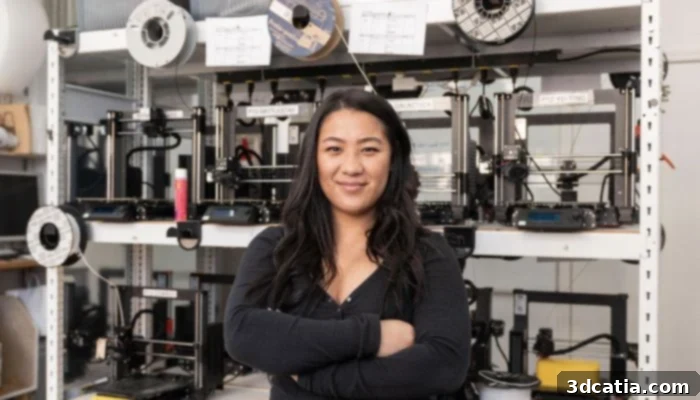
Christina Perla is head of Makelab in New York (photo credit: Downtown Brooklyn)
It’s also important to note that firms can face severe legal consequences not only from their competitors but also from government regulatory bodies. In a notable case, various US government departments recently imposed substantial fines totaling up to $27 million on the 3D printing service bureau 3D Systems. The penalties were for nineteen violations of the Export Administration Regulations (EAR), stemming from the company’s sharing of design documents, blueprints, and technical specifications with its then-subsidiary in China to facilitate 3D printing. John Sonderman, Director of OEE, commented on the case, stating, “Today’s enforcement action highlights a troubling trend of U.S. companies offshoring 3D printing operations and ignoring the export controls on the technical data sent overseas to facilitate the 3D printing.” This incident serves as a stark reminder that intellectual property protection also intertwines with national security and export control regulations, adding another layer of complexity for businesses operating globally.
Improvement and Reform: Organizations and Individuals Advocating for Change
The existing intellectual property laws, not just in the context of 3D printing, are continually scrutinized, and numerous key organizations actively advocate for reform. The aforementioned Creative Commons, for example, is a strong proponent of copyright law reform. Its fundamental vision is to facilitate “universal access to research and education and full participation in culture,” by making public access to culture and knowledge easier. To achieve this, it aims to help overcome “legal obstacles” inherent in traditional copyright. This philosophy underpins its deliberate choice to offer licenses that are free, simple, and standardized, encouraging broad sharing and collaboration. Another influential group with similar objectives is Public Knowledge, a US-based non-profit organization. Public Knowledge champions freedom of expression and an open internet by advocating for consumer rights and fostering creativity through a balanced approach to copyright law, seeking to ensure that IP protections do not unduly restrict public benefit.
Unlocking 3D Printers: A Campaign for User Freedom
The desire for reform extends beyond copyright licenses, with specific movements emerging to address perceived restrictions within 3D printing hardware. Michael Weinberg, whose extensive profile covers many 3D printing legal concerns, has been a central figure in the movement to “unlock 3D printers.” This initiative seeks to free machines from proprietary constraints that limit them to working only with certain materials or consumables. The goal is for printers to be restricted solely by practical capabilities rather than by a company’s preset, often profit-driven, regulations.
In the United States, every three years, the US Copyright Office reviews petitions for exemptions to the regulations of Digital Rights Management (DRM), specifically outlined in Section 1201 of the 1998 Digital Millennium Copyright Act (DMCA). This review process allows groups with compelling reasons to seek legal permission to bypass these digital locks. In 2017, Michael Weinberg filed a petition to lift restrictions preventing 3D printer users from “unlocking” their machines to use their preferred choice of materials. He framed this advocacy as a desire “to eliminate copyright law from any discussion about third-party materials in 3D printers because copyright law does not belong there,” arguing that material compatibility should be a technical, not a legal, matter.
In 2018, Stratasys, a major industry player, formally opposed Weinberg’s petition. Among their arguments, Stratasys contended that closed systems were necessary to “mitigate risks involved in the use of a specific material, such as fire hazards or hazardous fumes.” Despite this opposition, the ruling in favor of Mr. Weinberg’s petition to remove limitations preventing users from “unlocking” their 3D printers was extended in 2020. This means that in the USA, users cannot be sued for using their own materials on their 3D printers. However, there’s a crucial caveat: this exemption is available “solely for the purpose of using alternative material, not for the purpose of accessing design software, design files, or proprietary data.” This demonstrates a nuanced legal attempt to balance consumer freedom with legitimate IP concerns.
The RepRap Movement: Offering Democratized 3D Printing Through Open Source
While organizations like Creative Commons critique copyright law, other movements actively challenge the lack of democratization in manufacturing and technology. A prime example is the Maker Movement, a social trend that emphasizes the development, sharing, and creation of designs and physical objects. Within this ethos, projects like RepRap, founded at the University of Bath by Adrian Bowyer in 2005, stand out. RepRap is dedicated to creating freely available, open-source 3D printers that are capable of self-replication – meaning they can print most of their own components. These machines are licensed under the GNU General Public License (GPL), a powerful open-source license that ensures the freedom to run, study, change, and distribute the software and hardware. This technology has been a cornerstone for companies like Prusa Research, which built its success on open-source principles.
Mr. Bowyer’s primary motivation for the RepRap project, beyond pure scientific curiosity, was to empower individuals by granting them the ability to build and create for themselves. His choice of the GPL was strategic because it “employs copyright to facilitate opening the sources of a project in a way that obliges subsequent developers also to open them similarly,” fostering a truly collaborative and openly accessible ecosystem. The RepRap project notably did not face significant patent controversy despite utilizing FDM/FFF technology. This is largely because, under European patent law, conducting research into patented technology can be considered fair use or falls under specific research exemptions, allowing for exploration and development without immediate infringement.
Interestingly, according to Mr. Bowyer, he was the one who coined the term FFF (Fused Filament Fabrication) after a request from Stratasys to avoid using their trademarked term FDM. The enduring popularity and influence of the RepRap movement vividly demonstrate the widespread appeal of a democratized 3D printing world among consumers and smaller innovators, if not always among large corporations. It also proves that such democratization is achievable with relative ease, thanks to existing legal exceptions and the availability of suitable open-source licenses. A further non-profit example showcasing similar aims is the Projet FabricAr3v, a multidisciplinary consortium funded by the EU. This project leverages a Metal Injection Molding-like technology and uses granules as a material, aiming to provide lower-cost machines that are accessible to organizations such as SMEs, FabLabs, and universities, further democratizing additive manufacturing.
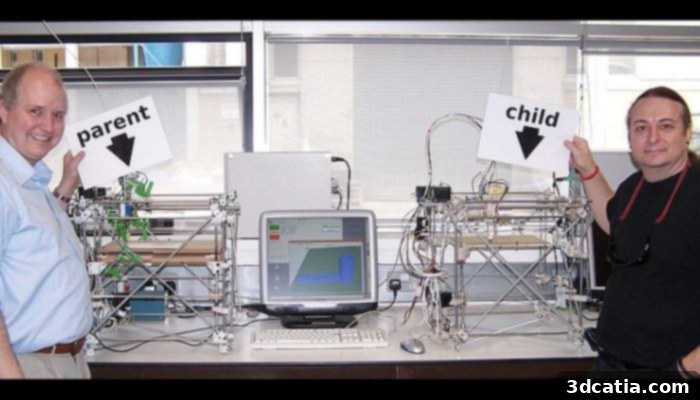
Adrian Bowyer (left) and Vik Olliver(right) with a parent RepRap machine, made on a conventional rapid prototyper, and the first complete working child RepRap machine, made by the RepRap on the left. (Photo credit: RepRap)
Beyond copyright law, patent law in 3D printing also faces its share of criticism and detractors. There are growing concerns among legal professionals regarding the perceived low standard for granting patents. According to Dr. Lukaszewicz, in her PhD law thesis titled ‘The Maker movement meets patent law,’ nearly half of all registered patents may actually be non-valid – meaning they do not meet the rigorous standards required for legitimate patent registration. Dr. Lukaszewicz’s thesis outlined her commitment to working on patent reform within her expertise as a legal expert. Many critics argue that an overabundance of questionable patents can stifle innovation, creating “patent thickets” that make it difficult for smaller companies to develop new processes or products without infringing on existing, potentially invalid, patents. This ultimately risks suffocating smaller companies out of the market, as they lack the resources to challenge these patents or develop proprietary processes around patented technologies.
Findings: Is It Time for Intellectual Property Reform in 3D Printing?
Intellectual property law is an inescapable and integral part of the 3D printing landscape, affecting everyone from hobbyists and small businesses to major industrial players. In theory, these laws are meticulously designed to protect innovation, incentivize investment in research and development, and foster creative pursuit. In practice, however, the application of IP law in this rapidly evolving digital manufacturing sector frequently leads to complex and often contentious legal situations. Individuals ranging from small-scale mesh file designers to massive multinational conglomerates can find themselves entangled in disputes, facing the risk of costly legal action.
A recurring critique is that the existing legal framework often appears to rule in favor of larger companies, with some rulings perceived as overly hostile to open creativity and collaborative innovation, a concern frequently voiced by organizations like Creative Commons. In response to these perceived imbalances, various individuals and advocacy groups, such as Public Knowledge, are engaged in long-term battles for greater open access to creative works. They tirelessly campaign for the modification and modernization of copyright laws to better serve public use and promote a more equitable sharing economy. Within the commercial 3D printing industry, there remains a strong emphasis on the importance of robust intellectual property protection for innovation and commercial success. This often leads to highly controversial and nuanced cases and rulings, where the desire for protection clashes with calls for openness and accessibility.
Overall, the application of intellectual property laws in the dynamic world of 3D printing represents a deeply complex and nuanced issue. As additive manufacturing continues its rapid expansion and integration into more facets of global industry and daily life, the importance and complexity of these legal frameworks are only set to grow. Striking a delicate balance between protecting legitimate innovations and fostering a vibrant, accessible, and democratic creative ecosystem remains the central challenge, indicating that the debate over IP reform in 3D printing is far from over.
What are your thoughts on the current intellectual property laws as they apply to 3D printing? We invite you to share your perspective in a comment below or join the conversation on our LinkedIn, Facebook, and Twitter pages! Don’t forget to sign up for our free weekly Newsletter here to get the latest 3D printing news delivered straight to your inbox. You can also find all our videos on our YouTube channel.