
Revolutionizing Cultured Meat Production: The Role of Low-Cost 3D Printing and Sustainable Scaffolds
The global demand for meat continues to surge, placing immense pressure on conventional animal agriculture. This industry is a significant contributor to greenhouse gas emissions, deforestation, land degradation, and water pollution, while also raising considerable ethical concerns regarding animal welfare. In response to these pressing challenges, lab-grown meat, also known as cultured meat (CM) or cellular agriculture, has emerged as a groundbreaking alternative. This innovative food source is produced by cultivating animal muscle cells in vitro, offering the nutritional benefits of traditional meat without the environmental and ethical drawbacks associated with industrial farming. The potential of cultured meat to transform our food systems towards a more sustainable and ethical future is undeniable, yet significant hurdles remain, particularly in terms of scalability, cost-effectiveness, and achieving a texture that truly replicates conventional meat.
Addressing these critical challenges, a pioneering team of scientists from the National University of Singapore, the National University of Singapore Suzhou Research Institute in China, and Xi’an Jiaotong-Liverpool University, China, has unveiled a novel method to produce cultured meat with an appealing texture. Their breakthrough centers on the development of new low-cost 3D printing inks, which serve as innovative scaffolding materials for cell growth. This research represents a significant leap forward in making cultured meat a viable and accessible option for consumers worldwide, moving closer to a future where meat can be produced sustainably and ethically on a mass scale.
The Crucial Role of Scaffolds in Cultured Meat Development
At the heart of this new approach is the meticulous creation of 3D scaffolds designed to support the proliferation and differentiation of skeletal muscle cells. In their study, the researchers successfully cultivated both bovine (beef) and porcine (pork) muscle cells on these intricate 3D structures. Scaffolds are fundamental to the successful development of cultured meat because they mimic the extracellular matrix (ECM) found in natural muscle tissue, providing the necessary structural integrity and a conducive environment for cells to grow, align, and mature into muscle fibers.
The primary function of these scaffolds extends beyond mere structural support. They play a pivotal role in maintaining the product’s overall integrity and are instrumental in achieving the ideal texture of the cultured meat. By carefully separating cell layers, scaffolds ensure uniform growth and prevent cells from clumping together, which is essential for developing a meat-like consistency. Given their direct interaction with edible cells and their eventual integration into the final product, it is paramount that these scaffolds possess specific characteristics. Crucially, they do not require high tensile strength; instead, they must be fully edible and capable of being absorbed into the cultured meat as it develops. This ensures that the final product is not only structurally sound but also safe and pleasant to consume.
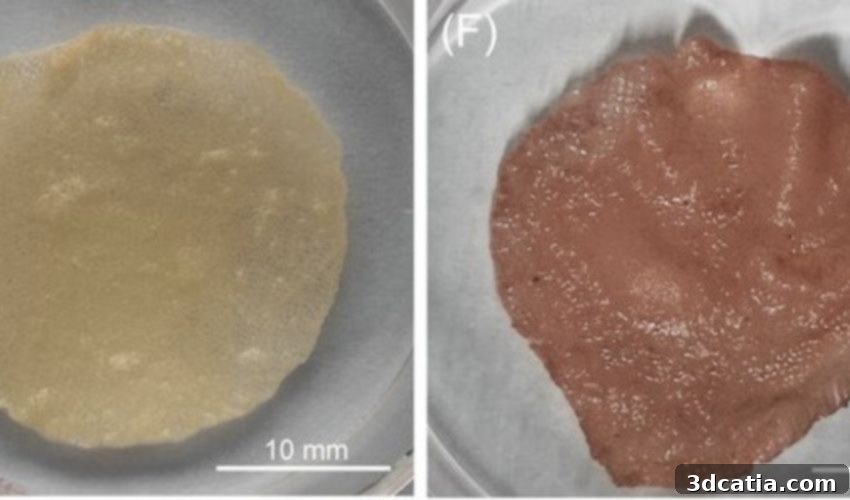
The researchers particularly focused on developing fibrous scaffolds due to their remarkable ability to “resemble the in vivo muscle tissue structure.” This biomimicry is vital for guiding cell organization and promoting the development of authentic muscle architecture, thereby enhancing the texture and mouthfeel of the cultured meat. To produce these fully edible fibrous scaffolds, the team ingeniously selected cereal prolamins, a group of plant storage proteins commonly found in rye and other cereals. This choice is significant as it aligns with the broader goal of reducing reliance on animal-derived components in cultured meat production. Furthermore, to enhance the visual resemblance to traditional meat, the scaffolds were subtly colored with beet extract, demonstrating an understanding of consumer perception and acceptance as critical factors for market success. This innovative use of plant-based materials for scaffolding not only makes the process more sustainable but also potentially lowers production costs and broadens the appeal of cultured meat to a wider consumer base.
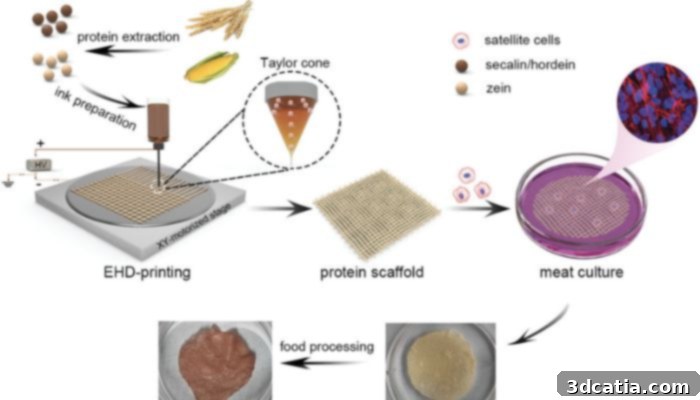
Photo credit: Jie Sun/Xi’an Jiaotong-Liverpool University
Electrohydrodynamic (EHD) Printing: Precision for Cultured Meat
To fabricate these highly specialized fibrous scaffolds, the researchers employed Electrohydrodynamic (EHD) printing, an advanced manufacturing technology known for its exceptional precision and versatility. EHD printing stands out as a high-resolution printing method, capable of creating intricate patterns and fine structures that are essential for mimicking the complex extracellular matrix of muscle tissue. Unlike conventional extrusion-based 3D printing, which often operates at larger scales, EHD printing offers unparalleled control at the micro and nanoscale, making it ideal for the delicate requirements of cellular agriculture.
The mechanism behind EHD printing is fascinating. The liquid ink, containing the scaffold material (in this case, cereal prolamins), is precisely driven by an electric field. When an electric field is applied to a polarizable liquid, it causes the mobile ions within the liquid to accumulate at the surface. This accumulation of charge induces powerful electric forces that act upon the meniscus – the curved surface of the liquid at the nozzle. These forces cause the meniscus to deform into a characteristic conical shape, known as a Taylor cone. As the electric field strength increases, the electrostatic repulsion from the accumulated surface charge overcomes the surface tension of the liquid, leading to the emission of a fine jet or stream of liquid from the tip of the Taylor cone. This process allows for extremely precise deposition of the printing ink. The remarkable accuracy of EHD printing is evident in the fact that deposited droplets can be as minute as 240 nanometers, with spatial accuracy maintained within hundreds of nanometers. This level of control is crucial for constructing scaffolds with the highly organized, fiber-like structures necessary to guide the growth and alignment of muscle cells, ultimately contributing to a more realistic and desirable texture in the final cultured meat product. The ability to achieve such fine resolution at a relatively low cost further underscores the disruptive potential of this technology for scaling up cultured meat production efficiently and economically.
Why This Research Matters: Paving the Way for Sustainable and Affordable Cultured Meat
The implications of this research are profound, extending far beyond the laboratory. The discovery that these novel fibrous scaffolds, created from specially formulated 3D printing inks, are highly effective for producing cultured meats marks a pivotal moment for the cellular agriculture industry. Professor Sun from Xi’an Jiaotong-Liverpool University eloquently summarized the immense significance of this experiment, stating, “This is a novel and disruptive idea to mass produce cultured meat.” This statement highlights the potential for this technology to fundamentally change the paradigm of meat production, moving it from niche to mainstream.
One of the most compelling aspects of this innovation lies in its sustainable approach to resource utilization. Professor Sun further elaborated on this, explaining, “Using nutrients from food waste to print scaffolds not only uses and increases the value of the food waste but also alleviates the pressure on the environment from animal agriculture.” This circular economy model is a game-changer. By repurposing food waste – which is a major environmental problem in itself – into valuable nutrients for scaffold production, the process addresses two critical sustainability challenges simultaneously. It reduces the vast quantities of organic waste that often end up in landfills, generating methane and other greenhouse gases, while simultaneously providing a low-cost, sustainable input for cultured meat. This drastically cuts down the environmental footprint of cellular agriculture, aligning it perfectly with global efforts to combat climate change and resource depletion. The ability to create scaffolds from such sustainable and readily available sources makes the entire cultured meat production process significantly more eco-friendly and economically viable.
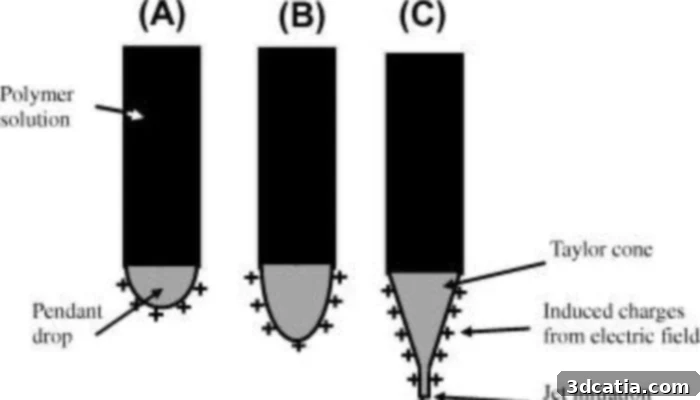
The process of EHD printing; (C) shows the nozzle ready to eject the ink. (Photo credit: Neil Basson/Free volume of electrospun organic-inorganic copolymers).
The economic viability of cultured meat has long been a major barrier to its widespread adoption. Currently, the prohibitive cost of cultured meat is largely attributed to the expensive nutrient media required to cultivate muscle cells, which often relies on animal-derived proteins, such as fetal bovine serum. Recognizing this, Professor Sun pointed out a crucial future direction: “Currently, one of the major reasons for the high cost of cultured meat is the nutrient medium for muscle cells, which is still from animal proteins. In the future, if suitable plant extracts can be found to supply nutrients, that will further reduce the cost of cultured meat, making it more affordable.” This vision underscores a pathway to dramatically reduce production costs, moving cultured meat beyond a luxury item and making it genuinely competitive with conventional meat in terms of price. Developing fully plant-based growth media would not only lower expenses but also eliminate remaining ethical concerns associated with animal-derived components, thereby broadening its appeal to vegetarians and vegans. This research, by offering a low-cost, sustainable scaffold solution, takes a critical step toward achieving this broader affordability goal, bringing the promise of sustainable protein closer to consumers.
Future Prospects and the Broader Landscape of Food 3D Printing
This groundbreaking experiment by the Singaporean and Chinese scientists fits into a wider landscape of innovation in food technology and 3D printing. The convergence of these fields is opening up unprecedented possibilities, from personalized nutrition to entirely new culinary experiences. For example, similar pioneering schemes include 3D Treats’ innovative use of FDM printing to create unique and original desserts, showcasing how additive manufacturing can revolutionize confectionery. Another notable project is Aleph Farms’ ambitious endeavor to produce 3D printed lab-grown steak, demonstrating the potential for precise control over the structure and texture of cultured meat products. These examples, alongside the current research, underscore a global movement towards harnessing 3D printing technology to address food security, sustainability, and consumer preferences.
The future of cultured meat, propelled by advancements like the low-cost 3D printing inks and EHD technology, holds immense promise. As research continues, the focus will likely expand to optimizing flavor profiles, scaling up production to industrial levels, and navigating the regulatory frameworks necessary for global market acceptance. Overcoming these challenges will be crucial for cellular agriculture to fulfill its potential as a sustainable, ethical, and delicious alternative to traditional meat. This research not only offers a viable path to more affordable and appealing cultured meat but also sets a precedent for how food waste can be ingeniously integrated into future food production cycles, leading to a truly circular and environmentally conscious food system.
What are your thoughts on these innovative 3D printing inks and their potential to transform the future of food? We would love to hear your perspective! Let us know in a comment below or connect with us on our Linkedin, Facebook, and Twitter pages. Don’t forget to sign up for our free weekly Newsletter here to get the latest 3D printing news delivered straight to your inbox! You can also find all our engaging videos on our YouTube channel. For more detailed information on this specific experiment, you can access the full research paper HERE.