
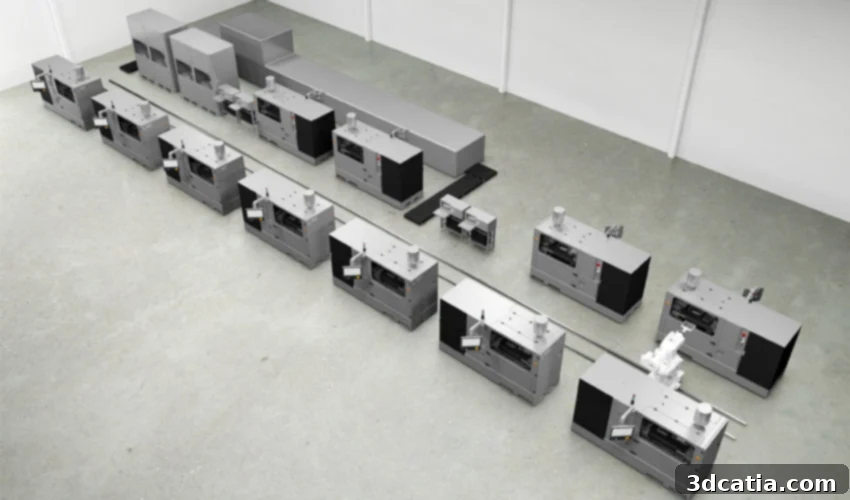
Digital Metal Supercharges Metal 3D Printing: DM P2500 Triples Production Speed for Industrial Manufacturing
Swedish manufacturing pioneer Digital Metal, renowned for its expertise in metal additive manufacturing, has unveiled a significant enhancement to its proprietary printing software. This groundbreaking upgrade empowers users of the DM P2500 machine to achieve an astonishing three times faster printing speed. Originally operating at 100 cm3/hour, this advancement promises to revolutionize production capabilities for manufacturers across various industries. This leap in performance will enable businesses to dramatically accelerate their production rates without compromising the exceptional quality that Digital Metal’s technology is known for. The company confirms that all newly manufactured DM P2500 machines will come equipped with this cutting-edge feature. Furthermore, for existing units already deployed in the field, an accessible upgrade kit will be made available, ensuring that all customers can leverage this substantial boost in productivity.
Speed has long been a critical bottleneck in the wider additive manufacturing sector. While 3D printing offers unparalleled design freedom and customization, the time required to produce complex parts can often span many hours, or even days, hindering its widespread adoption for high-volume industrial applications. This challenge is compounded by the potential for errors, which can further prolong manufacturing processes and drive up costs. Although various initiatives have emerged to address speed limitations, particularly in extrusion-based machines, metal printing processes, due to their inherent complexities, often present unique challenges. Professionals who utilize metal 3D printers, operating in demanding sectors like aerospace, automotive, and luxury goods, prioritize productivity, repeatability, and cost-effectiveness above all else. By delivering such a substantial software update, Digital Metal directly responds to these crucial industry needs, solidifying its commitment to advancing the capabilities of industrial metal additive manufacturing.
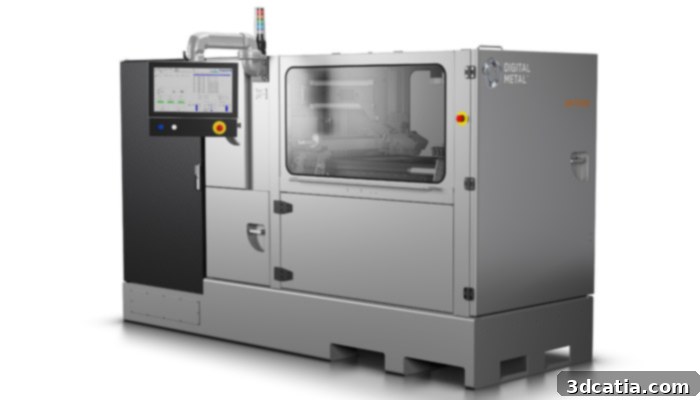
The DM P2500 metal 3D printer | Credits: Digital Metal
Unlocking Unprecedented Productivity in Metal Additive Manufacturing
The DM P2500 is engineered around the sophisticated binder jetting technology, a process recognized for its ability to produce highly detailed and complex metal parts. This machine boasts a generous print volume of 203 x 180 x 69 mm, offering ample space for creating a wide array of components. Coupled with an impressive resolution of up to 35 microns, the DM P2500 ensures exceptional precision and surface finish, crucial for demanding applications. A key advantage of binder jetting technology is its inherent ability to eliminate the need for printing supports. Unlike many other metal additive manufacturing processes, binder jetting forms parts within a bed of powder, which naturally supports the structure during printing. This unique feature dramatically shortens the overall manufacturing lead time by removing the laborious and time-consuming post-processing steps associated with support removal. Consequently, the DM P2500 already offered a highly efficient solution that met many of the stringent requirements of professional users seeking streamlined workflows. However, this new software update elevates the system’s capabilities even further, tripling the printing speed and opening up new avenues for industrial-scale productivity and throughput.
Addressing the Industry’s Demand for Speed and Efficiency
The pursuit of higher speeds in additive manufacturing is driven by a fundamental economic principle: reducing the cost per part. For industries where metal components are critical, such as aerospace, automotive, medical, and energy, faster production cycles directly translate to quicker product development, reduced time-to-market, and increased competitiveness. While traditional manufacturing methods like CNC machining and casting have established benchmarks for speed and volume, metal 3D printing offers unparalleled geometric complexity and customization. The challenge has always been to bring the speed of additive manufacturing closer to that of conventional methods without sacrificing its inherent advantages. Digital Metal’s latest software upgrade directly tackles this challenge. By boosting the DM P2500’s print speed threefold, the company empowers manufacturers to dramatically increase their throughput, making binder jetting a far more viable and attractive option for series production and larger batch runs where speed is paramount.
Alexander Sakratidis, Director of Sales and Marketing at Digital Metal, underscored the company’s unwavering commitment to continuous improvement: “We are constantly working to improve the performance of our printers so that our customers can work as cost-effectively as possible. This major upgrade allows us to achieve even higher production volumes without sacrificing component quality. We plan to continue to develop similar major upgrades twice a year.” This statement highlights Digital Metal’s proactive approach to innovation, ensuring their technology remains at the forefront of industrial metal 3D printing. The commitment to biannual major upgrades signals a robust product roadmap focused on delivering consistent value and enhanced capabilities to their global customer base, fostering long-term partnerships and enabling their clients to stay ahead in a rapidly evolving market.
Maintaining Quality and Precision at Higher Speeds
A common concern when increasing print speed in additive manufacturing is the potential compromise on part quality, dimensional accuracy, or material properties. However, Digital Metal asserts that this software upgrade achieves its impressive speed increase “without sacrificing component quality.” This is a testament to the sophistication of their binder jetting technology and the meticulous engineering behind their software. The DM P2500 utilizes advanced algorithms and precise control over the binder jetting process, ensuring that even at higher speeds, the deposition of binder and the subsequent sintering process maintain optimal conditions. This guarantees that printed parts exhibit the same high density, structural integrity, and surface finish that Digital Metal users expect. The company’s rigorous qualification processes for both their machines and materials ensure that faster production does not come at the expense of reliability or performance, which is paramount for critical applications in regulated industries.
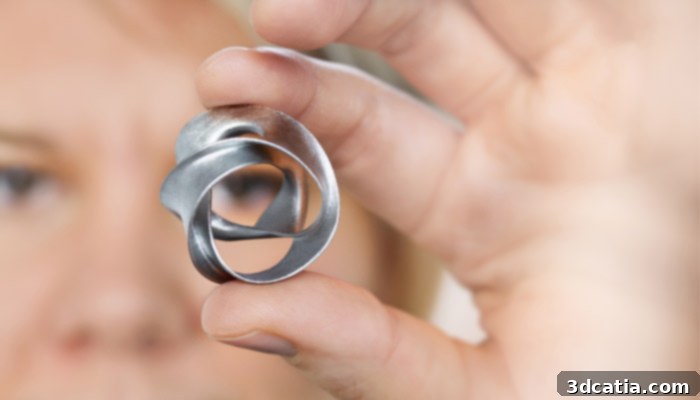
Example of a 3D printed metal part by Digital Metal | Credits: Digital Metal
Material Versatility and Sustainable Practices
Digital Metal’s DM P2500 is celebrated for its versatility in handling a range of high-performance metal powders. The compatible materials remain unchanged with this update, including various grades of steel, titanium, and specialized superalloys such as DM 625 and DM 247. This broad material palette allows manufacturers to produce parts with diverse mechanical properties, catering to the specific requirements of applications ranging from lightweight aerospace components to high-strength industrial tools and intricate luxury items. Steel offers excellent strength and cost-effectiveness, suitable for many industrial applications. Titanium, known for its exceptional strength-to-weight ratio and biocompatibility, is indispensable in aerospace and medical fields. Superalloys like DM 625 (Inconel 625) and DM 247 are crucial for high-temperature and corrosive environments, finding extensive use in gas turbines and power generation. This material flexibility, combined with the new speed capabilities, positions the DM P2500 as an incredibly adaptable tool for advanced manufacturing.
Beyond performance, Digital Metal is also a leader in promoting sustainable additive manufacturing practices. A significant environmental and economic advantage of their binder jetting process is the near 100% recyclability of unused powder. During the printing process, only a small amount of binder is used to create the green part, leaving the vast majority of the surrounding metal powder untouched and uncontaminated. This un-sintered powder can be almost entirely recovered, sieved, and reused for subsequent printing jobs. This significantly reduces material waste, lowers operational costs, and minimizes the environmental footprint of metal 3D printing. This commitment to sustainability aligns perfectly with modern industrial demands for eco-friendly production methods without compromising efficiency or output. For more in-depth information and the latest updates from Digital Metal, interested parties can visit the official news section on their website HERE.
Market Impact and Future Outlook for Metal AM
The tripling of print speed for the DM P2500 represents more than just an incremental improvement; it signifies a pivotal shift in the accessibility and economic viability of metal additive manufacturing for true industrial production. This advancement will undoubtedly bolster Digital Metal’s position in the highly competitive metal AM market, making their binder jetting solutions even more attractive to companies looking to scale their operations. For industries that have been hesitant to fully embrace metal 3D printing due to concerns about production timelines and cost-per-part, this speed increase provides a compelling new reason to re-evaluate. It enables faster prototyping, quicker iteration cycles, and, most importantly, cost-effective serial production of complex metal parts previously unattainable through traditional methods or slower additive processes.
Looking ahead, Digital Metal’s strategy of delivering biannual major upgrades points towards a future where software-driven innovation continuously pushes the boundaries of hardware performance in additive manufacturing. This iterative approach ensures that the DM P2500 system remains future-proof and increasingly capable, adapting to the evolving demands of industrial users. We can anticipate further developments focusing on even greater automation, expanded material capabilities, and potentially larger build volumes, all contributing to making metal 3D printing an indispensable tool in the global manufacturing landscape. The journey towards fully digitized and highly efficient factories will heavily rely on such breakthroughs in speed and productivity.
What are your thoughts on this significant update from Digital Metal and its potential impact on industrial metal 3D printing? We invite you to share your insights and comments below, or join the discussion on our Facebook and Twitter pages! Don’t forget to sign up for our free weekly Newsletter, ensuring you receive all the latest news and advancements in 3D printing directly in your inbox!