
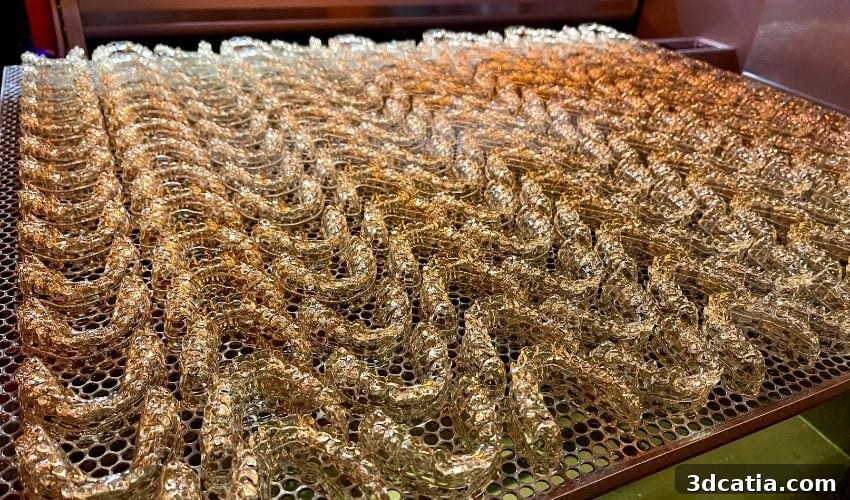
Anyone who has replaced traditional braces with clear dental aligners understands the appeal: aligners are more comfortable and far less conspicuous than metal wires. This growing preference for a discreet orthodontic experience is driving a major market shift and accelerating dental 3D printing, a sector forecast to expand from roughly $3 billion today to more than $12 billion by 2032.
Meeting this surge in consumer demand creates a manufacturing challenge: every smile is unique, so each aligner must be custom-made. To address the need for high-volume customization, San Diego-based Intrepid Automation is applying its expertise. The company combines patented modular Digital Light Processing (mDLP), advanced robotics, and AI-driven quality control—technologies it has deployed across aerospace, defense, and industrial casting—to streamline dental production. By enabling continuous manufacturing and automated post-processing, Intrepid aims to replace slow production lines with flexible, high-speed digital supply chains that can scale for dental applications.
We spoke with Ben Wynne, CTO and co-founder of Intrepid Automation, about how additive manufacturing is reshaping dental production, Intrepid’s automated approach to mass customization, and the ethical questions arising with automated digital healthcare. This interview has been edited for length and clarity.
3DN: Intrepid Automation serves many industries: aerospace and defense, automotive, medical, industrial machinery. So, why dental, and why now?
Ben Wynne: Dental and additive manufacturing are a natural fit. Dental parts are often small, complex and organic, and each one is unique—conditions where 3D printing excels. Clear aligners are a standout use case, with millions of unique parts produced daily. As 3D printing evolves, there’s tension between centralized production, which has been the traditional model, and edge or chair-side production for certain dental needs.
3DN: Is Intrepid Automation selling printers for chair-side production?
BW: Our primary focus is centralized, highly automated industrial production. Edge manufacturing has its place—some dental indications lend themselves to chair-side workflows, like surgical guides that are printed the morning of a procedure. But many dental providers prefer to focus on clinical care rather than manufacturing. For high-volume products like clear aligners, centralized, automated facilities—leveraging logistics infrastructure similar to major retailers—are typically more efficient. There will be markets for both models, but it’s important not to assume every dental product will suit the same production approach.
3DN: We hear a lot about circular production with additive manufacturing. Is using AM to produce dental aligners more sustainable than what’s currently available?
BW: Today’s aligner production already uses additive technology but typically involves multiple steps. After scanning and creating a treatment plan—often 20 or more stages to move teeth gradually—manufacturers 3D print molds in photopolymer resin, vacuum form a thermoplastic sheet over those molds, then trim and discard the molds. That workflow generates significant waste.
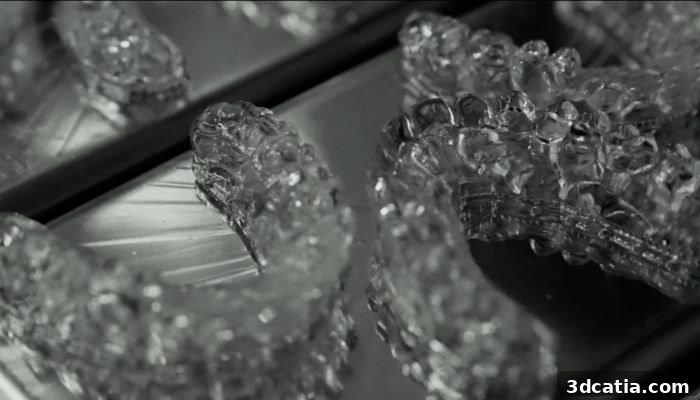
A promising development is printing aligners directly, skipping the mold and thermoforming steps. Direct printing is still emerging because the material must meet demanding criteria: biocompatibility, appropriate mechanical properties, and the ability to hold gentle force over extended periods. If those material challenges are solved, direct printing could greatly reduce waste by producing finished aligners instead of disposable molds. For processes that continue to use molds, creating a recyclability loop—either through recyclable thermoplastics or new chemistries that can be depolymerized and reused—would improve sustainability, though those solutions remain early-stage.
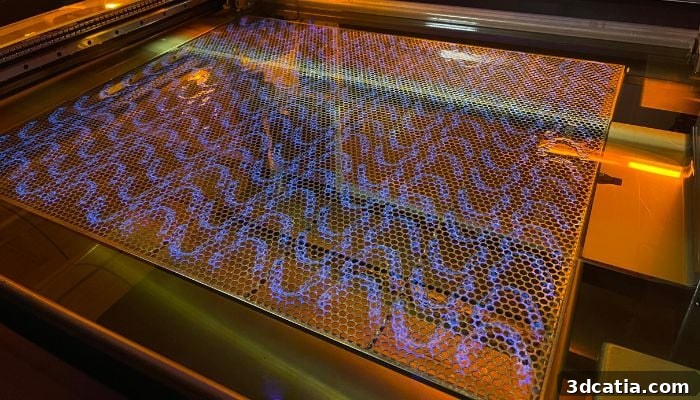
Printing clear aligner forms via multi-projection SLA enables entire layers to be produced at once. Here, 148 aligner molds were printed in just 25 minutes.
Some companies have experimented with recyclable thermoplastic molds, but those materials often lack the surface finish, accuracy and fidelity required for more complex dental applications. An ideal future would see photopolymer resins that can be chemically reverted to reusable feedstock, but this area is still nascent and under active research.
3DN: What is the biggest challenge Intrepid is facing with the centralized production of dental aligners?
BW: The industry has evolved. Leaders like Align Technology and Invisalign built dentist-centered workflows combining clinical expertise with manufacturing. More recently, direct-to-consumer models—companies promising at-home kits and remote treatment—rapidly expanded the market. Data we’ve encountered suggests a large share of direct-to-consumer customers never saw a dentist, which raises questions about whether growth should be pursued at all costs. Just because you can move teeth remotely doesn’t mean it’s always appropriate.
Direct-to-consumer models face regulatory and clinical scrutiny and may be in a phase of reassessment. Meanwhile, the broader market is growing as new geographies and emerging economies increase demand for aesthetic dental services. I see value in centralized production or kiosk-like edge manufacturing for some workflows, and I compare additive’s trajectory in dental to the history of subtractive machining for crowns and bridges. As intraoral scanning and other digital diagnostic tools become pervasive, they generate rich datasets that enable new products and services, and additive manufacturing will be one of the tools to deliver them.
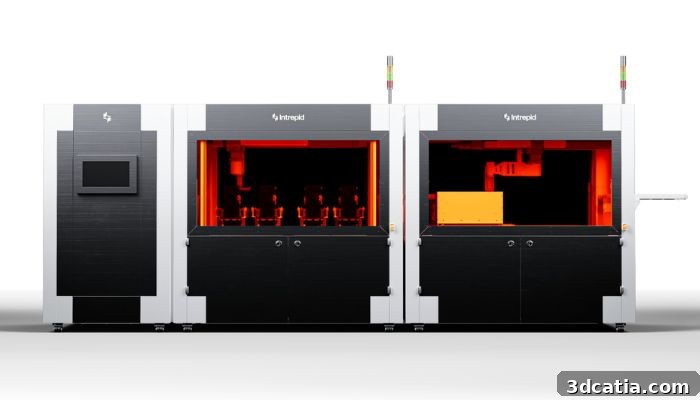
The EPIC Production System uses patented modular Digital Light Processing (mDLP) technology and solvent-free internal post-processing, making it well suited for applications like dental aligners.
3DN: How does Intrepid Automation integrate AI in its workflow?
BW: AI is integral across our operations, from R&D to product development. It enhances productivity and helps teams do more with less. Within our manufacturing systems, AI plays a critical role in closing the loop on the print process—ensuring parts remain accurate and within spec despite process variability. We use camera and monitoring systems with computer vision to detect anomalies in real time. As large language models and agentic AI mature, they become useful for orchestration across factories, robotics, supply chains and regulatory workflows. Advanced manufacturing must adapt to these tools or risk falling behind.
3DN: Is there anything else you’d like to share with our audience?
BW: 3D printing is a powerful technology, but it’s not always the right solution for every problem. Additive has seen cycles of overpromising in the past, so a pragmatic approach is important: treat additive as one tool within a broader advanced manufacturing toolbox that includes AI, robotics and subtractive methods. When applied thoughtfully, these technologies can complement each other and deliver better outcomes.
We welcome feedback on Intrepid Automation’s work in the dental sector. Share your thoughts in the comments below.
*All photo credits: Intrepid Automation