
Pioneering Sustainable Housing: 3D Printing with Soil and Living Architecture
The rapid advancements in 3D printing technology for housing have opened new avenues for efficient and rapid construction. However, the dominant material used in this innovative field is often concrete. While concrete offers structural stability and can be processed relatively quickly, it presents several significant challenges. Homes constructed with 3D printed concrete, despite their inherent insulation qualities, can sometimes be prohibitively expensive. Moreover, managing interior temperatures within these structures often proves difficult, leading to a reliance on energy-intensive heating and cooling systems to maintain comfort. Beyond these practical concerns, concrete carries a substantial environmental burden. A 2019 report by The Guardian highlighted that the cement industry, a crucial component of concrete production, is responsible for approximately 4.9% of global CO₂ emissions when considering all facets of its manufacturing process. Furthermore, concrete relies heavily on non-renewable resources, underscoring its unsustainable nature in the long term. These environmental and economic pressures have spurred researchers worldwide to seek more sustainable alternatives. It is within this context that a visionary team at the University of Virginia (UVA) has embarked on a groundbreaking endeavor, exploring an entirely new approach to 3D printing construction: utilizing an innovative, soil-based ink.
UVA’s Collaborative Innovation: Engineering the Future of Eco-Conscious Building
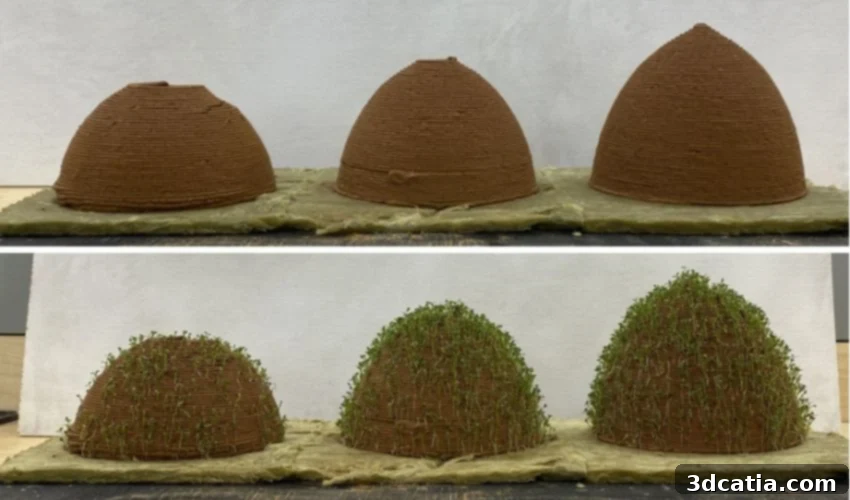
The ambitious project at the University of Virginia is a testament to the power of interdisciplinary collaboration, uniting experts from diverse scientific and architectural fields. At the heart of this research is Ji Ma, an assistant professor of materials science and engineering at UVA’s School of Engineering and Applied Science. Professor Ma’s profound expertise in material composition and engineering principles was fundamental in developing the novel soil-based ‘ink’ with the necessary rheological properties for 3D printing. To ensure the ecological integrity and viability of the material, Ma forged a crucial partnership with David Carr, a distinguished research professor in UVA’s Department of Environmental Sciences. Professor Carr’s deep understanding of soil mechanics, local ecosystems, and sustainable resource management provided invaluable insights into selecting and processing natural materials. The architectural vision for how these innovative materials could translate into functional and habitable structures came from Ehsan Baharlou, an assistant professor in UVA’s School of Architecture. His contributions were vital in conceptualizing the design possibilities and structural implications of soil-based 3D printing. Adding to the practical execution of the project was Spencer Barnes, a recent graduate of the University. Barnes played a hands-on role in the experimental phase, meticulously experimenting with different soil compositions and additives to create a printable ‘ink.’ His work further explored two distinct methods for integrating living elements into the structures: one technique involved alternately printing layers of soil and then adding layers of seeds, allowing for precise placement of future plant life; the second method entailed pre-mixing the seeds directly into the soil-based ink before the printing process began, aiming for a more uniform distribution of plant growth throughout the material. These carefully refined methods culminated in the successful creation of cylindrical prototypes, offering tangible proof of concept for this pioneering approach to sustainable construction.
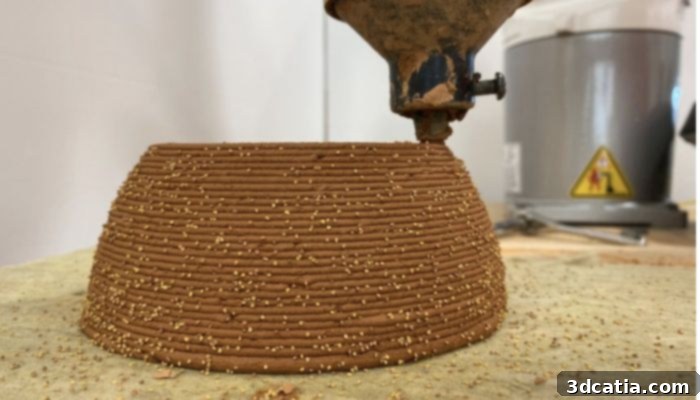
The UVA team successfully developed a unique soil ‘ink’ specifically formulated for FDM-style 3D printing, enabling the creation of structures that actively support and foster plant growth. (Photo credit: Ehsan Baharlou).
The Multifaceted Benefits of Soil-Based 3D Printing for a Regenerative Future
The adoption of locally-sourced biomaterials holds immense potential for revolutionizing the construction industry, steering it towards a truly sustainable and regenerative model. A cornerstone advantage of 3D printing with soil is its inherent ability to champion a circular economy. Unlike conventional building practices that often involve long supply chains and significant material waste, this method promotes the use of readily available soil from the construction site or nearby regions. This drastically curtails transportation costs, reduces the carbon emissions associated with logistics, and supports local economies. Furthermore, any surplus or waste material generated during the printing process can be effortlessly recycled back into the ‘ink’ mixture, effectively minimizing waste generation to an unprecedented degree. This inherent recyclability and minimal waste stand in stark contrast to traditional concrete production, which is notorious for generating substantial debris and requiring considerable energy inputs for both manufacturing and disposal. As global imperative for sustainable development intensifies in the face of climate change and resource depletion, the appeal of eco-conscious building solutions like soil-based 3D printing becomes increasingly clear. While still in its developmental stages, this innovation presents itself as a highly valid and desirable choice for future housing, promising structures that are not merely functional but intrinsically aligned with ecological health and planetary well-being. It represents a shift from extractive to regenerative practices, where buildings become part of the natural cycle.
Living Architecture: Cultivating Green Buildings from the Ground Up
Perhaps the most transformative and aesthetically captivating feature of UVA’s soil 3D printing technique is the deliberate integration of seeds directly within the building material. This innovative approach means that within a remarkably short period—sometimes just days after printing—the newly formed soil structures begin to sprout, bringing forth vibrant plant life. This concept echoes the burgeoning trend of “green buildings,” vertical gardens, and biophilic designs that have gained significant traction in densely populated urban centers, notably in places like Singapore, which are celebrated for their ecological benefits and visual appeal. The advantages of such “living architecture” are extensive and deeply impactful. Firstly, the burgeoning plants act as dynamic, natural sunshades, significantly reducing the amount of solar radiation that strikes and is absorbed by the building’s exterior. This passive cooling mechanism can lead to substantial reductions in interior temperatures, lessening the demand for artificial air conditioning, thereby conserving energy and lowering utility costs. Secondly, plants are nature’s most efficient air purifiers; they actively absorb carbon dioxide (CO₂) from the atmosphere—a primary greenhouse gas and contributor to climate change—along with other common airborne pollutants. This natural filtration process contributes directly to improved air quality, both around and potentially within the immediate vicinity of the living spaces. Thirdly, the psychological benefits of integrating greenery into our built environment are increasingly recognized. Far more visually pleasing and soothing than stark, unadorned concrete or simple earthen walls, these green facades create a calming, refreshing, and aesthetically rich environment. Extensive research demonstrates that consistent exposure to nature and natural elements positively influences human moods, alleviates stress, and enhances overall cognitive function and well-being. By seamlessly merging structural integrity with vibrant plant life, soil-based 3D printed homes offer a long-term, beautiful, and profoundly sustainable solution, moving beyond conventional architecture to create environments that actively nourish both people and the planet.
Beyond Greenery: Advanced Thermal Management and Enhanced Indoor Air Quality
While the visual appeal of a building blossoming with greenery is inherently attractive, the practical benefits extend well beyond aesthetics, particularly concerning thermal performance and indoor environmental quality. Traditional concrete structures, while robust and durable, possess a high thermal mass, meaning they efficiently absorb and retain heat. While this characteristic can be advantageous in certain climates for passive heating, it frequently results in significant overheating during warmer seasons, making it challenging to regulate interior temperatures effectively without relying on energy-intensive active cooling systems. The living plants thoughtfully integrated into the soil-printed walls offer a dynamic and naturally responsive solution. Through the process of evapotranspiration, plants release water vapor into the surrounding air, which induces a cooling effect similar to a natural evaporative cooler. This physiological process, combined with the continuous shading provided by the foliage, can collectively create a much more stable and comfortable internal environment for occupants, substantially reducing the energy required for climate control. Furthermore, as these plants establish and grow, they contribute to the development of a thriving microbial ecosystem within the wall structure. This active microbiome can play a role in filtering particulate matter and absorbing volatile organic compounds (VOCs) from the air, thereby significantly enhancing the overall quality of the air breathed by the inhabitants. This holistic approach transcends the mere concept of “building green”; it introduces “building living,” fostering structures that are active, integral participants in their immediate ecosystem and directly contribute to the long-term health, comfort, and environmental well-being of their occupants and the planet.
The Road Ahead: Navigating Challenges and Embracing Opportunities for Soil 3D Printing
While the pioneering research emanating from the University of Virginia paints a compelling vision for the future of sustainable construction, it is crucial to recognize that 3D printing with soil is still in its nascent stages of development. The journey from innovative cylindrical prototypes to fully functional, habitable homes will necessitate addressing several significant challenges. Foremost among these are considerations of structural integrity and long-term durability. Soil, by its very nature, is susceptible to erosion and degradation when exposed to various environmental elements such as heavy rainfall, strong winds, and fluctuating temperatures. Researchers must therefore focus on developing sophisticated natural binders, advanced reinforcement techniques, and protective coatings to ensure that soil-printed structures can reliably withstand diverse climatic conditions and rigorously meet existing building codes and safety standards. Moreover, scaling up this technology from relatively small experimental prototypes to entire rooms, multi-story buildings, or even entire communities presents considerable engineering complexities. This includes the demand for larger, more powerful 3D printing systems capable of consistently handling the unique rheological properties of soil ‘inks’ over extended operational periods, as well as developing efficient, automated methods for material preparation and delivery. Economic viability and widespread market acceptance are also pivotal factors. While the local sourcing of materials can drastically reduce raw material costs, the initial investment required for specialized 3D printing equipment, alongside the ongoing research and development to standardize processes, will need careful financial management and incentive structures. Despite these formidable hurdles, the opportunities presented by this technology are immense and transformative. This research paves the way for the creation of truly biodegradable building materials, substantially reducing our global reliance on resource-intensive manufacturing processes, and actively promoting the development of localized, resilient, and environmentally conscious construction industries worldwide. As the global push for sustainability continues to accelerate and drive innovation, it is highly probable that public perception and regulatory frameworks will evolve to embrace and facilitate soil-based construction as an increasingly attractive and accepted option for future housing. The groundbreaking work at UVA transcends merely constructing buildings; it aims to cultivate a new philosophical paradigm for how humanity interacts with its built environment, fostering structures that exist in harmonious partnership with nature rather than in opposition to it, thus redefining our relationship with the spaces we inhabit.
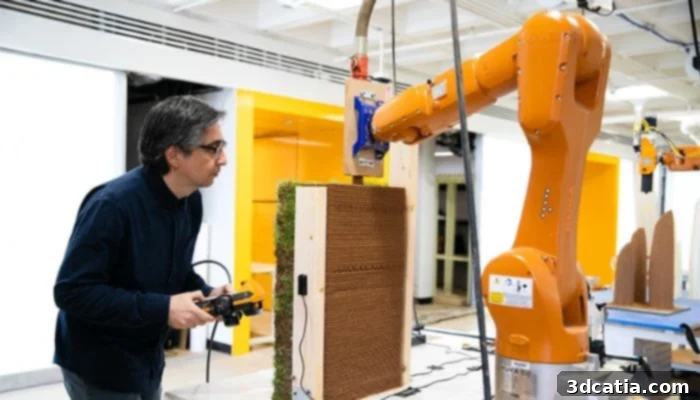
Ehsan Baharlou’s architectural research focuses on translating innovative material science into tangible, functional, and aesthetically pleasing design solutions. (Photo credit: Tom Daly).
Conclusion: Cultivating the Future of Green Construction
The innovative research currently underway at the University of Virginia represents a monumental leap forward in the global pursuit of truly sustainable and eco-friendly construction practices. By daring to challenge the established norms of concrete-centric 3D printing, and instead embracing the profound potential of locally-sourced soil enriched with integrated plant life, the dedicated team is achieving more than just developing a novel building material—they are actively envisioning and prototyping an entirely new paradigm for human habitats. This pioneering approach promises not only a drastically reduced environmental footprint, primarily through lower CO₂ emissions and minimal waste generation, but also delivers a cascade of tangible benefits, including superior natural thermal regulation, significantly enhanced indoor air quality, and the creation of psychologically uplifting and biophilic living spaces. While inherent challenges related to structural scalability, long-term durability, and regulatory integration will undoubtedly require further intensive research and development, the fundamental principles of circularity, biodegradability, and biophilic design embedded in this work are profoundly compelling. As our planet confronts escalating environmental pressures and the urgent need for climate change mitigation, pioneering efforts like these are absolutely crucial for forging a viable path toward a more responsible, harmonious, and resilient built environment for future generations. The future of housing, it seems, might very well be deeply rooted in the very earth beneath our feet, cultivating vibrant and resilient structures that truly breathe with life.
We invite you to explore more detailed information about this fascinating project by visiting HERE. What are your insights on the potential of soil-based 3D printing? Can you envision yourself or future generations living in a home crafted from this innovative, living material? We encourage you to share your perspectives and join the conversation in the comments section below, or connect with us on our LinkedIn, Facebook, and Twitter pages! Don’t miss out on the very latest advancements and breaking news in the world of 3D printing; make sure to sign up for our free weekly Newsletter here to receive updates directly in your inbox! Additionally, explore our comprehensive collection of video content on our YouTube channel for more in-depth insights and captivating innovations.
*Cover photo credits: E. Baharlou