
Revolutionizing Public Playscapes: XISUI Design’s 3D Printed Concrete Boulder Park
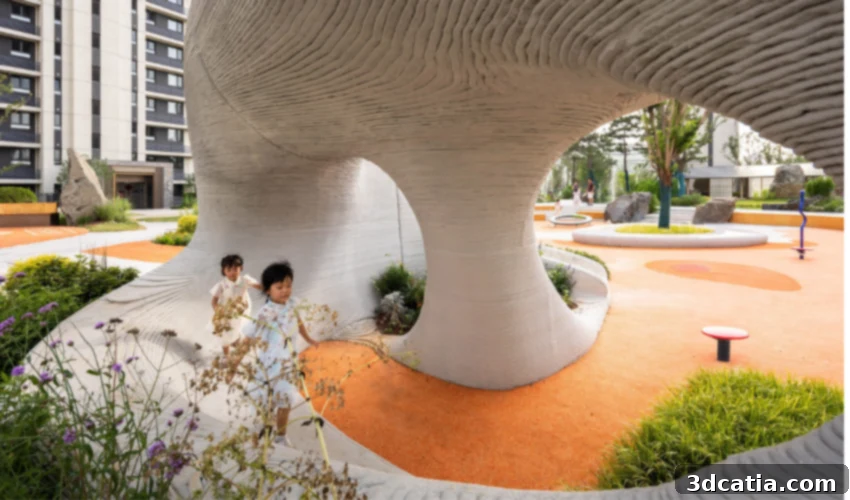
In a groundbreaking move that redefines the intersection of technology and urban design, XISUI Design, an innovative creative studio based in Shanghai, has unveiled its latest public project: Boulder Park in Jinan, Shandong province. This pioneering playscape stands as a testament to the transformative power of 3D printing in shaping modern public spaces. At its core, the park features three magnificent, large-scale 3D printed concrete boulders that transcend mere aesthetic appeal. These structures are ingeniously designed to serve multiple functions, acting as engaging tunnels, exhilarating slides, and challenging climbing structures, offering a rich tapestry of interactive experiences for children of all ages. Boulder Park not only captivates the eye but also sets a new benchmark for how public recreational areas can be both imaginative and enduring, showcasing the limitless potential of advanced manufacturing techniques in architectural and landscape applications.
Spanning an impressive 13,000 square meters, Boulder Park is a meticulously planned urban oasis, with the boulder playground forming one of its three distinct themed areas conceptualized and brought to life by XISUI Design’s visionary team. The studio’s primary objective was to harmoniously blend the inherent durability and resilience of concrete with the fluid, organic characteristics typically found in natural stone formations. To achieve this ambitious vision, they leveraged state-of-the-art 3D concrete printing technology, specifically employing a system equipped with an adjustable robotic arm. This advanced method allowed for the precise extrusion of concrete in successive layers, meticulously building up the material to forge uniquely contoured, naturally inspired forms that would be exceedingly difficult and costly to replicate using conventional construction methods. Each boulder is a masterpiece of design and engineering; the largest boulder integrates a spacious cave-like shelter, offering a cool retreat, alongside an exciting integrated slide platform for dynamic play. The smaller, yet equally engaging, boulders feature inviting crawl tunnels and interactive elements such as “ear trumpets,” encouraging children to explore, discover, and engage their senses within a stimulating environment.
The true ingenuity of Boulder Park lies not just in its impressive scale but in the revolutionary application of 3D printed elements to achieve complex, naturalistic forms that would otherwise be prohibitively expensive and immensely time-consuming to produce. This cutting-edge technology empowered XISUI Design to engineer structures that possess the organic appeal of natural rock formations while simultaneously adhering to the highest standards of safety and durability. Every individual installation within the park has been meticulously crafted with smooth, tactile surfaces and gently rounded edges, prioritizing child safety and comfort. By strategically applying additive manufacturing principles to landscape design, Boulder Park masterfully achieves a delicate yet powerful balance between boundless imagination, uncompromising safety, and practical functionality. This project exemplifies how digital fabrication can unlock new aesthetic possibilities, allowing designers to create fluid, non-standard geometries with unprecedented precision and efficiency, ultimately enhancing the user experience in public recreational spaces.
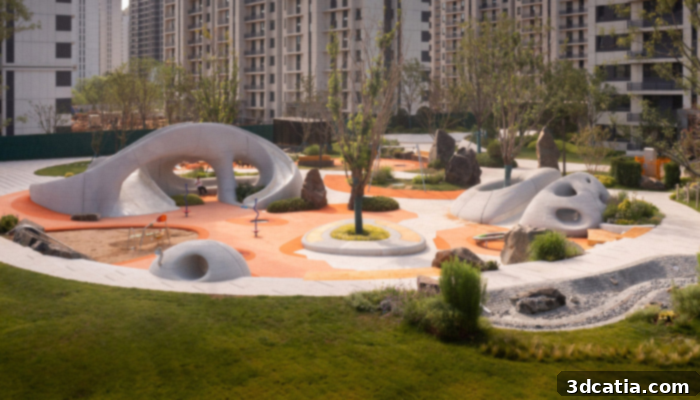
This visionary undertaking is not XISUI Design’s inaugural venture into the realm of digitally fabricated landscapes. The firm previously showcased its innovative prowess with the “Red Dunes” project, another notable playground situated in Guangzhou. That earlier project similarly utilized intricately designed concrete forms to craft compelling tunnels and inviting caves, demonstrating the studio’s foundational expertise in merging digital design with physical construction. However, with the new Boulder Park development, XISUI Design has embraced an even more direct and refined approach. Here, they have deliberately harnessed the raw, distinctive texture of the 3D printed concrete itself, not just as a structural material, but as a key design element. This strategic choice serves to powerfully highlight how additive manufacturing technology can not only replicate the grandeur and complexity of natural geological formations but also boldly reinterpret them, offering fresh perspectives on organic aesthetics within an urban context. The project exemplifies a maturation in their design philosophy, moving from mere imitation to a creative re-imagination of nature through technology, resulting in a unique visual and tactile experience for park visitors.
The implementation of 3D printing in Boulder Park has fundamentally altered the paradigm for constructing public amenities. Traditional methods involving molding, carving, or assembling natural stones would have incurred exorbitant costs, extensive labor, and prolonged construction timelines. In contrast, 3D concrete printing offers unparalleled speed, precision, and material efficiency. The robotic arm system allows for complex geometries to be produced directly from digital models, minimizing waste and drastically reducing the need for manual skilled labor in shaping intricate forms. This efficiency translates into more sustainable project delivery and greater design freedom, enabling architects and designers to push boundaries that were previously constrained by manufacturing limitations. Furthermore, the inherent strength and durability of 3D printed concrete ensure that the structures in Boulder Park are not only visually appealing but also built to withstand the rigors of public use and diverse weather conditions for many years, proving its resilience as a viable and superior construction method for dynamic outdoor environments.
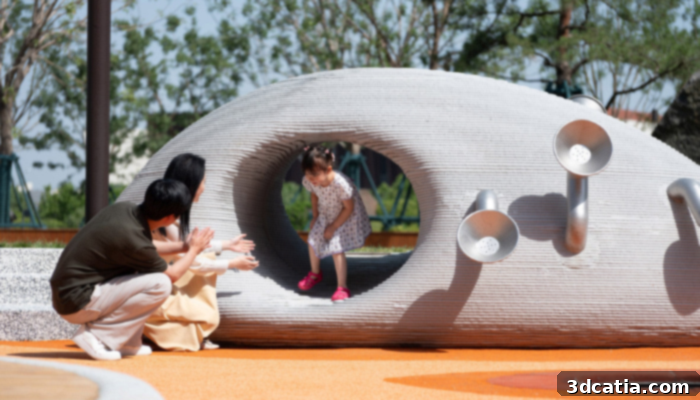
The ultimate achievement of Boulder Park is a vibrant, community-focused playscape that unequivocally demonstrates how 3D printing is rapidly expanding its influence beyond the confines of traditional architecture and infrastructure development. It compellingly ventures into the realm of crafting extraordinary outdoor experiences, particularly for children. As urban centers globally continue their pursuit of more innovative, sustainable, and cost-effective solutions for enhancing public spaces, Boulder Park emerges as a shining example. It vividly showcases the pivotal and growing role of additive manufacturing in shaping environments that are not only highly functional and structurally resilient but also profoundly engaging and aesthetically remarkable. This project underscores the potential for 3D printing to foster creativity, encourage physical activity, and build stronger community bonds by providing unique, accessible, and inspiring recreational areas. The success of Boulder Park signals a promising future where advanced manufacturing techniques are integral to designing smarter, greener, and more playful cities for generations to come, making urban living more enjoyable and stimulating for everyone.
What are your thoughts on the integration of 3D printing technology into the design of public parks and urban landscapes? We invite you to share your perspectives in a comment below or connect with us on our LinkedIn or Facebook pages! Furthermore, don’t miss out on the latest advancements in additive manufacturing—be sure to sign up for our free weekly Newsletter to receive top 3D printing news directly in your inbox. You can also explore all our insightful videos and project showcases on our YouTube channel.
*All Photo Credits: Hu Yihao and Zhou Sheng