
AMUG 2021 Recap: Unveiling Key Innovations and Strategic Partnerships in Additive Manufacturing
The Additive Manufacturing User Group (AMUG) 2021 conference has officially concluded, leaving a lasting impression on the global additive manufacturing (AM) community. Held from May 2 to 6, 2021, in Orlando, Florida, this event was more than just an annual gathering; it marked a significant return to physical conferences in the AM world after a challenging year dominated by virtual interactions and cancellations due to COVID-19. AMUG, known for its foundational motto, “for users, by users,” has consistently aimed to educate and empower all stakeholders in additive manufacturing technologies since its inception in the 1990s. This year, its importance was magnified as it provided a much-needed platform for face-to-face networking, collaboration, and the unveiling of groundbreaking innovations.
Strict safety measures were meticulously implemented to ensure the well-being of all attendees. These included mandatory face masks, rigorous social distancing protocols, widespread hand sanitizer stations, and adherence to all CDC guidelines. Despite the necessary precautions, the palpable excitement and energy were undeniable as industry leaders, innovators, and users converged to discuss the latest advancements and future directions of 3D printing. With a multitude of attendees from diverse sectors, the conference was a hotbed of news and announcements. For those who couldn’t attend or might have missed some of the pivotal developments, we’ve compiled a comprehensive recap of the most impactful revelations from AMUG 2021.
Essentium’s Strategic Partnerships Driving Industrial AM Forward
Essentium, a frontrunner in industrial additive manufacturing solutions, demonstrated remarkable dynamism at AMUG 2021, showcasing its accelerated pace of innovation and strategic expansion. Following the successful launch of their new Essentium High Speed Extrusion (HSE) 280i HT 3D printer, the company shifted focus at the conference to spotlight its crucial new partnerships. These collaborations are specifically designed to push the boundaries of additive manufacturing within the demanding aerospace and defense sectors, areas where precision, reliability, and advanced material capabilities are paramount. Essentium highlighted its ongoing work with esteemed partners and customers, including industry giants like Mercury Systems and Rolls Royce. This collaboration underscores Essentium’s commitment to delivering high-performance solutions for critical applications. The implications of these partnerships are far-reaching; by working with leaders in aerospace and defense, Essentium is directly addressing the stringent requirements for lightweight, durable, and complex components that are essential for next-generation aircraft and defense systems.
Further emphasizing its commitment to innovation and national security, Essentium revealed in a press release that it is actively engaged in testing and developing new materials and processes. These efforts leverage the advanced capabilities of their 290i HT printer and are being conducted in close coordination with the Department of Defense (DoD). This initiative signifies Essentium’s role in advancing material science for additive manufacturing, contributing to the development of robust and high-performance components vital for defense applications. The focus on new materials and processes aims to enhance the mechanical properties, thermal resistance, and overall reliability of additively manufactured parts, ensuring they meet the rigorous specifications required by the DoD. These advancements are critical for enabling the rapid production of spare parts, custom tools, and mission-critical components, ultimately bolstering operational readiness and supply chain resilience for defense agencies.
Stratasys and DyeMansion Forge a Path to Production-Scale Additive Manufacturing
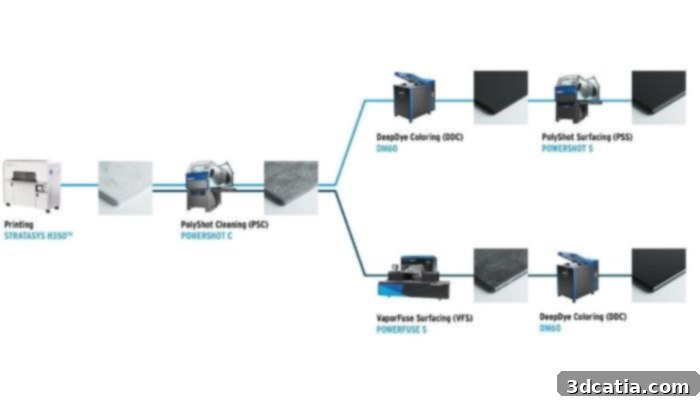
Photo Credits: DyeMansion
As we previously covered earlier this week, the announcement of the partnership between Stratasys and DyeMansion at AMUG 2021 resonated strongly throughout the industry, emphasizing the growing importance of integrated solutions for industrial-scale additive manufacturing. These two pioneers have joined forces to develop a groundbreaking “reference architecture” specifically tailored for production-scale additive manufacturing. This initiative is crucial for bridging the gap between prototyping and true serial production, a challenge that many companies adopting 3D printing still face. The jointly created reference architecture is not merely a theoretical concept; it’s designed to provide tangible, concrete possibilities for the additive series production of end-use parts. By demonstrating proven workflows and configurations, this partnership aims to simplify complex purchasing decisions for businesses and individuals looking to invest in advanced 3D printing solutions for high-volume applications.
The core of this powerful collaboration lies in combining Stratasys’ cutting-edge hardware with DyeMansion’s advanced post-processing capabilities. Specifically, the integration of Stratasys’ new H350 printer, known for its high-throughput and robust performance, with DyeMansion’s Powershot C system, a leader in automated cleaning and surface finishing, creates a seamless end-to-end solution. This synergy allows users unprecedented control over the entire production cycle of their parts, from initial print to final finish. For manufacturers, this means greater efficiency, consistency, and ultimately, higher quality parts ready for market. The partnership extends beyond just technology; both companies plan to leverage their extensive global networks to make this comprehensive, integrated solution widely accessible across various industries. This global reach is expected to accelerate the adoption of additive manufacturing for mass production, setting a new standard for industrial 3D printing workflows and enabling more businesses to harness the full potential of AM for end-use part manufacturing.
PostProcess Technologies Integrates with Carbon’s Ecosystem for Enhanced Post-Printing Automation
In a parallel announcement coinciding with AMUG 2021, PostProcess Technologies, a leading global provider of automated and intelligent 3D post-printing solutions, declared its strategic entry into Carbon’s expanding ecosystem. This significant development means that PostProcess’ industry-leading resin removal technology will now be fully compatible with Carbon’s innovative platform, marking a pivotal step towards streamlining and automating the post-processing phase for Digital Light Synthesis (DLS) parts. For users of Carbon’s sophisticated 3D printers, this integration promises a dramatic improvement in efficiency, consistency, and scalability of their additive manufacturing operations. Resin removal, often a bottleneck in the production workflow for resin-based AM, is now set to become more automated and precise, reducing manual labor and improving throughput.
According to PostProcess Technologies, the initial product from their portfolio to achieve compatibility with Carbon’s platform will be the PostProcess® DEMI 910™. This advanced solution is engineered to offer substantial capacity and efficiency, capable of processing an entire build from a Carbon L1 printer or simultaneously handling two build platforms from a Carbon M2 printer. The DEMI 910™ utilizes PostProcess’ proprietary Submersed Vortex Cavitation (SVC) technology, which combines agitation, ultrasonics, and specialized detergents to deliver consistent, high-quality, and hands-free resin removal. This automation is particularly beneficial for high-volume production environments where manual post-processing can be labor-intensive, inconsistent, and time-consuming. By integrating with Carbon’s ecosystem, PostProcess Technologies is not only simplifying the post-printing workflow but also enabling Carbon users to achieve higher levels of automation and predictability, critical factors for widespread industrial adoption of additive manufacturing.
Massivit 3D Unveils the Massivit 5000 for Large-Format and High-Speed Applications
Massivit 3D Printing Technologies, a pioneer renowned for its innovative large-format 3D printing solutions, made a significant splash at AMUG 2021 with the unveiling of its newest machine: the Massivit 5000. This cutting-edge printer is designed to cater to the growing demand for rapid production of large-scale parts across various industrial sectors. The Massivit 5000 boasts an impressive build volume of 1450 x 1110 x 1800 mm, making it exceptionally well-suited for applications that require substantial part dimensions without compromising on speed or precision. The new product appears to be specifically aimed at industries such as automotive, marine, and rail, where there is a constant need to reduce lead times for prototyping, tooling, and the production of large-scale end-use parts. These sectors often grapple with the logistical and cost challenges associated with manufacturing large components using traditional methods, and the Massivit 5000 offers a compelling solution.
At the heart of the Massivit 5000’s capabilities is the company’s proprietary Gel Dispensing Printing (GDP) technology. GDP is distinct for its much faster curing process, which significantly accelerates production times compared to other large-format additive manufacturing methods. This rapid curing allows for the creation of very large parts in a fraction of the time, providing a substantial competitive advantage for industries operating on tight schedules. For instance, in the automotive industry, the Massivit 5000 can expedite the creation of full-scale prototypes or large jigs and fixtures, drastically cutting down development cycles. Similarly, in marine and rail applications, it can produce large molds, concept models, or custom interior components with unprecedented speed. The combination of its expansive build volume and high-speed GDP technology positions the Massivit 5000 as a transformative tool for accelerating product development and manufacturing efficiency in sectors where size and speed are critical determinants of success.
Titan Robotics Introduces Atlas-HS: A Hybrid Solution for Advanced Industrial Production
Titan Robotics, a Colorado-based company renowned for specializing in large-scale 3D printing solutions, unveiled its innovative Atlas-HS system at AMUG 2021. This new printer represents a significant leap forward in additive manufacturing technology by introducing a truly hybrid machine concept. The Atlas-HS uniquely combines both additive and subtractive manufacturing capabilities within a single, integrated platform. This means that parts can be 3D printed and then precisely machined on the same machine, eliminating the need for multiple setups and transfers between different equipment. The strategic integration of these two processes on one system streamlines the production workflow, reduces handling errors, and improves overall manufacturing efficiency.
Specifically, Titan Robotics has ingeniously incorporated its high-performance pellet extrusion system with a precise 3-axis milling system. The pellet extrusion technology offers several advantages over traditional filament-based systems, including the ability to process a wider range of engineering-grade materials, often at a lower cost per kilogram, and at higher deposition rates. Once the part is additively manufactured, the integrated 3-axis milling system can perform subtractive operations, such as surface finishing, drilling, or creating precise features that are challenging to achieve with additive processes alone. Titan Robotics emphasized that this hybrid solution is their answer to taking additive manufacturing to the next level of industrial production. By offering a comprehensive manufacturing approach, the Atlas-HS aims to significantly shorten part cycle times, from design to finished product. This holistic integration of additive and subtractive capabilities is expected to drive greater adoption of AM in demanding industrial applications, enabling manufacturers to produce higher quality, more complex parts with improved efficiency and reduced costs.
nScrypt’s nRugged: Precision 3D Manufacturing for Extreme Environments
Orlando-based manufacturer nScrypt captivated attendees at AMUG this year by presenting its newest 3D printing platform, the nRugged system. This innovative machine stands out as a pioneering solution for specialized applications, claiming the title of the first and only precision 3D manufacturing and bioprinting platform designed specifically for harsh and challenging environments. The nRugged system is essentially a ‘ruggedized’ version of nScrypt’s acclaimed Factory in a Tool (FiT) platform, which integrates multiple fabrication capabilities into a compact, deployable unit. The core advantage of the nRugged is its ability to perform highly precise 3D printing or bioprinting operations in conditions where traditional industrial machines would typically fail or be unable to operate effectively. This includes, for instance, deployment on a naval ship at sea, within a mobile trailer in remote locations, or even in extreme climatic conditions.
The nRugged system is engineered with a host of robust features to ensure its performance and reliability in demanding situations. It can be configured with up to four tool heads, offering versatility for both 3D manufacturing (for creating functional parts and electronics) and biomanufacturing (for tissue scaffolds and medical devices). While nScrypt has not elaborated on every specific aspect of its ‘rugged’ design, certain features prominently highlight its capability for ‘out of factory’ operations. A standout example is the optional 48-hour battery power supply, which can be further extended through solar charging capabilities. This critical feature ensures continuous operation even when conventional power sources are unavailable, making it ideal for field deployments, disaster relief, military applications, or remote research outposts. The nRugged platform represents a significant advancement in mobile and resilient additive manufacturing, opening up new possibilities for on-demand fabrication in environments previously deemed unsuitable for high-precision 3D printing technologies.
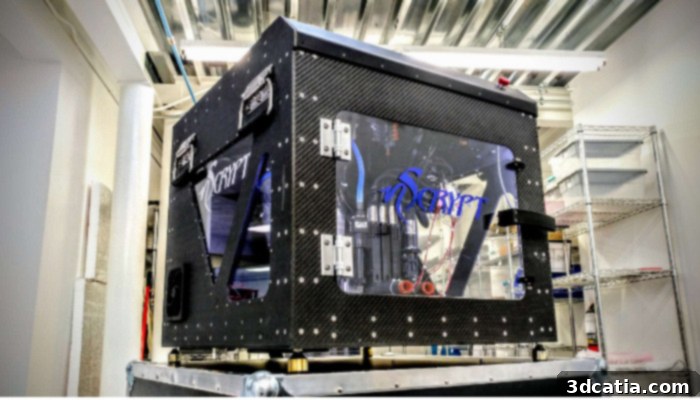
Photo Credits: nScrypt
The AMUG 2021 conference truly delivered on its promise, not only by providing a safe and much-anticipated physical gathering but also by showcasing a vibrant landscape of innovation and collaboration within the additive manufacturing sector. From strategic partnerships accelerating industrial adoption to groundbreaking machinery pushing the boundaries of large-format and hybrid production, the announcements made at the event underscore the rapid evolution and growing maturity of 3D printing technologies. These developments collectively point towards a future where additive manufacturing is increasingly integrated into mainstream production workflows, enabling greater efficiency, design freedom, and material versatility across diverse industries.
What are your thoughts on all the exciting news and advancements unveiled at AMUG 2021? Were you fortunate enough to attend this pivotal conference and experience the innovations firsthand? We invite you to share your insights and experiences in the comments section below, or engage with us on our Facebook and Twitter pages! Don’t miss out on the latest developments in the fast-paced world of 3D printing – be sure to sign up for our free weekly Newsletter, delivering all the essential news straight to your inbox.
*Thumbnail photo credits: Michelle Raponi/Pixabay