

Airbus Propels Aerospace Manufacturing Forward: Qualifies Materialise and EOS for Advanced SLS 3D Printing
In a monumental stride for aerospace innovation and advanced manufacturing, Airbus, a global titan in aircraft production, has officially qualified Materialise and EOS for the manufacturing of certified aircraft parts using state-of-the-art Selective Laser Sintering (SLS) technology. This pivotal decision reaffirms Airbus’s unwavering commitment to integrating additive manufacturing as a core component of its production strategy, moving beyond conventional methodologies to fully embrace the transformative potential of industrial 3D printing. This marks a new and exciting chapter for the European aerospace giant, as it formally incorporates SLS, a highly versatile and efficient 3D printing process, into its stringent manufacturing ecosystem for the very first time.
The qualification specifically targets parts produced on the advanced EOS P 770 3D printer, utilizing PA 2241 FR – an innovative, flame-retardant polyamide material meticulously developed by EOS. This material has been engineered with extreme precision to satisfy the rigorous safety and performance criteria indispensable for the aviation sector. For many years, Airbus has been a pioneer in leveraging additive manufacturing for a diverse array of applications, ranging from complex prototypes to essential end-use components for both its cutting-edge aircraft and critical spare parts. The formal qualification of SLS technology, in close collaboration with its trusted partners Materialise and EOS, represents a strategic augmentation of its production capabilities, empowering the creation of intricate geometries and highly optimized designs that were previously unattainable or prohibitively challenging through traditional manufacturing techniques.
A Deep-Rooted Partnership: Materialise and Airbus’s Evolving Journey in Additive Manufacturing
The collaborative history between Materialise and Airbus is not merely recent but a testament to a long-standing dedication to advancing additive manufacturing solutions within the aerospace domain. Their journey together began in 2015 when Materialise, a prominent Belgian 3D printing specialist, commenced producing its initial 3D-printed components for Airbus using Fused Deposition Modeling (FDM) technology. This foundational cooperation paved the way for a more profound integration of 3D printing into Airbus’s intricate global supply chain. With the recent, groundbreaking qualification of Selective Laser Sintering (SLS), this enduring partnership ascends to unprecedented heights, unlocking an even broader spectrum of applications and manufacturing opportunities.
Currently, Materialise is actively engaged in 3D printing approximately 100 distinct part types for the state-of-the-art A350 aircraft, a flagship model celebrated for its pioneering design and operational efficiencies. This robust initial phase signals a clear and ambitious goal: to substantially increase this number and extend the profound advantages of additive manufacturing to an expanded fleet of aircraft models in the near future. The integration of SLS promises not only the production of existing parts more efficiently but also enables the redesign of components for superior performance, reduced weight, and consolidated assemblies, all critical factors in modern aerospace engineering.
Bart Van der Schueren, Technical Director at Materialise, eloquently captured the profound significance of this achievement: “This accomplishment definitively solidifies our enduring partnership with Airbus and concurrently unlocks a wealth of additional 3D printing applications for Airbus and its extensive network of suppliers. Laser sintering stands as one of the most widely adopted and versatile 3D printing technologies, uniquely capable of enabling the realization of exceptionally complex design features, such as sophisticated interlocking mechanisms and intricate internal structures. It is an immense honor for Materialise to be recognized as Airbus’s inaugural qualified manufacturer for this truly transformative technology.” This statement not only highlights the robust strength and trust inherent in the partnership but also underscores the strategic imperative of SLS for engineering parts with elevated functionality and substantial weight reduction, factors that are absolutely paramount in the highly competitive and regulated aerospace industry.

The EOS P 770 is a dual-laser laser sintering system designed for efficient production of large-scale, high-quality polymer parts. (Photo credits: EOS)
Pioneering Performance: The Distinct Characteristics of EOS’s PA 2241 FR Material
At the heart of this groundbreaking qualification lies EOS’s newly certified material, PA 2241 FR. This advanced flame-retardant polyamide material represents a true paradigm shift for aerospace applications, having been meticulously engineered to not only meet but to surpass the exceptionally rigorous quality and safety standards mandated for flight-certified components. A critical attribute of PA 2241 FR is its impressive recycle rate, a feature that aligns seamlessly with the escalating global emphasis on sustainability and environmentally responsible manufacturing practices, which are becoming increasingly vital across all industrial sectors, including aerospace.
Crucially, according to EOS, PA 2241 FR is uniquely formulated and tested for parts demanding a superior degree of protection against fire, smoke, and toxicity (FST properties). These FST characteristics are absolutely paramount for ensuring passenger and crew safety within aircraft cabins. In the aerospace industry, 3D printed parts are extensively utilized within aircraft interiors for a myriad of applications, which include, but are not limited to, robust structural supports, efficient ventilation ducts, secure cable guides, and aesthetically pleasing interior trim components. The inherent ability of PA 2241 FR to effectively resist fire and minimize smoke emission positions it as an exemplary candidate for these mission-critical applications, thereby guaranteeing strict compliance with international aviation safety regulations.
The advanced resistance properties of this material extend beyond merely meeting minimum requirements; they empower aerospace designers and engineers with unprecedented freedom to innovate. This ensures that their components will perform flawlessly even under the most extreme operational conditions, thereby significantly enhancing the overall safety, reliability, and longevity of the aircraft. This material not only contributes to passenger comfort and safety but also supports the creation of lighter, more integrated cabin systems, further driving efficiency.
Markus Glasser, Senior Vice President EMEA at EOS, expressed immense pride and satisfaction in this monumental achievement: “We are exceptionally proud that following an exhaustive and incredibly rigorous testing program, Airbus has officially qualified the EOS PA 2241 FR material and its associated processes for global application throughout the entire company. This seminal qualification powerfully reaffirms the high maturity and unwavering, consistent quality of EOS’s advanced powder materials and sophisticated systems. Furthermore, it continues to underscore the undeniable and growing relevance of industrial 3D printing in both polymers and metals across diverse high-stakes industries.” Glasser’s statement effectively encapsulates the extensive validation process undertaken to ensure that every single facet of the material and process not only meets but exceeds Airbus’s extremely exacting standards. It also reflects a broader, accelerating industry trend where polymer 3D printing is rapidly transitioning from a niche or experimental technology to a fully mainstream, indispensable manufacturing methodology that offers unparalleled advantages in efficiency, design freedom, and material performance.
Transforming the Skies: The Broader Impact on Aerospace Manufacturing
The formal qualification of SLS technology and the PA 2241 FR material by Airbus represents a truly significant milestone that resonates far beyond these specific components or the immediate partners involved. It heralds a profound and enduring shift in how critical components for the aerospace industry are conceptualized, meticulously designed, and ultimately produced. Polymer 3D printing, especially sophisticated processes like SLS, offers an unparalleled suite of advantages in terms of design freedom, enabling engineers to craft parts with highly optimized structural integrity, substantially reduced weight, and seamlessly integrated functionalities. These inherent benefits directly translate into the development of more fuel-efficient aircraft, significantly lower operational costs throughout their lifecycle, and enhanced overall performance – all factors that are absolutely paramount in the fiercely competitive and innovation-driven aviation sector.
Moreover, the strategic adoption of industrial-scale 3D printing for certified parts also addresses critical vulnerabilities and challenges within traditional aerospace supply chains. By facilitating on-demand production capabilities and substantially reducing reliance on intricate, often globalized supply chains for conventional manufacturing methods, Airbus can achieve significantly greater operational agility, drastically cut lead times, and enhance overall resilience against unforeseen disruptions. This forward-thinking strategic move firmly positions Airbus at the vanguard of embracing and integrating advanced manufacturing technologies, solidifying its unwavering commitment to continuous innovation and sustainable operational practices. The impressive high recycle rate of PA 2241 FR further harmonizes with global imperatives to minimize environmental footprints, presenting a compelling and compelling argument for the continued and expanded integration of additive manufacturing into greener, more sustainable production cycles.
This pivotal development also transmits a clear and unequivocal signal to the broader global aerospace industry: polymer 3D printing is no longer relegated to merely being an alternative solution or a rudimentary prototyping tool. Instead, it has demonstrably evolved into a fully validated, industrial-grade solution, unequivocally capable of producing flight-critical components that meet the highest standards of safety and reliability. The meticulously thorough qualification process undertaken by Airbus sets an exemplary benchmark for other aerospace companies worldwide, actively encouraging broader adoption and strategic investment in similar cutting-edge technologies. As manufacturers accumulate more extensive experience and confidence in these advanced methods, the scope of applications for 3D printed polymer parts within aircraft is widely anticipated to expand dramatically, encompassing an even wider spectrum of interior, non-structural, and potentially even semi-structural components, thereby reshaping future aircraft design and production paradigms.
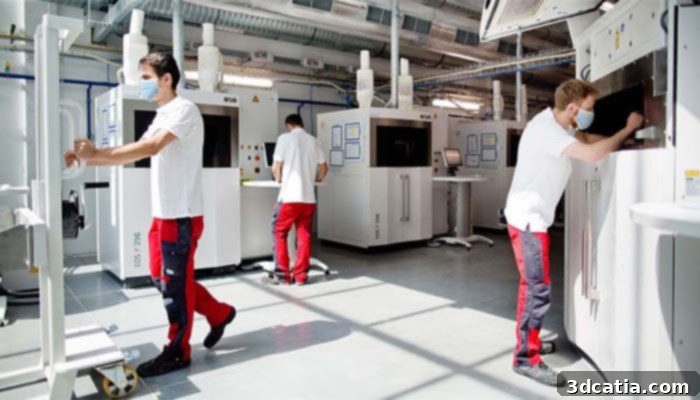
Materialise leverages cutting-edge EOS solutions to deliver certified additive manufacturing for aerospace. (Photo credits: Materialise)
The Future is Additive: Charting a New Horizon for Aviation
The successful qualification of both Materialise and EOS by Airbus for advanced SLS technology, particularly through the utilization of the groundbreaking PA 2241 FR material, represents a truly seminal moment in the ongoing evolution of aerospace manufacturing. This landmark achievement not only profoundly reinforces Airbus’s undisputed leadership in the adoption and integration of cutting-edge industrial technologies but also firmly solidifies the indispensable position of additive manufacturing as a critical, core method for producing high-performance, flight-certified components. As the domain of polymer 3D printing continues its rapid maturation and gains ever-wider industrial acceptance, its transformative role in shaping the very future of aviation – encompassing everything from significantly enhancing aircraft performance and ensuring unparalleled safety to streamlining complex production processes and fostering profound sustainability – will only continue to grow exponentially. This powerful and innovative collaboration sets an incredibly compelling precedent for the continuous innovation, accelerated industrialization, and widespread adoption of 3D printing across the entire global aerospace sector, promising a future of lighter, stronger, and more efficiently produced aircraft.
What are your informed thoughts and perspectives on Airbus’s latest significant stride in additive manufacturing, achieved through its strategic partnership with EOS and Materialise? We warmly invite you to share your valuable insights and comments in the dedicated section below, or feel free to connect with us and join the conversation on our Facebook, Twitter, and LinkedIn pages! To stay consistently informed and receive the absolute latest 3D printing news and developments straight to your inbox, we encourage you to sign up for our free weekly Newsletter here!
Thumbnail Photo Credits: Airbus