
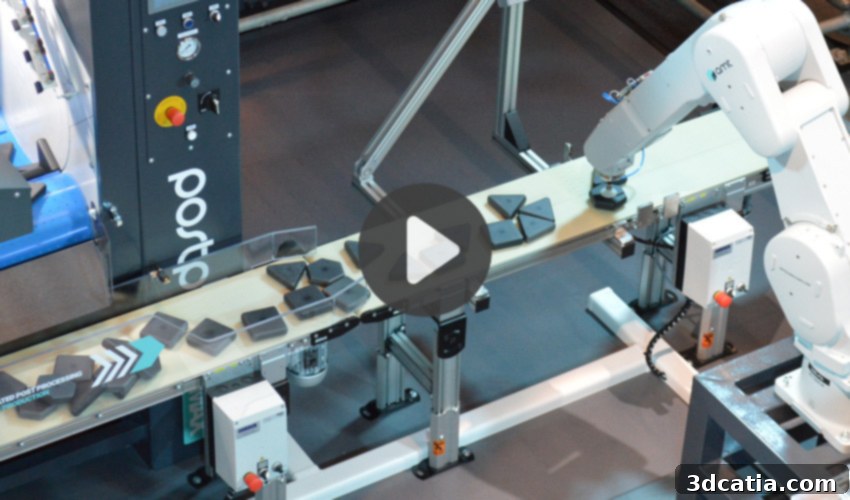
Revolutionizing Additive Manufacturing: AMT Unveils Automated Post-Processing Innovations at Formnext 2022
Additive Manufacturing Technologies (AMT) continues its pioneering journey at the forefront of post-processing solutions for the additive manufacturing industry. With a steadfast mission to transform 3D printing into a truly viable and scalable alternative to traditional manufacturing methods, AMT consistently delivers cutting-edge automation through its acclaimed PostPro line. At Formnext 2022, the premier global exhibition for additive manufacturing, AMT once again captivated the industry with its latest advancements, specifically emphasizing automation and unparalleled flexibility for users. A key highlight was the introduction of an advanced digital manufacturing system, meticulously designed to manage the entire post-processing workflow from start to finish, offering an end-to-end solution for industrial-scale additive production.
The journey from a raw 3D printed part to a market-ready product often involves intricate and time-consuming post-processing steps. These steps are critical not only for aesthetic appeal but also for achieving desired mechanical properties, surface finish, and overall part performance. Traditionally, post-processing has been a bottleneck, heavily reliant on manual labor, which introduces inconsistencies, increases costs, and hinders scalability. AMT’s PostPro solutions directly address these challenges by automating key stages such as surface finishing, material removal, cleaning, and coloring. By removing human variability and significantly reducing processing times, AMT enables manufacturers to achieve higher throughput, superior part quality, and a more predictable manufacturing process. This commitment to automation is central to AMT’s vision of making additive manufacturing truly industrialized, moving it beyond prototyping into high-volume production environments.
The Imperative of Automated Post-Processing for Industrial Additive Manufacturing
For additive manufacturing to fully realize its potential as a mainstream production technology, the post-processing phase must be as efficient and reliable as the printing process itself. This stage is often overlooked but plays a crucial role in the final quality and functionality of 3D printed components. Common challenges include achieving consistent surface roughness, removing support structures without damaging the part, optimizing mechanical properties, and ensuring repeatable results across large batches. Manual post-processing is labor-intensive, costly, and prone to human error, leading to variability in part quality and significantly slowing down production cycles. This bottleneck can negate the speed and design flexibility benefits offered by 3D printing.
AMT’s PostPro range is specifically engineered to overcome these hurdles. By integrating intelligent automation, their solutions ensure that every part meets stringent quality standards while minimizing operational expenditure. Automated systems reduce the need for skilled manual labor, allowing for lights-out manufacturing and round-the-clock operations. This not only drives down costs but also frees up valuable human resources to focus on higher-value tasks, such as design optimization and process innovation. Furthermore, the precision and repeatability offered by automated systems guarantee that each finished part exhibits identical characteristics, which is paramount for critical applications in industries like aerospace, medical, and automotive where consistency is non-negotiable. AMT’s approach transforms post-processing from a necessary evil into a strategic advantage, enabling manufacturers to scale their additive operations with confidence and efficiency.
AMT’s Digital Manufacturing System: End-to-End Automation for Unrivaled Flexibility
At Formnext 2022, AMT showcased its vision for a truly integrated additive manufacturing workflow through its new digital manufacturing system. This innovative system represents a significant leap forward, offering end-to-end post-processing management. What does “end-to-end” truly mean in this context? It signifies a comprehensive solution that handles multiple post-processing steps sequentially and autonomously, from the moment a part leaves the 3D printer until it is ready for final assembly or direct use. This includes advanced cleaning, precise surface finishing, support removal, and even coloring or dyeing, all managed within a single, interconnected digital framework.
The core benefit of such a system is the unparalleled flexibility it offers to users. Manufacturers can program the system to handle diverse geometries, materials, and batch sizes with minimal human intervention. This adaptability is crucial for businesses that deal with a wide variety of parts or need to frequently adjust their production lines. The digital nature of the system allows for real-time monitoring, data collection, and optimization, providing manufacturers with deep insights into their production processes. This data-driven approach facilitates continuous improvement, enabling companies to fine-tune parameters for optimal results and predict maintenance needs before they occur. The result is a highly efficient, scalable, and resilient manufacturing ecosystem that can respond dynamically to market demands, significantly reducing lead times and accelerating product development cycles. By providing a holistic solution, AMT removes the complexity traditionally associated with integrating various post-processing machines, offering a streamlined, user-friendly, and highly efficient pathway to finished additive parts.
Introducing the PostPro SF PP: A Game-Changer for Polypropylene 3D Printed Parts
In addition to the overarching digital manufacturing system, AMT leveraged Formnext 2022 to unveil a highly anticipated new machine: the PostPro SF PP. This specialized surface finishing machine is specifically engineered to address the unique challenges of post-processing polypropylene (PP) 3D printed parts. Polypropylene is a highly versatile and widely used thermoplastic, prized for its excellent chemical resistance, flexibility, fatigue resistance, and low density. These properties make it an ideal material for a myriad of applications, from automotive components and medical devices to consumer goods and industrial tooling. However, achieving a smooth, high-quality surface finish on 3D printed PP parts has historically been a significant hurdle due to the material’s inherent properties, such as its semi-crystalline structure and propensity for stringing or rough surfaces during printing.
The PostPro SF PP represents a breakthrough in this area. It utilizes AMT’s proprietary chemical vapor smoothing technology, meticulously optimized for polypropylene. This process precisely refines the surface of the 3D printed part, eliminating layer lines, improving tactile feel, and enhancing overall aesthetic appeal without compromising the part’s mechanical integrity or dimensional accuracy. The benefits extend beyond cosmetics; a smoother surface reduces friction, improves hygiene, and can enhance the performance of parts in demanding environments. For industries looking to leverage the advantages of 3D printed PP, the PostPro SF PP machine is invaluable. It opens up new possibilities for producing end-use parts with confidence, knowing that the post-processing stage will deliver consistent, high-quality results. This innovation underscores AMT’s commitment to developing tailored solutions that push the boundaries of what’s possible in additive manufacturing, making advanced materials like PP more accessible and effective for industrial applications.
Leadership Insights: Joseph Crabtree and Dr. Konstantin Rybalcenko on AMT’s Vision
During their presentation at Formnext 2022, Joseph Crabtree, CEO and Founder of AMT, alongside Dr. Konstantin Rybalcenko, Global Head of R&D, provided invaluable insights into the specifics of these new systems and their profound benefits. They articulated AMT’s strategic vision for truly automated additive manufacturing, emphasizing how these solutions are not just incremental improvements but foundational shifts towards industrializing 3D printing. Crabtree highlighted the market need for scalable and repeatable post-processing, positioning AMT’s innovations as critical enablers for widespread adoption of additive technologies across various sectors. Dr. Rybalcenko delved deeper into the technical intricacies, explaining how the digital manufacturing system’s algorithms optimize process parameters for different geometries and materials, ensuring unparalleled efficiency and quality.
They further elaborated on the PostPro SF PP, explaining the meticulous research and development that went into perfecting its process for polypropylene parts. Their discussions underscored AMT’s commitment to pushing the boundaries of material compatibility and process versatility in post-processing. The video above captures key snippets from their presentation, offering a direct glimpse into their expertise and passion for advancing additive manufacturing. Viewers can gain a deeper understanding of the technological breakthroughs and the tangible benefits these solutions bring to the manufacturing landscape, reinforcing AMT’s position as a visionary leader in the post-processing segment.
The Future of Additive Manufacturing Through Advanced Post-Processing
AMT’s innovations showcased at Formnext 2022 are not merely product launches; they represent a significant step towards a fully industrialized future for additive manufacturing. By addressing the critical bottleneck of post-processing with intelligent, automated, and flexible solutions, AMT is enabling manufacturers to unlock the full potential of 3D printing. The ability to consistently produce high-quality, end-use parts at scale, regardless of material or complexity, transforms additive manufacturing from a niche technology into a cornerstone of modern production. This shift empowers businesses to innovate faster, reduce costs, enhance supply chain resilience, and create products with unprecedented design freedom.
The digital manufacturing system and specialized machines like the PostPro SF PP are instrumental in making additive manufacturing a more predictable, cost-effective, and competitive option against traditional methods. As the industry continues to evolve, the integration of advanced post-processing automation will be paramount for widespread adoption, allowing companies to transition seamlessly from design to functional part. AMT’s forward-thinking approach ensures that the additive manufacturing ecosystem is equipped with the tools necessary to meet the demands of tomorrow’s industrial landscape.
To stay informed about all the breaking news and exciting developments from Formnext and beyond, don’t hesitate to subscribe to our dedicated newsletter. This is your direct link to behind-the-scenes access, exclusive interviews, and the latest innovations from leading exhibitors in the additive manufacturing space. We continuously strive to bring you the most relevant and impactful stories.
We’re eager to hear your thoughts! What do you think of the advanced post-processing solutions developed by AMT? How do you foresee these innovations impacting your industry or specific applications? Please share your insights and comments below. You can find all our in-depth videos and exclusive content on our official YouTube channel. For more real-time updates and discussions, be sure to follow us on Facebook and Twitter. Join our community and stay connected with the pulse of additive manufacturing!