
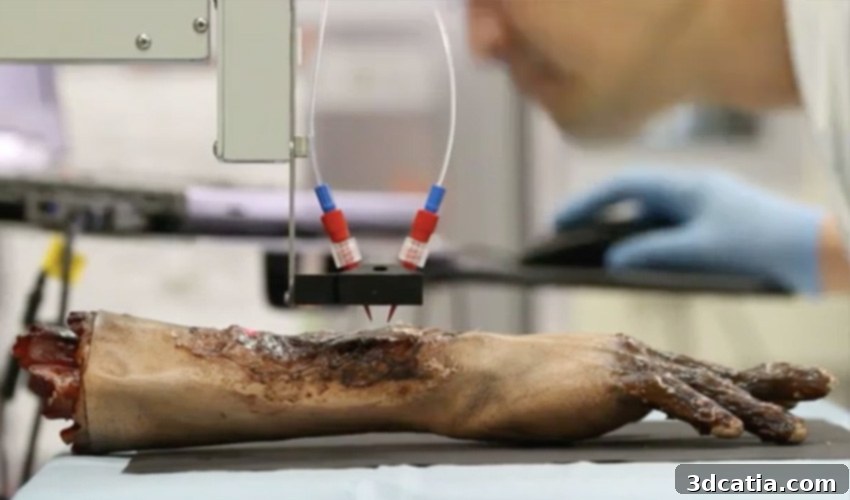
Revolutionizing Wound Care: Mobile 3D Bioprinter Directly Prints Skin for Enhanced Healing
A pioneering team of scientists at the Wake Forest Institute for Regenerative Medicine (WFIRM) has unveiled a groundbreaking innovation: a mobile 3D bioprinter specifically designed to print skin directly onto extensive wounds. This remarkable development addresses a critical need in medical practice, where the timely and effective closure of acute and chronic wounds is paramount for achieving normal healing outcomes and preventing the formation of hypertrophic scars. Traditional wound treatment methods often face significant hurdles, including the limited availability of suitable healthy donor skin for grafting and the necessity of multiple surgical procedures, which are both costly and contribute to prolonged patient recovery times. The solution proposed by WFIRM, through their advanced bioprinting process, promises rapid, on-site management of even the most widespread wounds, potentially transforming the landscape of wound care.
A Mobile Bioprinter for On-Site Extensive Wound Treatment
While this revolutionary technology currently undergoes rigorous testing on animal models, specifically mice and pigskin, its long-term potential for human application is immense. The scientific community and healthcare professionals eagerly anticipate the day this personalized bioprinting technique can be directly applied to patients, offering tailored treatments that adapt precisely to individual needs and wound characteristics. This represents a significant leap forward in personalized medicine, where the limitations of ‘one-size-fits-all’ approaches are increasingly overcome by precision-engineered solutions.
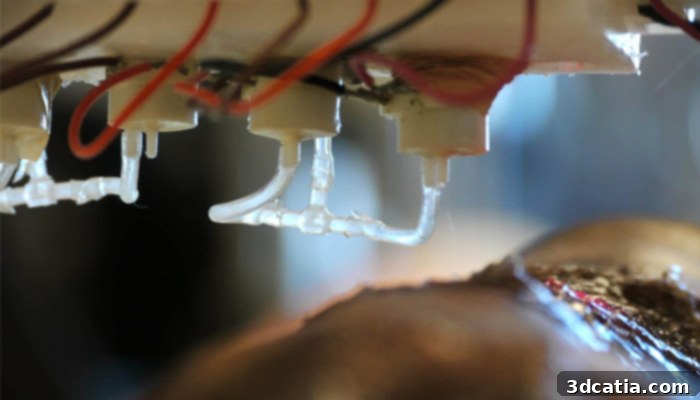
Mobile 3D bio-printer from WFIRM
Bioprinting, as a field, has already cemented its importance across numerous applications within the medical sector. Its capabilities range from facilitating organ transplants and developing more effective treatments for various diseases to, crucially, healing complex wounds and fabricating intricate tissues and blood vessels. One of the most compelling advantages of bioprinting lies in its capacity to deliver highly customized treatments, precisely adapted to the unique biological requirements of each patient. The research conducted by WFIRM is not merely an isolated breakthrough; it is a profound testament to the ongoing advancements and the limitless improvements yet to emerge in the dynamic field of regenerative medicine. This technology holds the promise of not just repairing, but truly regenerating, damaged human tissues.
How the Mobile Bioprinter Works: Precision and Innovation
The bioprinting system developed by WFIRM scientists is engineered as a compact, bedside machine, emphasizing portability and immediate clinical applicability. Its design allows for the direct fabrication of custom skin tissue right at the patient’s bedside. The core components of this sophisticated system include a hand-held 3D scanner, vital for accurately mapping the wound topography, and a specialized printing head. This printing head integrates an XYZ movement system, enabling precise deposition of bio-ink, and houses eight nozzles, each with a minuscule diameter of 260 µm. Each nozzle is independently driven by its own dispensing motor, ensuring meticulous control over the deposition of cells and biomaterials.
The ZScanner Z700 scanner, an integral part of the system, plays a crucial role in capturing comprehensive data of an entire wound area in a continuous scan. This digital map serves as the blueprint for the bioprinter, guiding the precise placement of skin cells. Furthermore, the researchers meticulously developed a specialized bio-ink optimized for printing. This innovative ink is comprised of autologous dermal fibroblasts and epidermal keratinocytes – critical cell types found in healthy human skin – suspended within a hydrogel carrier. This hydrogel provides a biocompatible environment, offering structural support and facilitating cell viability and proliferation post-printing, mimicking the natural extracellular matrix.
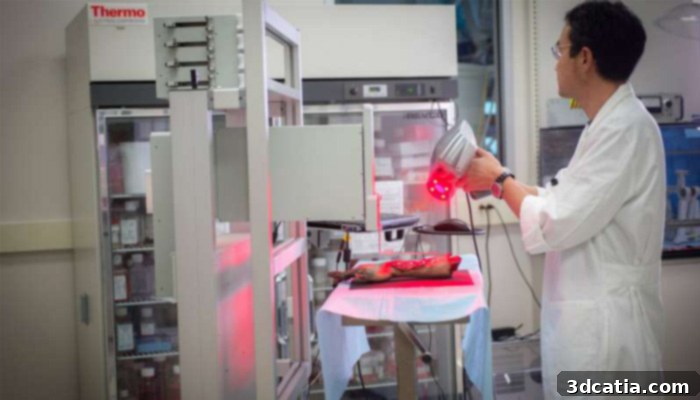
Researchers scanning the zone to be printed
The experimental results from studies involving excisional wounds bioprinted with this system have been exceptionally promising. The bioprinted wounds demonstrated remarkably rapid closure, significantly reduced wound contraction—a common complication that can lead to scarring and impaired function—and accelerated re-epithelialization. Re-epithelialization is the crucial process where epithelial cells migrate and proliferate to cover the wound surface, effectively sealing it off from the external environment. Importantly, the regenerated tissues exhibited a dermal structure and cellular composition strikingly similar to healthy, native skin, indicating genuine tissue regeneration rather than just superficial healing. These findings underscore the immense therapeutic potential of this technology in restoring both the integrity and function of damaged skin.
Addressing the Significant Demand for Extensive Wound Treatments
The need for advanced wound treatment solutions is staggering. In the United States alone, it is estimated that over 7 million patients are affected by chronic wounds annually, leading to an astronomical expenditure of approximately $25 billion each year on treatment. For the civilian population, approximately 500,000 individuals receive treatment for various wounds annually in the U.S. The situation is particularly dire for military personnel, where burn injuries constitute a significant portion—10-30%—of combat casualties in conventional warfare scenarios. In such critical situations, the early excision of damaged tissue and the prompt, proper coverage of wounds are absolutely vital steps, directly impacting the survivability and long-term recovery of patients with extensive burn injuries. The current limitations in rapidly and effectively covering large wound areas often contribute to higher mortality rates and severe long-term disability. This mobile bioprinter has the potential to drastically improve outcomes in both civilian and military medical contexts, providing immediate, life-saving intervention where traditional methods fall short.
WFIRM: At the Forefront of Regenerative Medicine
The Wake Forest Institute for Regenerative Medicine (WFIRM) stands as a beacon of innovation in the United States, committed to translating groundbreaking scientific discoveries into tangible clinical therapies. This highly interdisciplinary team of researchers and clinicians is relentlessly working towards engineering more than 30 different types of replacement tissues and organs. Beyond tissue engineering, WFIRM is also dedicated to developing advanced cell therapies aimed at enhancing natural healing processes. Their relentless pursuit of innovative solutions continues to push the boundaries of medical science, offering hope for patients suffering from a wide array of conditions requiring tissue repair and regeneration. More detailed information about their pioneering research can be found in their published works, accessible HERE.
This new research from WFIRM represents a significant milestone in regenerative medicine and 3D bioprinting. The ability to directly print functional skin onto large wounds at the point of care could revolutionize emergency medicine, battlefield treatment, and the management of chronic wounds. It offers the promise of faster healing, reduced scarring, and improved quality of life for millions of patients worldwide. As the technology matures and progresses towards human trials, its impact is poised to be transformative, moving us closer to a future where damaged tissues are not just repaired, but truly regenerated with personalized precision.
What are your thoughts on this revolutionary mobile 3D bioprinter and its potential to transform wound healing? Share your insights and comments below, or engage with us on our Facebook and Twitter pages! Don’t miss out on the latest advancements in 3D printing; make sure to sign up for our free weekly Newsletter, delivered straight to your inbox.