
Discover Extrudr Filaments: Innovation, Sustainability, and Performance in 3D Printing
In the rapidly evolving landscape of additive manufacturing, material innovation plays a pivotal role in pushing the boundaries of what 3D printing can achieve. Since its inception in 2014 by founder Johannes Früh, Extrudr has swiftly emerged as a significant and innovative manufacturer of 3D printer filaments. Hailing from Austria, this dynamic company, despite its relatively young age, has already cultivated an extensive and diverse portfolio of materials. This range includes widely used options such as PLA, TPU, and PETG, alongside specialized offerings like Durapro, a thermoplastic engineered for exceptional resistance to both UV (ultraviolet) light and high temperatures. Beyond conventional materials, Extrudr distinguishes itself with a strong commitment to sustainability, exemplified by its range of eco-responsible filaments: GreenTEC and Biofusion. This article will delve into two of their most popular and groundbreaking materials: GreenTEC, a biodegradable, heat-resistant option, and XPETG, an enhanced version of the versatile PETG.
To ensure global accessibility and reliable distribution, Extrudr partners with official resellers. In France, Atome3D serves as the official reseller, not only catering to the French market but also offering worldwide shipping of Extrudr’s complete product range. This strategic partnership ensures that high-quality Extrudr filaments are readily available to a broad international customer base. Customers are encouraged to visit the Atome3D website for the latest product offerings and any ongoing promotions on Extrudr filaments, including their innovative GreenTEC line, to discover how these advanced materials can elevate their 3D printing projects.
GreenTEC: The Biodegradable Filament Combining Performance with Environmental Responsibility
Among Extrudr’s most prominent innovations is its GreenTEC range, a testament to the company’s dedication to sustainable 3D printing. These filaments represent a significant leap forward, offering a truly ecological alternative to many standard 3D printing materials. What sets GreenTEC apart is its impressive environmental profile: it is certified as 100% biodegradable according to the stringent DIN EN ISO 14855 standard. This certification is crucial, meaning that GreenTEC materials can naturally decompose in industrial composting facilities, significantly reducing their environmental footprint compared to traditional petroleum-based plastics. In an era where environmental concerns are paramount, GreenTEC offers a compelling solution for businesses and hobbyists looking to minimize their ecological impact without compromising on print quality or part performance.
Unparalleled Performance and Safety
Beyond its eco-friendly credentials, GreenTEC boasts a remarkable set of functional properties. One of its standout features is its FDA approval for food contact applications. This makes GreenTEC an exceptionally safe choice for printing items that may come into contact with food, such as kitchen utensils, custom cookie cutters, or prototypes for food packaging, offering peace of mind to users in sensitive applications. This level of safety, combined with its biodegradability, makes GreenTEC a truly versatile material for a wide array of consumer and industrial uses.
From a printing perspective, GreenTEC is engineered for user-friendliness. According to Extrudr, it offers an ease of printing experience comparable to that of PLA, which is widely regarded as one of the easiest filaments to work with. This means less hassle with common printing issues, making it accessible even for those new to 3D printing. However, its performance capabilities far exceed those of standard PLA, competing effectively with more technical and traditionally challenging materials like PC (Polycarbonate), ABS (Acrylonitrile Butadiene Styrene), POM (Polyoxymethylene), or PEEK (Polyether Ether Ketone). GreenTEC demonstrates robust resistance to impact and wear, excellent tensile and flexural strength, which are critical for parts that need to withstand mechanical stress, and a noteworthy heat distortion temperature of up to 239°F (115°C). This makes it suitable for functional prototypes and end-use parts that might experience elevated temperatures in their operational environment, a significant upgrade from the lower temperature resistance of PLA.
Mitigating Printing Challenges
One of the persistent challenges in 3D printing, especially with larger objects or materials prone to thermal expansion differences, is warping. Warping occurs when different parts of a print cool at different rates, causing internal stresses that pull the edges of the print upwards and away from the build plate. This can lead to failed prints, wasted material, and frustration. GreenTEC filaments are specifically formulated to be less susceptible to this phenomenon, a considerable advantage. This reduced tendency for warping allows users to confidently manufacture larger parts and objects with more intricate or complex geometries, improving print success rates and enabling more ambitious projects. The consistent adhesion and dimensional stability offered by GreenTEC truly set it apart.
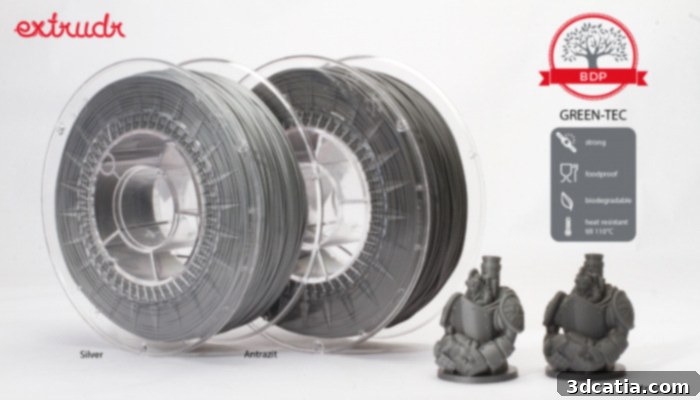
GreenTEC filaments are celebrated for their eco-friendly properties and excellent printability (photo credits: Extrudr)
Recommended Printing Parameters and Aesthetic Appeal
To achieve optimal results with GreenTEC, Extrudr recommends specific printing parameters. A printing speed of 40-60 mm/s is generally advised, striking a balance between detail and efficiency. The heated bed temperature should be set between 68-194°F (20-90°C), with the exact setting often depending on the specific printer and adhesion surface. The extrusion temperature, crucial for proper material flow, should range from 392-446°F (200-230°C). Adhering to these guidelines ensures smooth extrusion, excellent layer adhesion, and minimizes potential printing issues like stringing or clogs. Visually, GreenTEC filaments produce prints with a sophisticated matte surface finish and a muted appearance of the different layers. This aesthetic is often preferred for professional prototypes, architectural models, or artistic applications where a non-glossy, refined look is desired, effectively hiding minor layer lines and providing a consistent surface texture.
The standard GreenTEC filament is typically marketed at a competitive price point, with a 1.1kg spool often priced around $67.03 including tax (or €56). Furthermore, for those requiring even higher performance and specialized properties, the GreenTEC range also includes GreenTEC Pro and GreenTEC Pro+ versions. As the “Pro” designation suggests, these advanced iterations offer increased mechanical strength, higher heat resistance, or other enhanced characteristics, making them suitable for the most demanding engineering and industrial applications. This tiered approach allows users to select the GreenTEC variant that best matches their project’s specific requirements, from general-purpose functional parts to high-stress components.
XPETG: Elevating the Versatility of PETG for Demanding Applications
Another remarkable material developed by Extrudr is XPETG, which represents a significant evolution of classic PETG (Polyethylene Terephthalate Glycol-modified). While standard PETG is already popular for its balance of strength, flexibility, ease of printing, and excellent layer adhesion, Extrudr’s XPETG takes these attributes to the next level. It offers a higher performance version of classic PETG, specifically engineered for applications demanding superior properties. Key improvements include enhanced heat resistance, allowing parts to maintain their structural integrity in warmer environments where standard PETG might deform. Additionally, XPETG differentiates itself with an aesthetic matte finish, which contrasts with the typically brighter and more translucent appearance of conventional PETG filaments. This matte look can be highly desirable for certain product designs and functional components, offering a professional and understated aesthetic.
Certified Quality and Balanced Properties
Extrudr’s commitment to quality and safety is further underlined by XPETG’s adherence to various international standards. The material is certified to FDA (Food and Drug Administration) standards, making it potentially suitable for certain food-contact applications, similar to GreenTEC. It also complies with REACH (Registration, Evaluation, Authorisation and Restriction of Chemicals) regulations, ensuring that the chemical substances used are safely managed, and RoHS (Restriction of Hazardous Substances) directives, which limit the use of specific hazardous materials in electronic and electrical equipment. These certifications provide assurance of the material’s safety, environmental compliance, and suitability for use in a diverse range of industries, including consumer goods, medical devices, and electronics.
Extrudr explicitly states that XPETG has been specially developed for applications requiring a good balance between mechanical resistance and visual appearance. This makes it an ideal choice for functional prototypes, enclosures for electronic devices, custom tools, jigs, fixtures, and end-use parts where both durability and a professional aesthetic are crucial. Its enhanced mechanical properties, including improved impact strength and rigidity, ensure that parts are robust and reliable, while the matte finish provides a consistent, high-quality look that reduces visible layer lines and glare.
Optimal Printing Conditions and Specialized Versions
For successful printing with XPETG, specific parameters are recommended to leverage its full potential. The extrusion temperature should be set between 428-446°F (220-230°C), providing adequate flow for the material’s properties. A heated build plate is recommended, typically between 140-158°F (60-70°C), to ensure good bed adhesion and minimize any potential for warping, despite XPETG’s inherently good dimensional stability. A printing speed of 40-60 mm/s is generally effective for producing high-quality prints. These settings are crucial for achieving optimal layer bonding, surface finish, and overall part integrity.
Similar to the GreenTEC line, XPETG is available in various iterations to meet diverse application needs. In addition to the standard XPETG range, Extrudr offers a reinforced version: XPETG Carbon Fiber. This variant incorporates carbon fiber particles, significantly boosting the material’s stiffness, tensile strength, and heat resistance, while reducing its weight. XPETG Carbon Fiber is particularly well-suited for high-performance applications such such as drone components, lightweight structural parts, and automotive prototypes where strength-to-weight ratio and rigidity are paramount. The standard 1kg spool of XPETG typically retails for approximately $35.89 (€29.99) including tax, offering an excellent value proposition for a high-performance filament.
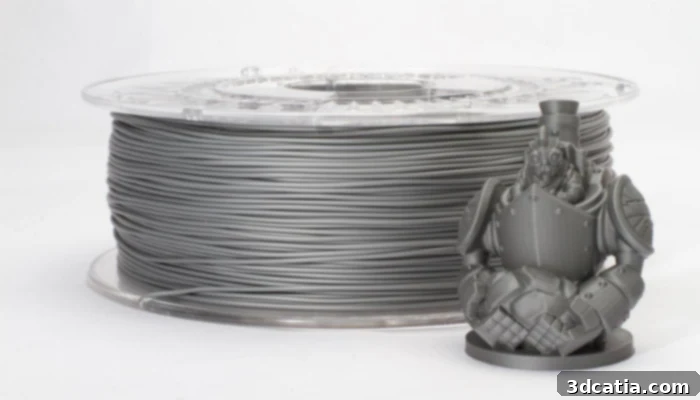
XPETG strikes an excellent balance between aesthetic appeal and robust mechanical properties (photo credits: Extrudr)
Choosing the Right Extrudr Filament for Your Project
Extrudr’s GreenTEC and XPETG filaments exemplify the company’s dedication to innovation, quality, and environmental responsibility in the 3D printing industry. When selecting between these two exceptional materials, consider the specific demands of your project. If sustainability, biodegradability, and food-contact safety are your top priorities, combined with good mechanical strength and moderate heat resistance, GreenTEC is an outstanding choice. Its ease of printing and matte finish make it versatile for both functional and aesthetic applications where an eco-conscious approach is valued.
Conversely, if your project requires superior mechanical resistance, enhanced heat deflection, and a sophisticated matte finish, with compliance to critical industrial standards, XPETG might be the better option. Its versatility extends across various industries, from consumer products to robust engineering prototypes. For even more demanding scenarios, both GreenTEC Pro and XPETG Carbon Fiber offer specialized, high-performance alternatives designed to tackle the toughest challenges. Extrudr continually strives to expand its material portfolio, offering specialized solutions like Durapro for extreme UV and heat resistance, and Biofusion for another biodegradable alternative, ensuring that designers and engineers have access to the most appropriate materials for their specific needs.
What are your thoughts on Extrudr’s innovative GreenTEC and XPETG filaments, and how do you envision incorporating them into your next 3D printing projects? You can explore the full range of Extrudr filaments and find more details on their specific properties and pricing on the Atome 3D website. We invite you to share your experiences and opinions in a comment below, or engage with us on our Facebook and Twitter pages! Don’t forget to sign up for our free weekly Newsletter to receive all the latest news, trends, and innovations in the world of 3D printing directly in your inbox!