

Revolutionizing Sustainability: 3D Printed Planters from Recycled Plastic Lead the Way
In an era defined by urgent environmental concerns, humanity faces an unprecedented challenge in managing plastic waste. Our landfills overflow, oceans are choked with debris, and the sheer volume of non-biodegradable materials continues to escalate. In response to this pressing global crisis, numerous industries are increasingly looking towards the innovative capabilities of additive manufacturing, commonly known as 3D printing, for viable and scalable solutions. This cutting-edge technology offers a unique pathway to transform waste into valuable products, thereby contributing significantly to a circular economy.
The potential of 3D printing in this context is vast and varied. Just recently, the world witnessed groundbreaking research from the Polytechnic University of Valencia, where scientists successfully developed 3D printed beams constructed entirely from recycled plastic. These innovative structural components are designed to serve as a sustainable alternative to traditional reinforced concrete, a material whose production is highly carbon-intensive. This pioneering work underscores the profound impact additive manufacturing can have on sectors as foundational as construction, offering eco-friendly alternatives for infrastructure development.
Yet, the Spanish researchers are not alone in their quest to harness recycled plastics through 3D printing. A remarkable collaboration has emerged between the Dutch sustainable architecture firm Aectual and the renowned architectural practice DUS Architects. Together, they are championing the use of 100% recycled plastic to create an exquisite line of plant pots, aptly named ‘Mussel’ planters. This initiative beautifully bridges the gap between innovative design, advanced manufacturing, and profound environmental stewardship, offering a tangible example of how waste can be reimagined into items of beauty and utility.
The Imperative of Plastic Recycling and 3D Printing’s Transformative Role
The global plastic pollution crisis has reached critical levels, threatening ecosystems, wildlife, and human health. Millions of tons of plastic enter our environment annually, persisting for hundreds of years and breaking down into microplastics that infiltrate every corner of the planet, from the highest mountains to the deepest oceans. Traditional recycling methods often fall short, struggling with contamination, sorting complexities, and the economic viability of processing diverse plastic types. This bottleneck has highlighted the urgent need for more robust, flexible, and efficient recycling solutions.
This is precisely where additive manufacturing emerges as a game-changer. Unlike conventional manufacturing techniques that often involve subtractive processes (cutting away material, leading to waste) or injection molding (requiring expensive molds and large production runs), 3D printing builds objects layer by layer. This inherent characteristic allows for remarkable material efficiency, significantly reducing waste during the production phase itself. Furthermore, 3D printing excels in customization and on-demand manufacturing, meaning products can be made precisely when and where they are needed, minimizing inventory and potential obsolescence.
For recycled plastics, 3D printing presents an unparalleled opportunity. It can effectively utilize plastic waste streams, transforming what was once considered refuse into high-value products. The technology’s versatility means that a wide array of plastic types can be processed, and the design freedom it offers allows for the creation of complex geometries and intricate forms that would be impossible or prohibitively expensive with traditional methods. By embracing 3D printing, industries can move closer to truly circular economies, where resources are kept in use for as long as possible, extracting maximum value from them before they are recovered and regenerated.
Aectual and DUS Architects: Pioneering Sustainable Design with Purpose
The journey of the ‘Mussel’ planters began as a direct response to an intriguing invitation from the Belgian magazine Sabato. Each year, as part of its celebrated “Knokke” series, Sabato extends an invitation to a select team of designers, challenging them to conceptualize and produce an item using only materials sourced directly from the picturesque Belgian coastal town. For this particular edition, DUS Architects and Aectual collaboratively embraced the challenge, making the bold and impactful decision to utilize plastic—a material often maligned but brimming with untapped potential.
This choice was not merely pragmatic; it was deeply ideological. Hans Vermeulen, the visionary co-founder and CEO of Aectual, articulates this philosophy with conviction: “We have to get rid of the negative idea that plastic is a disposable product.” His statement challenges a widespread perception, asserting that plastic, far from being a mere throwaway item, is a valuable raw material. Vermeulen champions the transformative power of 3D printing as a “new craft,” enabling the creation of truly beautiful and functional objects from what was once considered waste. Aectual’s overarching mission is deeply embedded in a desire to contribute positively to the environment: “We want to help make the highly-polluting construction world cleaner, and the world a little bit more beautiful. It all starts on a small scale with this planter.” This sentiment encapsulates their commitment to instigating change, beginning with impactful, albeit smaller, initiatives that pave the way for broader shifts in industrial practices.
The collaboration between Aectual and DUS Architects is a testament to their shared commitment to sustainability and innovative design. Both firms operate on the premise that design has the power not only to create aesthetically pleasing objects but also to solve complex societal problems. By consciously choosing recycled plastic and deploying advanced 3D printing techniques, they are not only creating unique products but also actively engaging in a dialogue about material value, circularity, and the future of manufacturing. Their work with the ‘Mussel’ planters is a shining example of how artistic vision and technological prowess can combine to forge a more sustainable and visually appealing world.
Aectual planters printed from recycled plastics (Photo Credit: Aectual)
The ‘Mussel’ Planters: Biomimicry Meets Additive Manufacturing
The innovative design of these 3D printed planters draws profound inspiration from the natural world, specifically from mussels. This choice is not arbitrary; it’s a deliberate act of biomimicry, where nature’s ingenious solutions are adapted for human design and engineering. Mussels, fascinating marine bivalves, construct their protective shells in a gradual, layer-by-layer process, steadily adding material to form their robust exoskeletons. This natural construction method bears a striking resemblance to the fundamental principle of additive manufacturing, where objects are built up incrementally, one layer at a time, until the final form is realized.
This parallel between the biological and the technological is central to the ‘Mussel’ planter concept. It highlights how observing efficient natural processes can inform and inspire advanced manufacturing techniques. By emulating the mussel’s organic growth pattern, Aectual and DUS Architects not only create a product with a compelling narrative but also optimize the material deposition process inherent in 3D printing. This approach results in designs that are not only structurally sound but also aesthetically fluid and organic, embodying a harmonious blend of natural inspiration and cutting-edge technology. The planters serve as a beautiful reminder that sustainable innovation often finds its deepest roots in the wisdom of the natural world.
Innovative Production with Recycled Materials
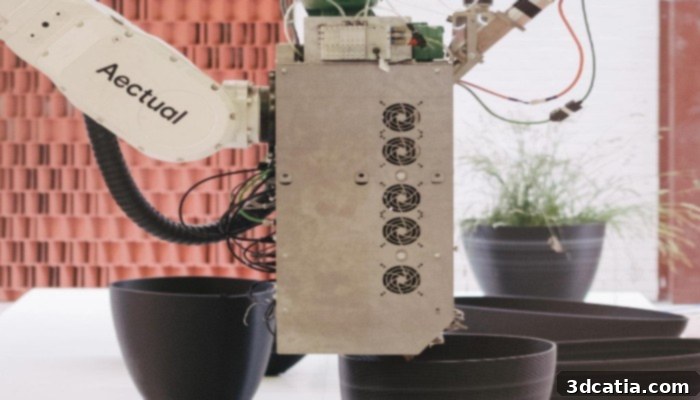
To bring these vision-driven planters to life, Aectual leverages its state-of-the-art manufacturing capabilities. The firm employs a formidable fleet of four robotic-armed 3D printers, each boasting impressive operational parameters. These industrial-scale machines are not just powerful; they are exceptionally versatile, capable of printing across a vast area exceeding 500 square feet with an expansive 360° range. This allows for the production of large-scale objects and offers unparalleled flexibility in design and positioning, crucial for creating diverse planter sizes and unique forms.
The choice of material for the ‘Mussel’ planters is as significant as their design and production method. Aectual is committed to localized circularity, sourcing the plastic directly from the beaches of Knokke—the very Belgian coastal town that inspired Sabato magazine’s challenge—as well as from household waste collected across Belgium. This local sourcing strategy minimizes transportation costs and emissions, while also directly addressing regional plastic pollution. The retrieved plastics are carefully processed and prepared for 3D printing, ensuring that waste is transformed into a valuable resource within the same geographical vicinity. The result is a product that is not only environmentally friendly but also deeply rooted in its local origin story.
A key advantage of this 3D printing approach is the ability to produce each planter individually. This bespoke manufacturing process ensures that every single ‘Mussel’ planter possesses its own unique details, subtle variations in texture, or slight differences in form that emerge from the layer-by-layer creation process and the nature of recycled materials. This individuality makes each planter a one-of-a-kind piece, moving away from mass-produced uniformity towards crafted uniqueness. Quantifying the impact, the Dutch company proudly revealed that the amount of plastic used for the manufacture of a single jar is equivalent to a staggering 120 bottles of shampoo. This powerful statistic vividly illustrates the significant volume of waste diverted from landfills and oceans with each planter produced, underscoring the tangible positive environmental contribution of this project.
Design Versatility and Accessibility
Beyond their sustainable origins and unique manufacturing process, Aectual’s ‘Mussel’ planters are designed with practicality and aesthetic flexibility in mind. The company explicitly states that these robust planters are suitable for both indoor and outdoor placement, a testament to the durability of the recycled plastic material and the meticulous design process. Whether adorning a modern living room, a sun-drenched patio, or a bustling office space, these planters are crafted to withstand various environmental conditions while adding a touch of contemporary design.
The collection offers a variety of sizes to accommodate different plant types and spatial requirements. The largest planter in the series measures an impressive 98 x 40 x 29 cm, providing ample space for substantial greenery and making a significant statement piece. For those seeking vertical presence, the tallest planter stands at 55 x 45 x 49 cm, perfect for elevating plants and creating dynamic visual interest. These dimensions highlight the versatility of Aectual’s robotic 3D printing technology, capable of producing objects of considerable scale and varied form, catering to diverse design needs.
For individuals eager to incorporate these eco-conscious and visually striking planters into their homes or projects, they are currently available for purchase through the Sabato magazine website. However, availability is limited and time-sensitive; the planters are on sale only until September 30th. With just 500 planters currently available on site, this offers a unique opportunity for early adopters to acquire a piece of innovative, sustainable design that supports a crucial environmental mission. The limited run emphasizes the exclusive nature of these creations, making them highly desirable for collectors and sustainability advocates alike.

The Aectual planters are designed for both indoor/outdoor use. (Photo Credit: Aectual)
Beyond Planters: The Future of Recycled Plastic in 3D Printing
The ‘Mussel’ planters by Aectual and DUS Architects are more than just aesthetically pleasing objects; they are powerful symbols and practical demonstrations of the immense potential held by combining recycled plastics with additive manufacturing. This project, alongside the Valencia University’s 3D printed beams, illustrates a burgeoning paradigm shift in how we perceive and utilize waste materials. The implications extend far beyond decorative items or specialized construction components, pointing towards a future where sustainable practices are integrated into every facet of production and consumption.
The success of initiatives like these opens doors for other industries to explore similar pathways. Imagine furniture, architectural elements, urban street furniture, or even bespoke consumer goods being routinely produced from localized plastic waste streams. This model fosters a truly circular economy, where resources are continuously looped back into production, minimizing the reliance on virgin materials and drastically reducing environmental impact. Challenges certainly remain, including ensuring consistent material properties from diverse waste sources, establishing industry standards for recycled plastic filaments, and scaling production efficiently. However, ongoing research and technological advancements are steadily overcoming these hurdles.
The future sees 3D printing enabling greater design freedom, allowing for complex, optimized structures that use less material while maintaining strength and durability. It also promotes distributed manufacturing, where products can be made closer to consumers, cutting down on global shipping and associated carbon emissions. Ultimately, projects like Aectual’s ‘Mussel’ planters serve as crucial proof-of-concept, demonstrating that sustainable innovation is not just feasible but also desirable. They inspire both consumers and industries to rethink waste, embrace new technologies, and contribute to a cleaner, more beautiful, and fundamentally more sustainable world for generations to come.
What are your thoughts on Aectual’s revolutionary 3D printed planters made from recycled plastic? We’d love to hear your perspective! Let us know in a comment below or join the conversation on our Facebook and Twitter pages. Don’t forget to sign up for our free weekly newsletter, bringing you all the latest news in 3D printing delivered straight to your inbox!