

Stratasys and Desktop Metal Merger Falls Apart: Navigating the Future of 3D Printing Giants
The additive manufacturing sector has been characterized by a dynamic landscape of innovation, strategic partnerships, and significant corporate consolidation in recent years. At the forefront of this trend have been two industry titans, Stratasys and Desktop Metal, whose corporate maneuvers have consistently made headlines. Both companies embarked on ambitious journeys of mergers and acquisitions to expand their market reach and technological portfolios. Desktop Metal, a key player in metal additive manufacturing, notably acquired EnvisionTEC and ExOne in 2021, strategically bringing specialists in DLP (Digital Light Processing) and sand-based 3D printing under its umbrella. These acquisitions were crucial for Desktop Metal to diversify beyond its core binder jetting technology and offer a broader range of solutions across various industrial applications, from medical devices to tooling and casting.
Simultaneously, Stratasys, a pioneer in polymer 3D printing, was also busy shaping its future. In the same pivotal year, Stratasys strengthened its materials capabilities by acquiring the 3D printing materials division from Covestro, a renowned company in advanced polymers and high-performance plastics. This move was intended to enhance its FDM (Fused Deposition Modeling) and PolyJet technologies with a wider array of specialized and high-performance materials. Amidst these strategic efforts, Stratasys found itself fending off multiple unsolicited acquisition bids from Nano Dimension, signaling its determination to steer its own course. The broader industry trend of consolidation, driven by the desire for market leadership, technological synergy, and economies of scale, eventually brought Stratasys and Desktop Metal into direct contention when Stratasys launched its own bid to merge with Desktop Metal earlier this year. This proposed combination captivated the industry, promising to create an unprecedented powerhouse spanning various 3D printing technologies. However, after a period filled with anticipation and uncertainty, this chapter has now definitively concluded, as Stratasys shareholders have ultimately rejected the terms of the merger agreement with Desktop Metal, which was initially announced in May 2023.
The proposed merger, had it materialized, was widely anticipated to deliver a significant financial boon for both companies, forging a combined entity with unparalleled global reach and technological breadth. Industry analysts and the companies themselves had projected that the synergy from combining their distinct yet complementary 3D printing technologies and vast global networks could generate a speculative $1.1 billion in annual revenue by 2025. This ambitious target was predicated on the belief that a unified Stratasys and Desktop Metal would capitalize on cross-selling opportunities, streamlined operations, shared research and development, and an expanded portfolio covering everything from polymer prototyping and production to advanced metal and sand additive manufacturing. Such a merger would have brought some of the biggest names and most innovative technologies across multiple 3D printing modalities under a single corporate umbrella, simplifying the additive manufacturing landscape for many industrial customers seeking comprehensive solutions. The discussions, which commenced in May, initially painted a picture of a transformative alliance designed to capture a larger share of the rapidly expanding additive manufacturing market and accelerate the adoption of industrial 3D printing across diverse sectors. However, despite the compelling strategic rationale, subsequent closed-door meetings involving Stratasys shareholders throughout August and September culminated in a final vote that failed to meet the necessary threshold for approving the merger terms. Consequently, the agreement has been formally terminated, leaving the future trajectories of both companies open to a great deal of speculation and renewed strategic considerations.
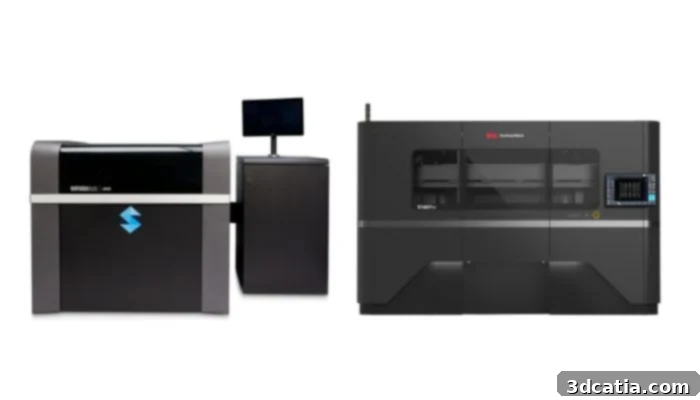
The Stratasys J850 (left) and the Desktop Metal X160 Pro (right). A potential merger would have brought the companies’ different technologies together under the same umbrella.
Stratasys Alters Course and Explores New Horizons
In the aftermath of the failed merger, Stratasys’ board of directors, through its chairman Dov Ofer, wasted no time in articulating a new direction for the company. The initial statement underscored a pivotal shift, declaring, “We have decided to undertake a comprehensive and thorough review of all available strategic alternatives. We are entering this review as the leader in the additive manufacturing space and will continue to execute our strategy, powered by innovation and profitable growth, which has led Stratasys to outpace the competition. Importantly, we remain focused on our mission to deliver value to customers and are committed to taking the appropriate actions to maximize value for all Stratasys shareholders.” This declaration signals a renewed commitment to organic growth and leadership within the additive manufacturing sphere, but also opens the door to a multitude of possibilities. “Strategic alternatives” could encompass a range of options, from considering other merger or acquisition targets – perhaps even revisiting past offers or exploring new partnerships that align more closely with shareholder interests – to significant internal restructuring, potential divestitures of non-core assets, or even exploring a take-private transaction. The emphasis on innovation and profitable growth indicates that Stratasys intends to leverage its strong foundation, extensive intellectual property, and established market presence to continue expanding its ecosystem of advanced polymer 3D printing solutions, regardless of its ultimate corporate structure.
On the other side of the now-terminated deal, Ric Fulop, Founder and CEO of Desktop Metal, responded with a message of resilience and confidence in his company’s independent path. He stated, “We’re grateful for our shareholders’ support. While the team at Desktop Metal believed in the merits of our combination, and is disappointed in the outcome of the merger agreement, we are completely confident in the trajectory of our business, which continues to lower operating costs while growing revenue.” Fulop’s statement highlights the company’s strategic focus on financial discipline and sustainable growth. Desktop Metal, despite its innovative technologies and significant market potential in metal additive manufacturing, has faced its share of financial challenges, including a net loss of $240 million in 2021. In response to these pressures, the company undertook rigorous cost-cutting and optimization measures, including laying off 12% of its workforce prior to the merger discussions. These actions were critical steps aimed at improving operational efficiency and accelerating the path to profitability. Desktop Metal’s confidence now rests on the continued adoption of its binder jetting solutions, which promise high-volume, cost-effective production for various industries, and its diversified portfolio stemming from the successful integration of EnvisionTEC and ExOne. The company will likely now redouble its efforts on scaling its core technologies, expanding its materials library, and driving profitability through organic growth.
The termination of the Stratasys-Desktop Metal merger not only closes one significant chapter but also opens new avenues of speculation and strategic maneuvering across the entire additive manufacturing industry. For Stratasys, the rejection of the merger raises questions about its receptiveness to other acquisition offers. It has, for instance, repeatedly rejected proposals from companies like 3D Systems, another major player in the 3D printing space, who has submitted formal bids to take over Stratasys. These rejections suggest a strong desire by Stratasys’ board to either remain independent or pursue a merger on its own terms and with a partner that offers the most compelling strategic fit and shareholder value. The announcement that Stratasys is now actively exploring “strategic alternatives” for the company underscores this point, although the precise nature of these alternatives remains undisclosed. This period of strategic review could lead to a variety of outcomes, from a renewed focus on internal innovation and expansion to a different merger or acquisition target, or even a recapitalization. For Desktop Metal, while the merger’s failure is undoubtedly a setback, CEO Ric Fulop’s reiterated confidence in the business trajectory is crucial. Despite its astounding growth in technology adoption, the company’s prior financial challenges, marked by layoffs and significant net losses, mean that a renewed focus on sustainable profitability and market penetration for its metal and production 3D printing solutions will be paramount. The broader industry will be keenly watching how both Stratasys and Desktop Metal navigate these unchartered waters, as their individual strategies will undoubtedly shape the competitive landscape and future of additive manufacturing.

Dr. Yoav Zeif, CEO of Stratasys (left) and Ric Fulop, co-founder, Chairman and CEO of Desktop Metal (right)
The decision by Stratasys shareholders to terminate the merger agreement with Desktop Metal marks a significant inflection point for both companies and the additive manufacturing industry at large. It underscores the complexities of large-scale corporate consolidation and the critical role of shareholder sentiment in shaping the future of leading technology firms. As both Stratasys and Desktop Metal embark on their individual paths, the industry watches with keen interest to see how these giants will leverage their strengths, address challenges, and continue to drive innovation in the rapidly evolving world of 3D printing. What are your thoughts on Stratasys terminating the merger agreement with Desktop Metal? Do you believe it’s a missed opportunity or a strategic move for both companies? Let us know in a comment below or join the discussion on ourLinkedIn, Facebook, and Twitter pages! Don’t forget to sign up for our free weekly Newsletter here to get the latest 3D printing news straight to your inbox! You can also find all our videos and interviews on our YouTube channel for deeper insights into the additive manufacturing landscape.
*Cover Photo Credits: 3Dnatives