

Revolutionizing Manufacturing with Nanoe’s Zetamix: Unlocking Industrial Potential Through Ceramic FFF 3D Printing
Since its groundbreaking introduction to the additive manufacturing market in 2018, Nanoe has been at the forefront of democratizing the use of advanced ceramic and metal Fused Filament Fabrication (FFF) 3D printing. This innovative approach offers an accessible and remarkably easy-to-implement process, rapidly transforming how industries approach complex part production and tooling. While its high-performance Zetamix filaments initially found a strong foothold in academic laboratories and research centers across France and internationally, their impact is now profoundly felt among manufacturers. These forward-thinking companies are increasingly integrating additive manufacturing in-house, leveraging Nanoe’s solutions to enhance their operational agility and efficiency.
The ceramic materials developed by Nanoe offer an exceptional suite of thermal, chemical, and mechanical properties, making them indispensable for a wide array of demanding industrial applications. These include, but are not limited to, specialized tooling for orbital welding, the precision manufacturing of critical components for industrial boilers, and the production of intricate turned parts. By adopting Zetamix filaments, numerous international manufacturers have successfully navigated complex production challenges. They have achieved significant improvements in agility by drastically reducing production lead times, minimizing costly machine downtime, and substantially lowering overall manufacturing expenses. This shift represents a paradigm change, moving away from traditional, often slower and more expensive, manufacturing methods towards a more responsive and cost-effective digital production workflow.
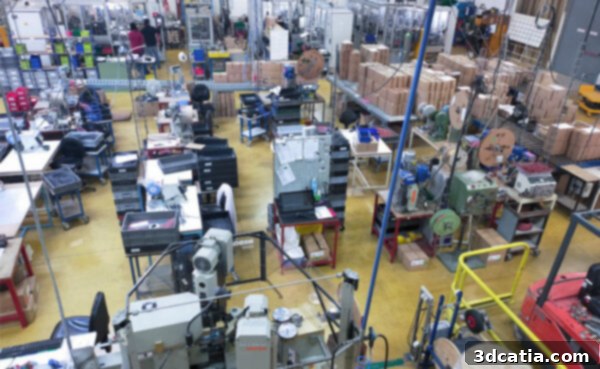
More and more manufacturers are integrating additive manufacturing (photo credits: SAPCO)
Pioneering Industrial Applications: Success Stories with Zetamix Ceramic 3D Printing
Among the growing community of Zetamix ceramic additive manufacturing solution users are three notable manufacturers: MGB, SAPCO, and Orbital Service. Each of these companies faced unique production bottlenecks that proved difficult, or prohibitively expensive and time-consuming, to resolve using conventional subtractive manufacturing techniques. The integration of 3D printing technologies, particularly Nanoe’s ceramic filaments, has delivered a multitude of advantages. A key factor that captivated all three manufacturers was the superior thermal capabilities of ceramic filaments, specifically those made from zirconia and alumina, which allow for operation in extreme environments and under demanding conditions. These case studies highlight the versatility and transformative power of Zetamix in addressing highly specific industrial requirements.
Alumina: A High-Temperature Resistant Material for Precision Manufacturing at MGB
MGB, a distinguished French company established in 1956, specializes in the meticulous manufacture of turned parts, primarily serving the highly demanding connector industry. Its clientele includes leading players in the medical, aerospace, and electronics sectors, all of whom require custom-made screws with exacting specifications. These specialized screws often feature varying levels of hardness, typically with a less resistant base and a hardened top section. To achieve this precise differential hardness, MGB developed a proprietary machine that utilizes induction annealing to selectively harden the upper part of the screw, ensuring it meets the required performance standards.
It is within this specialized annealing machine that MGB has ingeniously integrated a custom 3D printed part, fabricated from high-performance alumina. This component functions as a precisely engineered screw holder, featuring a punched end designed to securely cradle the specific screws being processed. During operation, the screw undergoes intense heating while a sophisticated heat sensor meticulously monitors its temperature. The challenge was to conceive a guide that could not only withstand such extreme temperatures but also perfectly conform to the unique shape of each screw and accommodate the presence of an electrical detector. This complex challenge was met with unprecedented speed and efficiency through the integration of additive manufacturing. MGB proudly reports that the entire design and manufacturing process for a new custom screw holder now takes less than a week. This accelerated timeframe would have been utterly unimaginable had the company relied on traditional subtractive manufacturing methods or external service providers, underscoring the profound impact of ceramic 3D printing on their operational agility and lead times.
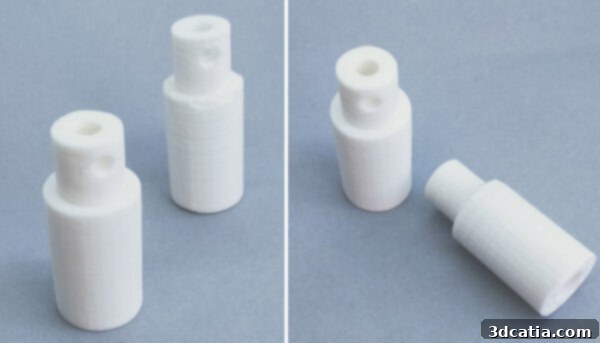
3D printed screw supports (photo credits: Nanoe)
Optimizing Orbital Welding Processes with Custom Zetamix Alumina Nozzles
Orbital Service, a leading German company renowned for its expertise in orbital welding, also turned to Nanoe’s Zetamix solutions to address critical manufacturing challenges. Their core business, TIG (tungsten inert gas) welding operations, inherently presents numerous difficulties, particularly in the imperative task of preventing oxidation and atmospheric contamination during the welding process. To mitigate these risks, the company must meticulously create an electric arc and then meticulously spray an inert shielding gas around the precise area to be welded. However, in the context of large-diameter tubes common in orbital welding, conventional TIG welding nozzles prove to be inadequate. Their design often fails to provide optimal gas coverage, which invariably favors oxidation and necessitates extensive post-treatment of the welded parts. This inefficiency significantly slows down production output and compromises the overall reliability of the welding process, leading to increased costs and reduced quality.
This is precisely where additive manufacturing, and specifically Nanoe’s ceramic FFF technology, offered a game-changing solution. Orbital Service strategically employed FFF technology and Zetamix ceramic filaments – with a specific focus on alumina – to design and produce custom TIG nozzles. These innovatively designed nozzles now feature a concave shape, meticulously engineered to be perfectly adapted to the larger volume and curvature of the tubes requiring welding. This tailored design provides superior shielding gas coverage, dramatically reducing welding defects and significantly optimizing the consumption of inert gas. The German company’s choice of alumina was predicated on its outstanding temperature resistance, ensuring the nozzles can withstand the intense heat of the welding arc. Furthermore, Orbital Service reports that the entire iterative design and rapid manufacturing process for these specialized nozzles now takes an astonishingly short period of just one week, a testament to the agility and efficiency offered by Zetamix ceramic 3D printing.
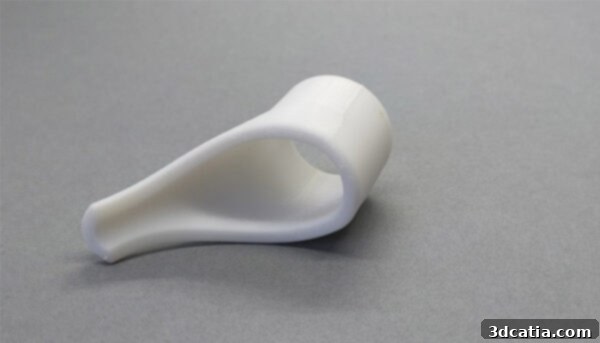
Thanks to additive manufacturing, Orbital Service can design more suitable concave nozzles (photo credits: Nanoe)
Choosing Zetamix Zirconia to Drastically Reduce Maintenance Time at SAPCO
SAPCO specializes in the manufacture of high-performance ceramic ignition and ionization electrodes, essential components integrated into various industrial boilers and burners. To ensure efficiency and precision, the company has developed highly automated production processes, particularly for the critical assembly stage. However, this automation presented a complex challenge: during the welding of the electrode, two metal edges are positioned around the main part using plastic welding pins. These plastic pins, due to their inherent material limitations, degrade rapidly under the high temperatures generated during the welding process. This frequent degradation leads to machine stoppages, often occurring at least once a day, severely disrupting SAPCO’s entire production workflow and necessitating a more robust solution for these critical pins.
Initially, SAPCO explored the possibility of using ceramic injection molding for these pins. However, this traditional ceramic manufacturing technique quickly proved to be impractical, excessively expensive, and exceptionally difficult to implement for their specific needs, especially for low-volume, custom components. Consequently, SAPCO pivoted its strategy and turned its attention to additive manufacturing, specifically opting for ceramics rather than polymers, recognizing the need for superior thermal resistance. Their choice landed on zirconia, a material renowned for its exceptional properties, capable of withstanding extreme temperatures of up to 800°C without significant degradation. The Zetamix solution from Nanoe proved to be the ideal choice due to its remarkable ease of deployment and user-friendliness. Within an impressively short span of just five days, SAPCO’s teams were able to successfully design, iterate, and produce optimized welding pins using Zetamix zirconia filaments. These new, robust ceramic pins now require changing only once a month, a dramatic improvement that has significantly reduced machine maintenance frequency, minimized costly downtime, and ultimately boosted SAPCO’s overall production efficiency and reliability.
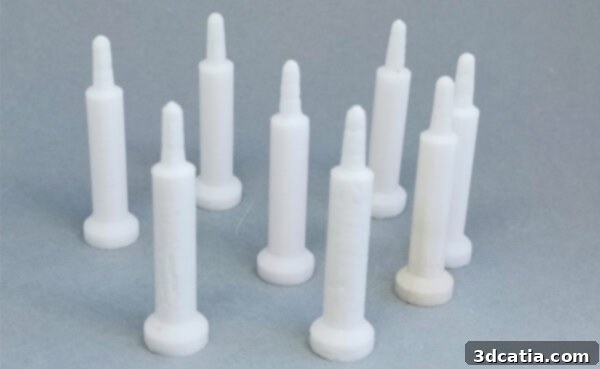
The welding pins are 3D printed with zirconia (photo credits: Nanoe)
Ceramic FFF 3D Printing: The Agile Solution for Industrial Tooling and Beyond
The compelling case studies from MGB, Orbital Service, and SAPCO vividly demonstrate the transformative potential of ceramic FFF 3D printing. When it comes to the rapid and cost-effective production of internal tooling, manufacturers can unequivocally rely on this advanced additive manufacturing technique to dramatically enhance their operational agility and significantly boost productivity. The strategic choice of high-performance ceramics, such as alumina and zirconia, provides industries with unparalleled material properties. This enables critical sectors like aeronautics, automotive, foundry operations, and even high-end jewelry manufacturing to produce components and tooling that can withstand extremely high temperatures, aggressive chemical environments, and severe mechanical stresses, far beyond the capabilities of conventional materials.
Furthermore, opting for Nanoe’s comprehensive Zetamix solutions offers distinct advantages, particularly its low-cost entry point compared to many other, more complex and expensive, ceramic printing processes available on the market. Beyond the significant economic benefits, a crucial factor is the inherent ease of use associated with the FFF process. Its straightforward implementation allows for seamless integration into existing production lines and workflows, making it an accessible technology even for companies new to additive manufacturing. This is especially pertinent for the rapid creation of internal tooling and jigs, where the Zetamix solution proves to be far more appropriate and efficient than alternative processes like photopolymerization. While photopolymerization excels in producing exceptionally precise and intricate parts, often favored for specialized applications in the biomedical sector, FFF technology shines for its robust, functional, and quickly producible industrial components. To delve deeper into the innovative range of ceramic and metal filaments offered by Nanoe, manufacturers and researchers are encouraged to visit the manufacturer’s official website.
What are your thoughts on the increasing integration and impact of ceramic FFF 3D printing within various industrial sectors? We invite you to share your insights and experiences in a comment below or join the conversation on our LinkedIn, Facebook, and Twitter pages! For the latest updates and breaking news in the world of 3D printing, don’t forget to sign up for our free weekly Newsletter here, delivered directly to your inbox. You can also explore our extensive library of insightful videos on our dedicated YouTube channel.