
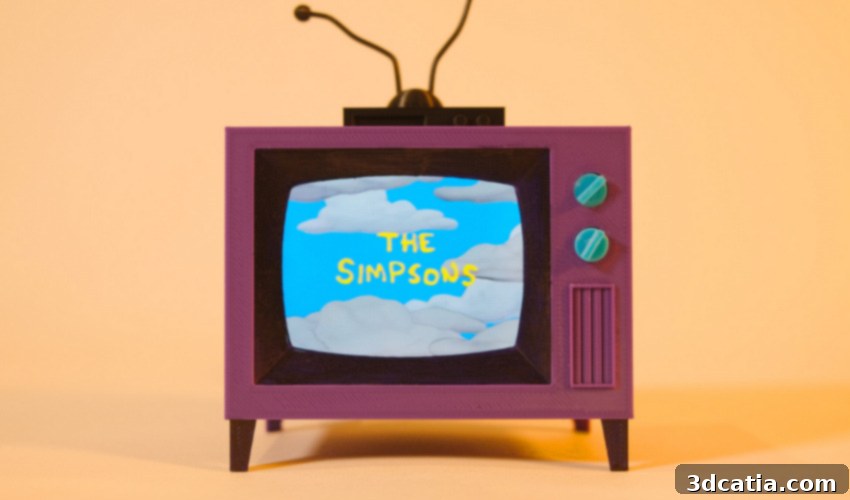
Unleash Nostalgia: Build Your Own 3D Printed Mini Simpsons TV with Raspberry Pi
In an age dominated by streaming services and ubiquitous internet connectivity, the idea of a television set that functions entirely offline might seem like something out of science fiction. Yet, the innovative spirit of the maker community continues to defy expectations. Reddit user Brandon Withrow has captivated enthusiasts worldwide by ingeniously combining the power of Raspberry Pi with the versatility of 3D printing to create a truly unique device: a miniature 3D printed television. This isn’t just any mini TV; it’s a dedicated portal to Springfield, capable of playing the first 11 seasons of the iconic cartoon series, The Simpsons, entirely without an internet connection. Designed with a delightful nod to the beloved television set from the animated series’ own living room, this compact marvel features two intuitive buttons on its top-right side—one for power control and another for volume adjustment. Withrow’s creation has not only sparked immense interest but has also catalyzed a new wave of creativity within the maker community, inspiring countless individuals to embark on their own journeys of crafting personalized mini monitors.
The synergy between Raspberry Pi and 3D printing has, time and again, proven to be a winning combination in the realm of DIY and electronics projects. It stands as one of the most powerful and widely utilized pairings within the modern maker community, consistently enabling creative minds to transform imaginative concepts into tangible realities. This potent combination fosters an environment where original projects flourish, often resulting in incredibly practical and functional devices. From custom-designed tablets and advanced astronomical telescopes to efficient cooling fans and bespoke music speakers, users leverage these technologies to bring their wildest ideas to life. The accessibility and flexibility offered by Raspberry Pi for embedded computing, coupled with the precision and customization potential of 3D printing, open up an almost limitless canvas for innovation. This particular project beautifully exemplifies how these two formidable technologies can be seamlessly integrated to deliver a product that is not only functional but also deeply nostalgic and personal.
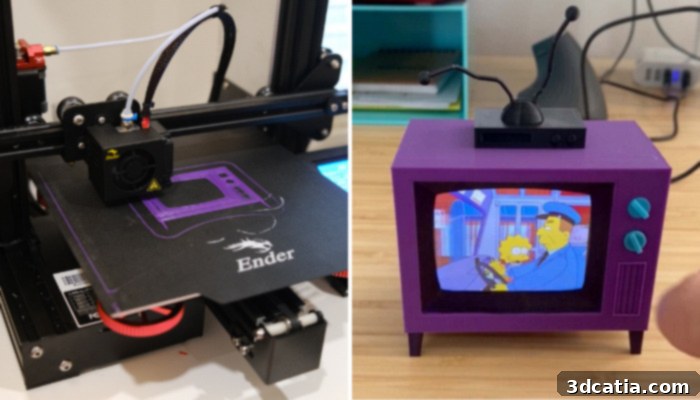
3D Printing the mini TV using the Creality Ender, a popular choice for hobbyists.
The Anatomy of a 3D Printed Mini TV: A Deep Dive into its Components and Construction
To truly appreciate the brilliance behind this mini TV, it’s essential to understand the individual components and the meticulous steps involved in its creation. Brandon Withrow’s comprehensive manufacturing guide meticulously outlines every detail, from material selection to final assembly. At the heart of this compact entertainment system lies a Raspberry Pi Zero, an incredibly small and cost-effective iteration of the popular single-board computer. This diminutive yet powerful board serves as the brain of the mini TV, running a specialized operating system known as Raspbian Jessie Lite. This lightweight OS is expertly configured to manage and play the vast library of Simpsons episodes. For visual output, the device is connected to a TFT (Thin-Film Transistor) screen, boasting a respectable resolution of 640 x 480 pixels. This resolution, while not high-definition by today’s standards, is perfectly suited for the retro aesthetic of the project and provides a remarkably clear and vibrant display for a device of its size. The choice of a TFT screen contributes significantly to the nostalgic feel, reminiscent of older portable televisions.
The physical enclosure and structural integrity of the mini TV are entirely attributed to the wonders of 3D printing. Withrow meticulously designed all the necessary models and parts using Fusion 360 software, a popular CAD (Computer-Aided Design) program favored by engineers and hobbyists for its robust features and user-friendly interface. Fusion 360 allowed for precise measurements and intricate detailing, ensuring that all components fit together flawlessly, creating a sturdy and aesthetically pleasing housing. Once the digital designs were finalized, a Creality Ender 3 Pro 3D printer was employed to manufacture each individual part of the television’s casing. The Creality Ender 3 Pro, renowned for its affordability, reliability, and excellent print quality, made it an ideal choice for this personal project. The FDM (Fused Deposition Modeling) technology used by this printer allows for the creation of complex geometries layer by layer, turning digital blueprints into physical objects with remarkable accuracy. This ability to custom-fabricate the enclosure is what truly allows the mini TV to perfectly mimic the iconic design from The Simpsons, making it a unique and personalized piece of technology. The combination of precise design software and an accessible 3D printer demonstrates the democratizing power of these technologies for creative individuals.
The Secret Behind Endless Offline Entertainment
One of the most intriguing aspects of Withrow’s mini TV is its ability to play episodes non-stop, without any internet connection. This impressive feat is achieved through a clever pre-processing and storage strategy. Withrow explains that the numerous Simpsons episodes were specifically compressed and optimized to perfectly fit the screen measurements and resolution of the mini TV. This compression ensures efficient storage and smooth playback on the Raspberry Pi Zero, which has limited processing power compared to full-sized computers. Once optimized, these digital video files are then copied onto an SD card, which serves as the permanent storage medium for the entire cartoon library. The magic truly begins when the Raspberry Pi is powered on via its USB port, conveniently located on the back of the device. Upon activation, the mini TV automatically springs to life, immediately commencing playback of a random episode from the stored collection. This seamless transition from one episode to the next creates an uninterrupted viewing experience, echoing the continuous broadcast of traditional television. Once an episode concludes, the system intelligently queues up another random episode, ensuring a fresh and unpredictable viewing journey every time. This ingenious design eliminates the need for any user interaction beyond simply turning the device on, making it a perfect set-and-forget entertainment solution for dedicated fans of The Simpsons. It harks back to simpler times of television viewing, free from the distractions and choices of modern streaming platforms, providing a pure, unadulterated dose of nostalgia. If you’re eager to embark on this fascinating maker journey and craft your very own mini TV, Brandon Withrow has generously made his comprehensive build guide available HERE, providing all the necessary instructions and insights to replicate this remarkable project.
The Enduring Appeal of DIY and Retro Tech
Projects like Brandon Withrow’s 3D printed mini Simpsons TV are more than just technical marvels; they represent a significant cultural phenomenon. They tap into a deep vein of nostalgia, offering a tangible connection to cherished memories and simpler times. In an increasingly digital and interconnected world, the allure of a dedicated, offline device that performs a single, specific function with charm and precision is powerful. It’s a rebellion against feature bloat and a celebration of focused design. Furthermore, this project serves as a brilliant demonstration of what is possible when accessible technologies like Raspberry Pi and 3D printing are put into the hands of creative individuals. It showcases how personal interests, whether it’s a love for classic cartoons or a passion for electronics, can be combined to produce something truly unique and inspiring. Such DIY endeavors foster problem-solving skills, encourage learning, and build a sense of accomplishment that off-the-shelf products simply cannot replicate. The fact that many users are following Withrow’s footsteps underscores the inspirational impact of open-source knowledge sharing within the maker community.
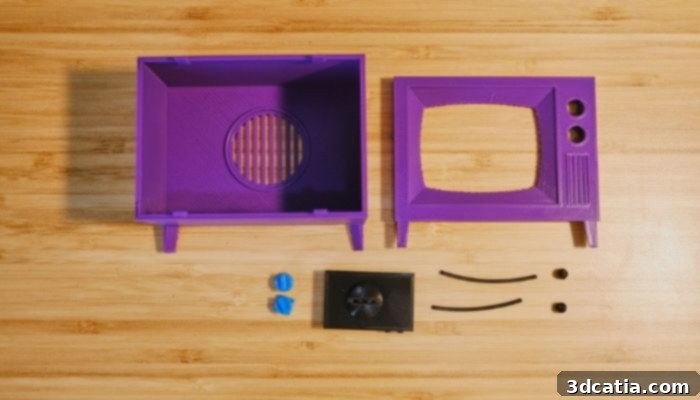
Beyond The Simpsons: Customizing Your 3D Printed Mini TV
While Brandon Withrow’s project is undeniably iconic with its Simpsons theme, the underlying principles and technologies offer boundless opportunities for customization. Imagine a mini TV playing classic cartoons from your childhood, a dedicated device showcasing a looped art installation, or even a tiny monitor displaying weather updates or a continuous feed from a specific website (if you choose to enable Wi-Fi). The beauty of 3D printing is that the enclosure can be redesigned to mimic almost any retro gadget or even invent entirely new aesthetic forms. The Raspberry Pi’s flexibility allows for different operating systems, playback configurations, or even the integration of additional sensors and features. This project is not just about replicating; it’s about learning, adapting, and innovating. It provides a robust framework upon which other makers can build, personalize, and expand, further demonstrating the potential of blending hardware and software in accessible and creative ways. The lessons learned from assembling such a device—from soldering components to flashing operating systems and designing physical parts—are invaluable for anyone interested in electronics, design, or embedded systems.
What are your thoughts on this incredible 3D-printed mini TV? Are you inspired to create your own internet-free entertainment device, or perhaps customize it with a different theme? We’d love to hear your ideas and experiences! Let us know in a comment below or join the conversation on our Facebook and Twitter pages. Don’t forget to sign up for our free weekly newsletter, where you’ll receive all the latest news, trends, and groundbreaking projects in the world of 3D printing delivered straight to your inbox!
Photo Credits: Brandon Withrow – A testament to individual innovation.