
Pioneering the Future: How 3D Printing Enabled the World’s First Double Hand and Face Transplant
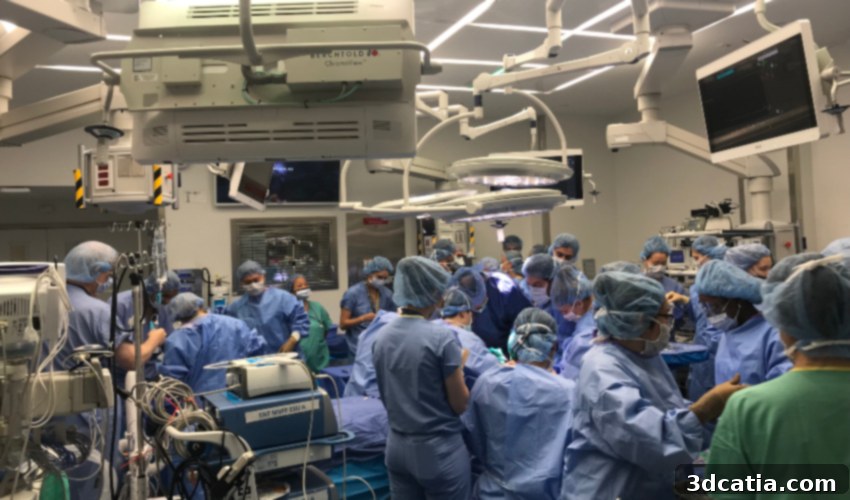
Earlier this week marked a monumental achievement in the annals of medical history as a dedicated team of Materialise clinical engineers and NYU Langone surgeons successfully performed the world’s first double hand and face transplant. This groundbreaking procedure represents a significant leap forward in reconstructive surgery, offering hope and new possibilities for patients with severe injuries. The extraordinary success of this complex transplant can be largely attributed to the innovative application of 3D printed personalized tools, which are rapidly becoming increasingly common and indispensable in routine and highly specialized surgical contexts. Materialise’s advanced 3D planning and printing technologies provided the surgical team with unparalleled levels of speed, precision, and confidence – all critical elements for the successful execution of such an intricate medical procedure. The recipient, a 22-year-old individual, tragically suffered catastrophic injuries, including severe burn wounds, extensive soft tissue damage, and profound trauma to his face and arms, following a devastating car crash. Under the exceptional leadership of Dr. Eduardo D. Rodriguez, the esteemed Helen L. Kimmel Professor of Reconstructive Plastic Surgery and chair of the Hansjörg Wyss Department of Plastic Surgery at NYU Langone, this pioneering procedure is expected to dramatically improve the patient’s physical function, restore his appearance, and significantly enhance his overall quality of life, paving the way for a more integrated and fulfilling future.
The pivotal role of 3D modeling in the meticulous preparation for this history-making surgery cannot be overstated. While the medical team had an extensive fourteen months to prepare conceptually and strategize for the procedure, the actual window for execution was incredibly narrow: once a suitable donor was identified, the surgeons would have only 24 hours to commence the operation. This compressed timeline meant that there was absolutely no margin for error, no room for flaws in the intricate surgical plan, nor for last-minute improvisations that could jeopardize the outcome. To address this formidable challenge, Materialise engineers leveraged the patient’s high-resolution CT-scans, converting them into a highly accurate and personalized 3D anatomical model. This digital replica of the patient’s unique bone structure and surrounding tissues became an indispensable tool. Thanks to this sophisticated 3D model, surgeons and clinical engineers were able to meticulously plan the entire procedure in a virtual environment, allowing them to anticipate and preempt a multitude of potential scenarios that could arise during the actual surgery. The 3D model offered an extraordinarily detailed and personalized rendering of the patient’s intricate anatomical bone structure, extending beyond mere visualization to include precise measurements and relationships between complex structures. This unprecedented level of detail enabled the surgical team to accurately rehearse the operation multiple times, virtually performing each incision, bone cut, and repositioning step. This iterative rehearsal process allowed them to fine-tune their plan with unparalleled precision, explore different approaches, and optimize every facet of the surgical strategy. Consequently, the team was able to determine the most optimal surgical flow, minimize intraoperative surprises, and create an accurate, step-by-step surgical plan that drastically reduced risks and enhanced efficiency for the demanding transplant.
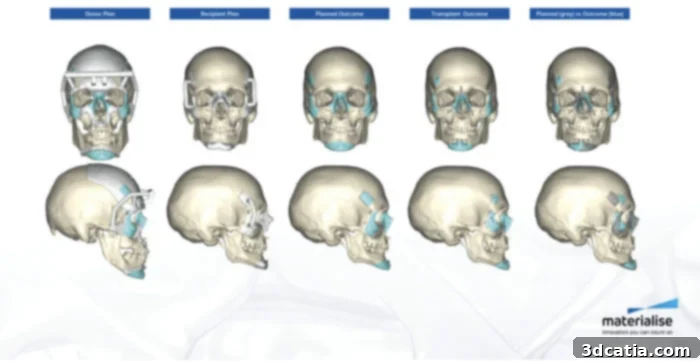
Pre-surgical planning, powered by advanced 3D modeling, allowed surgeons to virtually select and precisely position various medical implants, ensuring an optimal anatomical fit before the actual procedure. (Photo Credit: Materialise)
Bryan Crutchfield, Vice President and General Manager at Materialise, profoundly underscored the transformative impact of 3D modeling and printing, stating: “Image-based planning and medical 3D printing have completely revolutionized personalized patient care by providing surgeons with detailed insights and an additional level of confidence before entering the operation room.” He further elaborated on the widespread adoption and future implications, continuing, “as a result, leading hospitals are adopting 3D planning and printing services as part of their standard medical practices because they create a level of predictability that would be impossible to achieve without the innovative use of 3D technologies.” These detailed insights include precise anatomical measurements, the ability to foresee potential complications, and the capacity to practice challenging maneuvers in a risk-free environment. This not only bolsters surgeon confidence but also significantly enhances patient safety and outcomes. The shift towards integrating 3D planning into routine medical practices by prominent hospitals highlights a paradigm change in healthcare, where personalized, data-driven approaches are becoming the gold standard, promising greater surgical precision, reduced operative times, and more successful patient recoveries across a spectrum of complex procedures.
Beyond the virtual planning phase, the tangible benefits of 3D printed surgical tools extended directly into the operating room. These patient-specific instruments were instrumental in enabling the surgical team to precisely select the most appropriate medical implants and accurately predict their optimal anatomical positioning within the recipient’s complex structure. Once the comprehensive surgical plan was finalized and approved, Materialise utilized its advanced 3D printing capabilities to produce a range of highly customized anatomical models and specialized tools designed for direct use during the transplant surgery. This critical suite of instruments included a sophisticated, fully guided system specifically engineered for bone fragment repositioning and fixation. This system was meticulously tailored to the patient’s unique anatomy, ensuring that every bone segment could be precisely aligned and secured with unparalleled accuracy, a feat nearly impossible with traditional methods. The exceptional precision offered by these bespoke medical tools had a profound impact on the efficiency of the procedure, significantly reducing the total surgery time – a crucial factor in minimizing patient exposure to anesthesia and mitigating risks. Furthermore, Materialise also 3D printed specialized models that were vital during donor transport, allowing for accurate assessment and preparation. Additionally, custom 3D printed splints were created, enabling the optimal positioning of donor hands during the intricate phases of soft tissue reconstruction, guaranteeing the best possible integration and functional outcome for the patient.
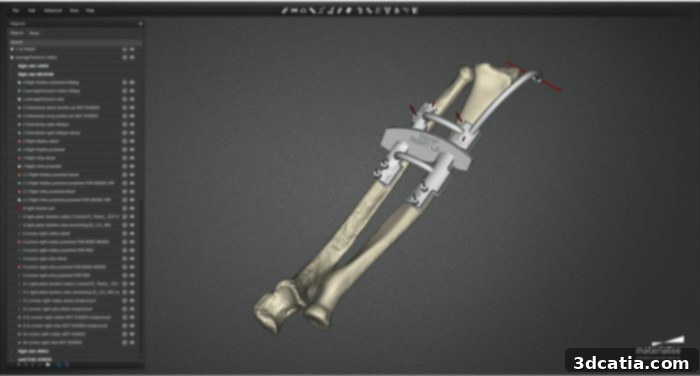
Materialise engineers meticulously coordinated the development of a detailed surgical plan and created an accurate on-screen 3D model based on high-resolution CT-scans, serving as the foundation for the complex transplant. (Photo Credit: Materialise)
According to Dr. Rodriguez, the lead surgeon on this unprecedented case, the nature of such an operation demands the highest level of planning and coordination: “Complex transplant surgery like this brings together a large team of specialists and presents new and unique challenges. This demands careful planning and makes timing, efficiency and accuracy absolutely critical. Virtually planning the surgery in 3D and creating 3D printed, patient-specific tools offers additional insights in the pre-operative phase and increased levels of speed and accuracy during a time-critical surgery.” He emphasized that uniting a multidisciplinary team, encompassing plastic surgeons, orthopedic surgeons, anesthesiologists, nurses, and many more, requires a unified, precise approach facilitated by advanced technology. The additional insights gained from 3D virtual planning include a clearer understanding of tissue interfaces, nerve pathways, and vascular connections, allowing the team to anticipate and prepare for every contingency. This level of preparation ensures that when the critical surgical phase begins, every step is executed with optimal speed and accuracy, directly correlating to better patient outcomes and minimizing intraoperative complications.
This historic double hand and face transplant, underpinned by the indispensable role of 3D planning and printing technologies from Materialise, unequivocally demonstrates the transformative power of additive manufacturing in modern medicine. It heralds a new era of personalized patient care, where surgical interventions for even the most severe and complex cases can be approached with unprecedented precision, foresight, and confidence. As medical science continues to advance, the integration of 3D printing is poised to become an even more fundamental component of surgical practice, expanding the boundaries of what is medically possible and offering renewed hope to countless patients worldwide. This remarkable achievement is not just a testament to the skill of the surgical team but also to the relentless innovation in medical technology. You can delve deeper into the specifics of this groundbreaking procedure by reading the full press release here. What are your thoughts on this incredible medical breakthrough? We encourage you to share your insights in a comment below or join the discussion on our Facebook and Twitter pages! For the latest advancements and news in the world of 3D printing delivered straight to your inbox, don’t forget to sign up for our free weekly Newsletter here.