
MIT’s Breakthrough: Ushering in a New Era of Portable Fluid Transfer with 3D Printed Magnetic Diaphragm Pumps
In a significant stride towards revolutionizing microfluidics and portable device technology, a visionary research team at MIT’s Microsystems Technology Laboratories (MTL) has successfully engineered a groundbreaking 3D printed diaphragm pump that operates through magnetic actuation. This innovative device, characterized by its remarkable portability and efficiency, stands as a compelling testament to the transformative potential inherent in additively manufactured technologies. The scientists behind this pioneering project are optimistic that this proof-of-principle pump will serve as a powerful catalyst, inspiring a broader exploration and adoption of additive manufacturing techniques. They envision these advanced methods increasingly replacing conventional mass-production approaches, particularly for intricate and specialized components.
To fully appreciate the significance of this innovation, it’s helpful to understand the fundamental concept of a diaphragm pump. Often referred to as a membrane pump, it belongs to the category of positive displacement pumps. These pumps are distinguished by their ability to move fluids by repeatedly displacing a fixed volume, typically through the reciprocal action of a diaphragm. This diaphragm acts as a flexible barrier between the fluid and the driving mechanism. Traditional applications span a vast spectrum, from industrial processes involving corrosive chemicals to precise dosing in medical equipment. Luis Fernando Velásquez-García, a principal research scientist at MIT and a key figure in this project, elaborates on the widespread utility of such pumps, noting their applicability in diverse fields, ranging “from fuel cells to power generation to heat exchangers” designed for cooling sensitive computer chips. The miniature scale and unique properties of the MIT-developed pump open up entirely new avenues for these critical applications.
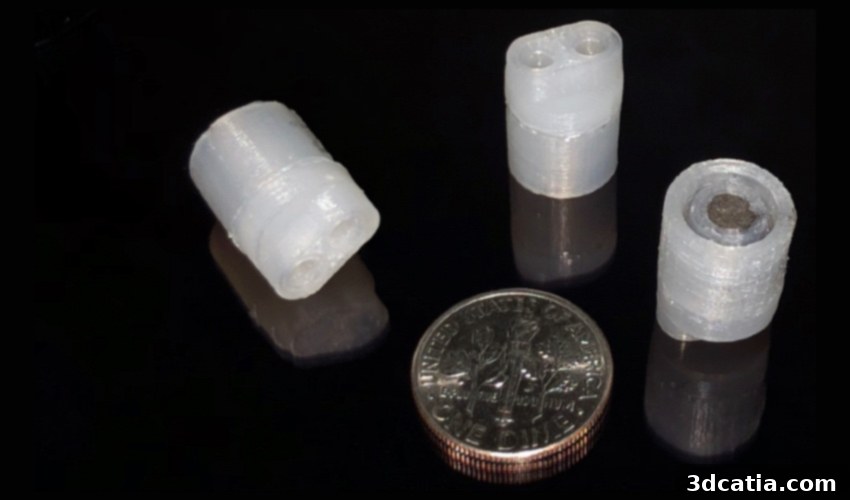
The MIT team’s 3D printed pump is exceptionally compact, boasting a mere 1-centimeter diameter. Beyond its diminutive size, its fabrication process is remarkably efficient and cost-effective. Each unit can be manufactured in approximately 75 minutes, with material costs plummeting to less than $3.89 per device. This rapid, low-cost production capability underscores one of the core advantages of leveraging additive manufacturing for specialized components. Furthermore, the device demonstrates superior performance compared to standard pumps of similar dimensions, capable of efficiently moving both liquids and gases while consuming less power and exhibiting a significantly reduced propensity for clogging. A particularly noteworthy achievement is that one of the pump designs was fabricated monolithically—meaning it was 3D printed as a single, integrated piece—a pioneering feat for this type of device.
All image credits: MIT Microsystems Technology Laboratories
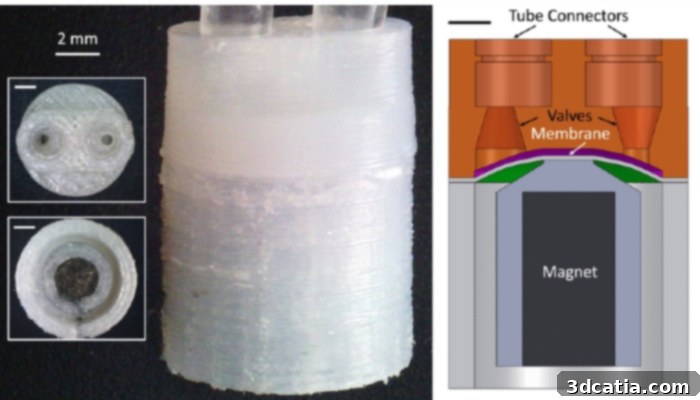
Delving into the engineering specifics, the miniature pumps are ingeniously designed in the form of cylinders, each surmounted by a flexible membrane. Above this membrane lies the fluid chamber, meticulously engineered with two valveless ports at the top, allowing for seamless tube attachment. This valveless design simplifies the structure, reducing potential points of failure and further enhancing the pump’s reliability and efficiency. For the structural material, the researchers made a deliberate choice to utilize Nylon 12, a thermoplastic renowned for its excellent mechanical properties and chemical resistance, making it an ideal candidate for applications requiring durability and precision.
The project involved the development of two distinct and innovative designs, each leveraging Nylon 12 in a unique way to achieve magnetic actuation. In the first design, a conventional magnet is precisely press-fitted into a dedicated cavity within the structure of an enclosing piston. This approach provides a robust and reliable magnetic drive. The second design, however, represents a more advanced integration of materials science and additive manufacturing. In this monolithic pump variant, the researchers innovatively embedded Nylon 12 with neodymium magnet (NdFeB) microparticles directly during the 3D printing process. This groundbreaking technique allowed for the creation of an integrated magnetic core within the pump’s structure itself, eliminating the need for separate assembly steps and enabling a truly monolithic device. Neodymium magnets are known for their exceptional strength, making them ideal for generating the necessary magnetic forces at a micro-scale.
The selection of Nylon 12 as the primary structural material was critical to the success of both designs, particularly for the embedded microparticle variant. Its inherent properties make it an exceptional choice for this specialized application. Nylon 12 possesses a unique ability to absorb and effectively integrate large quantities of magnetic particles within its polymer matrix. Crucially, it is also sufficiently sturdy and rigid to immovably hold the NdFeB microparticles in place during the initial magnetization process. This structural integrity is paramount because it facilitates the proper alignment and orientation of the magnetic domains within the microparticles, a necessary condition for the creation of strong, permanent magnets. As Velásquez-García succinctly explains, “In a softer material, the particles would wobble, resulting in no net magnetization of the magnetic composite.” This highlights Nylon 12’s dual role: acting as both a structural scaffold and a magnetic composite host.
One of the most compelling advantages of this 3D printed pump lies in its magnetically driven operation. This design choice fundamentally enhances its portability compared to more traditional pneumatic pumps. Pneumatic systems typically necessitate a physical coupling to an external source of pressurized fluid, such as an air compressor or a gas cylinder. This requirement adds bulk, complexity, and reduces mobility, making pneumatic pumps less suitable for compact or field-deployable applications. In contrast, the MIT pump, powered by magnetic fields, can be actuated wirelessly or with minimal electrical input, significantly streamlining its design and expanding its potential for integration into portable diagnostic kits, miniature robots, wearable medical devices, and advanced microfluidic systems where space and power efficiency are paramount.
The implications of this technology extend far beyond its immediate capabilities. By demonstrating the feasibility of creating complex, high-performance micro-pumps using additive manufacturing, MIT is paving the way for a new generation of devices across various sectors. In the biomedical field, these pumps could enable more sophisticated drug delivery systems, portable medical diagnostics, or even miniature lab-on-a-chip devices for rapid analysis. For electronics, the precise and efficient fluid handling could lead to highly advanced cooling solutions for next-generation processors and high-power electronic components, overcoming thermal limitations that currently impede performance. In environmental monitoring, portable magnetic pumps could be integrated into compact sensors for real-time air or water quality analysis in remote locations. The low cost and rapid fabrication also make them ideal for rapid prototyping and iterative design in research and development, accelerating the pace of innovation in numerous scientific and engineering disciplines.
This breakthrough also underscores the maturation of additive manufacturing technologies. The ability to print complex geometries, integrate multiple materials (like Nylon 12 and magnetic microparticles), and achieve functional monolithic structures is transforming what’s possible in engineering. It moves 3D printing from merely creating prototypes to producing highly functional, end-use components that surpass the capabilities of traditional manufacturing methods in specific applications. The flexibility and precision offered by 3D printing allow for intricate internal channels and custom designs that would be impossible or prohibitively expensive to achieve with conventional machining or molding. This research not only introduces a novel pump but also champions additive manufacturing as an indispensable tool for future technological advancements, especially in micro-scale engineering.
What are your thoughts on this incredible 3D printed magnetic pump developed by the visionary team at MIT? Do you envision its application in new, unforeseen areas, or perhaps overcoming existing challenges in your field? We invite you to share your insights and comments below, or connect with us on our Facebook and Twitter pages. Stay at the forefront of additive manufacturing innovations by signing up for our free weekly Newsletter, delivering all the latest news in 3D printing directly to your inbox!