

The Sparkle of Innovation: How 3D Printing is Driving the Jewelry Market to Nearly $1 Billion by 2031
The global jewelry market, renowned for its intricate craftsmanship and timeless appeal, is undergoing a transformative shift fueled by the rapid advancements in additive manufacturing. A comprehensive new study from SmarTech Analysis, specifically dedicated to the additive manufacturing market within the luxury and fashion sectors, highlights the profound impact of 3D printing on the jewelry industry. According to this pivotal report, the 3D printed jewelry market is poised for significant expansion, with projections indicating it will reach an impressive value of $989 million by the year 2031. This represents a substantial leap from its current valuation of $489 million this year, translating to a robust 10% annual growth rate over the entire study period. This remarkable trajectory is not attributable to a single factor but rather a synergy of technological breakthroughs and market dynamics. Key drivers include the exciting emergence and increasing sophistication of precious metal 3D printing processes, which enable direct production of high-value pieces, alongside the continuously declining costs of resin 3D printing machines. These highly accessible and precise machines are particularly favored by the industry for their critical role in producing high-quality molds for traditional investment casting, a method that continues to be a cornerstone of fine jewelry production.
Jewelry, at its core, is a deeply complex and multifaceted market, often intrinsically linked with the epitome of luxury, heritage, and emotional significance. It is a sector historically anchored by very traditional methods, passed down through generations, and reliant on exceptional, long-standing craftsmanship that values precision and artistry above all else. Yet, despite its deep roots in tradition, it is also a field where innovation is not just welcomed but absolutely essential. To stay competitive and captivating in a dynamic consumer landscape, players within this industry must constantly reinvent themselves, pushing creative boundaries to offer truly unique, sensational, and often personalized pieces that resonate with modern tastes while upholding classic elegance. The integration of additive manufacturing in jewelry is far from a recent phenomenon; indeed, the technology has a rich history within the sector. Historically, 3D printing was primarily utilized in the design and prototyping phases, allowing designers to quickly iterate on complex geometries and visualize concepts before committing to expensive production. It was also, and still is, extensively employed in the creation of highly detailed lost-wax casting models. This foundational application remains incredibly relevant today, and the recently published SmarTech Analysis report clearly demonstrates that these core application cases continue to hold a significant and indispensable market share, proving the enduring value of 3D printing even in traditional manufacturing workflows.
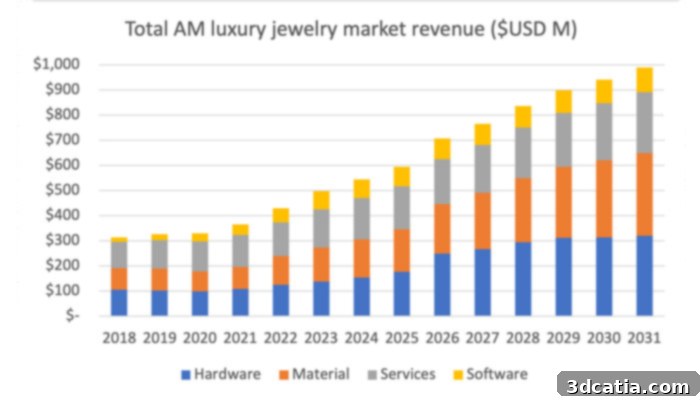
The evolution of the 3D printing and jewelry market (photo credits: SmarTech Analysis)
While the traditional applications of 3D printing in jewelry remain robust, the projected annual growth rate of 10% for the 3D printed jewelry market through 2031 is largely driven by revolutionary developments in direct metal additive manufacturing. This includes advanced processes such as binder jetting and continuous innovations around laser powder bed fusion. These cutting-edge technologies have opened up unprecedented possibilities, allowing for the direct design and fabrication of jewelry pieces using precious metals like gold, silver, platinum, and palladium. This represents a monumental leap, as jewelers can now leverage 3D printers to produce incredibly complex, intricate, and truly unique rings, necklaces, bracelets, and other ornaments that would be exceptionally challenging, if not impossible, to achieve with conventional manufacturing techniques. The ability to create lightweight, lattice structures, or highly personalized designs with unparalleled precision fundamentally reshapes what is creatively and economically viable. However, it is crucial to acknowledge the current financial implications: such advanced metal 3D printers still represent a substantial capital investment. While prices are indeed becoming more accessible than they once were, it is still unlikely that every small-scale jeweler will immediately be able to equip their workshops with their own metal additive manufacturing system. This creates opportunities for specialized service bureaus, offering access to these advanced capabilities without the prohibitive upfront cost, thereby democratizing access to direct precious metal printing for a wider array of designers and brands.
For many jewelers, particularly smaller studios and bespoke artisans, the more immediate and impactful answer to adopting 3D printing may lie in light-curing technologies, specifically resin 3D printing. According to the SmarTech Analysis study, one of the primary and most significant factors propelling market growth is the continually increasing accessibility and affordability of resin 3D printing solutions. These technologies, encompassing stereolithography (SLA), digital light processing (DLP), and LCD-based printers, offer an exceptional balance of precision, surface finish, and cost-effectiveness. Stereolithography, in particular, is renowned for its capacity to produce highly detailed parts with incredibly smooth surfaces, an absolute necessity for jewelry applications where even microscopic imperfections are critical. These machines excel at creating intricate wax patterns for investment casting, master models for mold making, and even directly printing concept models or non-precious components. Today, manufacturers in the resin 3D printing space are relentlessly striving to improve not only the already impressive print quality but also to enhance printing speed and increase build volume. This ongoing innovation means that players in the jewelry market can increasingly count on more reliable, efficient, and versatile 3D printers that seamlessly integrate into their existing workflows. The rise of specialized jewelry resins, mimicking traditional waxes for burnout, further solidifies the role of light-curing technologies as an indispensable tool for contemporary jewelers seeking both precision and productivity.
The SmarTech Analysis study extends beyond mere market forecasts, offering a truly comprehensive and granular look at the entire value chain of additive manufacturing in the jewelry sector. This detailed analysis examines forecasts across critical segments, including 3D equipment, specialized materials, sophisticated software, and essential services. Each of these components plays a vital role in the overall ecosystem of 3D printed jewelry. For instance, the demand for advanced 3D printing equipment – ranging from high-resolution resin printers to industrial metal systems – is continuously expanding, driven by technological improvements and decreasing costs. Materials development is equally crucial, with ongoing innovations in castable resins, precious metal powders, and even exotic alloys tailored for jewelry applications. Software, encompassing CAD tools for design, CAM solutions for print preparation, and simulation packages for process optimization, empowers designers to unlock the full potential of additive manufacturing. Furthermore, the growth of services, including bureaus offering print-on-demand, post-processing, and expert consultation, makes these advanced technologies accessible to a broader audience. Among the most influential and recognized players shaping this evolving landscape are industry leaders such as Sisma, renowned for their metal 3D printing solutions particularly favored in the high-end jewelry and dental sectors; Formlabs, a powerhouse in accessible, high-resolution resin 3D printing that has democratized professional-grade additive manufacturing; Desktop Metal, making strides in binder jetting for metals; and 3D Systems, a pioneer with a broad portfolio spanning various AM technologies. These companies, along with many others, are not just supplying machines but are actively innovating and collaborating to push the boundaries of what is possible in jewelry creation.
The adoption of 3D printing brings a multitude of undeniable benefits to the jewelry industry, extending far beyond the sheer ability to create complex geometries. One of the most significant advantages is the unprecedented degree of customization and personalization it facilitates. Consumers are increasingly seeking unique, one-of-a-kind pieces, and additive manufacturing allows jewelers to fulfill this demand efficiently, whether through intricate custom designs or mass customization approaches. It significantly reduces material waste compared to subtractive manufacturing methods, contributing to more sustainable production practices. The ability to rapidly prototype and iterate on designs dramatically shortens development cycles, bringing new collections to market faster and allowing for more creative experimentation. Moreover, for smaller jewelers and independent designers, 3D printing democratizes access to sophisticated manufacturing capabilities, enabling them to compete with larger brands by offering highly specialized and innovative products. This technological shift is not merely an incremental improvement; it represents a fundamental redefinition of design, production, and business models within the venerated world of fine jewelry. It empowers artisans to blend traditional craftsmanship with digital precision, creating a future where unique beauty and technological innovation go hand-in-hand.
In conclusion, the trajectory of 3D printing within the jewelry sector is unequivocally upward. The SmarTech Analysis report clearly paints a picture of a dynamic market set for substantial growth, driven by a blend of accessible resin technologies and groundbreaking direct metal printing capabilities. While challenges such as initial investment costs for advanced metal systems and the need for specialized skills remain, the overarching trend is one of innovation and expansion. Additive manufacturing is transforming how jewelry is designed, prototyped, and produced, enabling levels of complexity, customization, and efficiency previously unattainable. It promises a future where the creation of exquisite and unique pieces is more accessible, sustainable, and creatively boundless than ever before, firmly positioning 3D printing as an indispensable tool for the modern jeweler.
What do you think of the evolving role of 3D printing in jewelry? We invite you to share your insights and comments below or connect with us on ourLinkedIn,Facebook, andTwitter pages! Don’t miss out on the latest advancements and industry news by signing up for our free weeklyNewsletter here, delivered straight to your inbox! You can also find all our compelling videos and interviews on ourYouTube channel.