
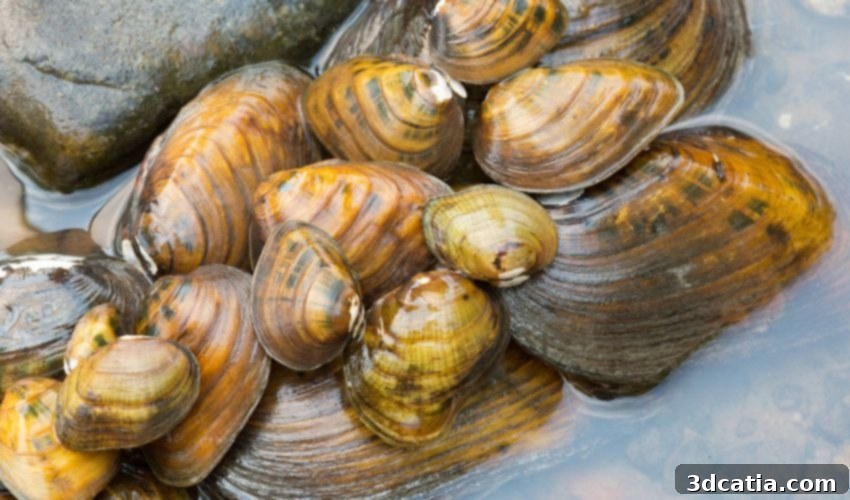
Revolutionizing Conservation: How 3D Technologies Are Saving Endangered Freshwater Mussels
The global biodiversity crisis stands as one of humanity’s most pressing challenges. Biologists worldwide are striving to preserve Earth’s delicate ecosystems by protecting countless endangered species. While iconic creatures like black rhinos, mountain gorillas, African forest elephants, orangutans, and hawksbill sea turtles often capture public attention, the sheer scale of the threat extends far beyond these well-known examples. With over 41,000 species currently assessed as being under threat of extinction by the International Union for Conservation of Nature (IUCN), the list of vulnerable life forms is extensive and includes many species in our own backyards – for instance, over 1000 species are endangered or threatened in the USA alone. Amidst this daunting challenge, a groundbreaking collaboration has emerged: scientists and imaging specialists from the Florida Museum of Natural History and the Smithsonian Institution’s National Museum of Natural History have united to deploy cutting-edge 3D technologies in a vital effort to protect one of the world’s most critically endangered groups: freshwater mussels.
The Silent Crisis: Why Freshwater Mussels Are Critical to Aquatic Ecosystems
Freshwater mussels, often overlooked due to their unassuming nature, are in fact among the most endangered animal groups globally. John Pfeiffer, curator of bivalves at the Smithsonian Institution, underscores the severity of their plight. He notes that despite the U.S. being a significant hotspot for freshwater mussel biodiversity, “Many of the country’s freshwater mussels are at risk of extinction. Roughly one out of every three species are protected under the Endangered Species Act, and another 30 species are thought to have recently gone extinct.” This alarming statistic highlights a silent ecological catastrophe unfolding beneath the surface of our rivers and streams. The potential extinction of these species could trigger catastrophic ripple effects throughout their biomes, disrupting critical ecological balances. Mussels serve as nature’s indispensable water purifiers, actively filtering water to remove algae, excess nutrients, and heavy metals from their surroundings. Furthermore, their dense colonies play a crucial role in stabilizing streambeds, preventing erosion and creating microhabitats for other aquatic life. Their health is often an indicator of the overall health of an aquatic system, making their decline a stark warning sign for our freshwater resources. This latest collaborative effort to leverage advanced technology against their rapid disappearance is therefore not just a scientific endeavor but an urgent plea for ecosystem stability.
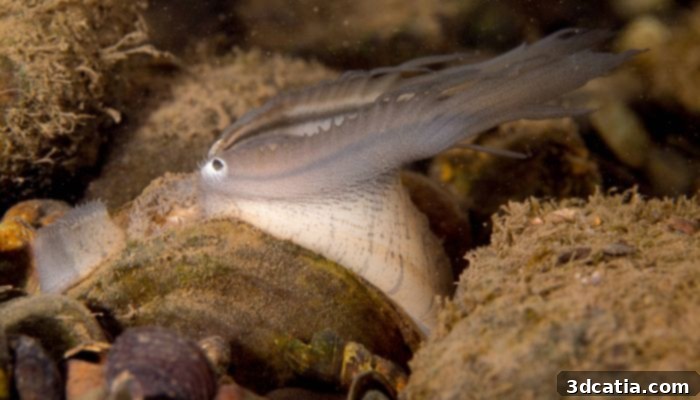
Freshwater mussels, such as these pictured here, use fish to help transport them upstream (photo credits: Ryan Hagerty, U.S. Fish And Wildlife Service, CC0)
Harnessing Innovation: 3D Technologies for Mussel Conservation
The innovative application of 3D technologies to safeguard freshwater mussels is designed as a comprehensive, two-pronged strategy. This approach aims not only to bolster scientific understanding and training but also to dramatically enhance public engagement and accessibility to critical reference materials. By integrating both physical and digital methods, researchers are creating a robust framework for long-term conservation and education.
Empowering Education Through 3D Printing
A fundamental component of effective species protection lies in cultivating widespread awareness and providing direct, hands-on resources for the biologists and conservation professionals actively working to preserve them. Recognizing this, the National Conservation Training Center is spearheading an initiative to integrate 3D-printed replicas of mussel shells into its Freshwater Mussel Identification course. This course, offered to conservation professionals across the nation as well as interested citizens, is vital for accurate species identification – a prerequisite for targeted conservation efforts. The significance of 3D prints in this context cannot be overstated. As wild mussel populations dwindle, the availability of actual reference specimens for critical research and training becomes increasingly scarce. Physical 3D models provide an invaluable substitute, offering durable, accurate, and readily available tactile learning tools. These replicas allow trainees to intimately familiarize themselves with the intricate morphological characteristics of various mussel species without disturbing fragile natural populations or relying on limited and often hard-to-access museum specimens. This hands-on educational approach enhances learning, improves identification skills, and ultimately strengthens the capacity of conservationists to protect these vulnerable bivalves, fostering a deeper understanding and appreciation for their ecological value.
Building a Digital Legacy: Photogrammetry for Virtual Collections
Beyond tangible 3D prints, another cornerstone of this ambitious project involves the creation of comprehensive digital models using advanced photogrammetry techniques. This process is building an expansive and accessible digital 3D library of freshwater mussel species. Pfeiffer elaborates on the necessity of this digital approach: “Some of the specimens are incredibly rare or delicate, and it’s next to impossible to have a comprehensive reference collection to help train people. So instead, we came up with the idea to create a digital 3D library that improves access to specimens by putting all U.S. species directly at your fingertips.” This virtual collection overcomes the physical limitations associated with traditional biological collections, making specimens that are too fragile, rare, or geographically isolated available to anyone with an internet connection, regardless of their location or the physical condition of the original artifact. This democratizes access to invaluable scientific data, enabling broader research and educational opportunities.
Photogrammetry, a technique that meticulously stitches together multiple high-resolution photographs of a single specimen into a precise 3D composite, is proving to be a game-changer in biodiversity conservation. This method is not new to the realm of digital preservation; it has been widely adopted in cultural heritage studies, where projects like Scan the World or recent efforts to preserve the Easter Island heads have successfully demonstrated the power of 3D models in promoting access to important cultural and historical artifacts. Now, the same robust and proven process is being skillfully adapted and applied to the intricate world of freshwater mussels, offering an unprecedented level of detail and accessibility for biological research and education. These digital models can be rotated, zoomed, and examined from any angle, offering insights that might be difficult or impossible with physical specimens alone, especially when considering internal structures or extremely minute features.
The Florida Museum boasts one of the fastest and most efficient photogrammetry rigs currently in operation, which has been further optimized specifically for this project. Their setup is ingeniously designed to simultaneously photograph specimens from multiple angles, ensuring comprehensive data capture. The process begins with specimens being carefully placed on an automated turntable, housed within a specially designed lightbox. As the turntable rotates, photographs are meticulously taken at programmed intervals, capturing every nuance of the mussel’s form. Once a full rotation is complete for the top half, the specimen is precisely flipped, allowing the bottom half to be similarly imaged. This meticulous 360-degree coverage guarantees that every contour, texture, and identifying feature of the mussel shell is captured in stunning detail, forming a highly accurate and versatile digital replica. This level of precision is crucial for researchers studying subtle morphological differences between species or populations, which can be key to understanding their evolutionary history and guiding conservation strategies. The efficiency and consistency of this automated system allow for the rapid digitization of a vast number of specimens, building a truly comprehensive digital library far quicker and with greater uniformity than traditional manual methods, ensuring that this vital information is preserved for future generations.
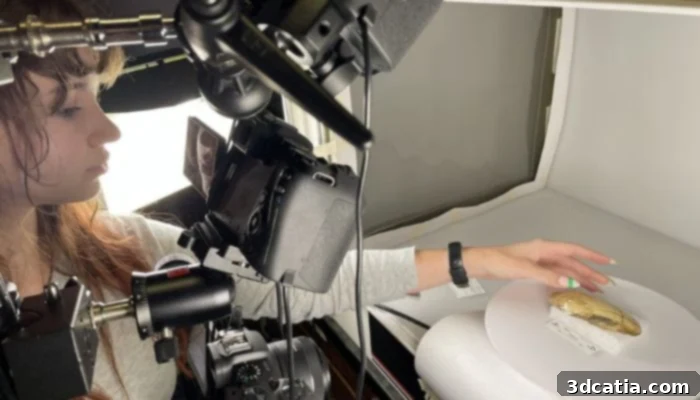
A technician positions a shell on the turntable in order to capture its image (photo credits: Zachary Randall/Florida Museum)
Beyond Mussels: The Future of Conservation with 3D Technology
This pioneering project represents more than just an effort to save freshwater mussels; it establishes a powerful paradigm for how advanced 3D technologies can be integrated into broader conservation strategies for a multitude of endangered species. The collaborative spirit between leading institutions and the innovative use of both physical and digital 3D models offer a scalable and sustainable model for biodiversity preservation across the globe. Matthew Patterson, course leader with the Services’ National Conservation Training Center, encapsulates the enthusiasm surrounding this initiative: “This project is very exciting because it provides opportunities to teach field biologists and the public how to identify all of the freshwater mussel species native to the United States, including the nearly 100 species listed as threatened and endangered. And all of this is happening in 2023 as the Endangered Species Act is turning 50 years old.” The timing of this project, coinciding with the 50th anniversary of the Endangered Species Act, further underscores its importance and the enduring commitment to protecting America’s natural heritage. This initiative is a testament to how interdisciplinary collaboration and technological advancement can provide critical tools in the ongoing fight to prevent extinctions, empowering a new generation of conservationists with unprecedented resources and knowledge, thereby ensuring a more secure future for our planet’s invaluable biodiversity.
To delve deeper into this incredible conservation effort, you can find more information in the official press release HERE, or explore the digital library directly HERE to view the meticulously crafted 3D models.
What are your thoughts on these innovative efforts to help save freshwater mussels through the sophisticated application of 3D technologies? We invite you to share your insights in a comment below or join the conversation on our LinkedIn, Facebook, and Twitter pages! Don’t miss out on the latest advancements in 3D printing and conservation; sign up for our free weekly Newsletter here, delivered straight to your inbox! Additionally, you can discover all our compelling videos on our YouTube channel.
*Cover Photo Credits: Ryan Hagerty, U.S. Fish And Wildlife Service, CC0