

Sustainable Cities of Tomorrow: The BANYAN ECO WALL’s 3D Printed Innovation in Green Walls
In an era demanding innovative solutions for sustainable urban living and architectural excellence, the BANYAN ECO WALL emerges as a groundbreaking achievement. This fully 3D printed, irrigated green wall system, developed by NOWLAB in close collaboration with BigRep, represents a significant leap forward in both architectural design and environmental technology. By leveraging BigRep’s state-of-the-art large-format FDM 3D printers, the BANYAN ECO WALL seamlessly integrates an advanced, embedded drainage and water supply system, all while showcasing a remarkable bionic design inspired directly by the efficiencies of natural systems. This prototype isn’t merely a testament to what can be achieved with advanced 3D printing technologies; it is a vivid demonstration of unprecedented innovation across design aesthetics, functional efficiency, technological integration, and large-scale application possibilities. It exemplifies how additive manufacturing can transform passive structures into active, life-sustaining elements of our built environment, fostering greener, healthier urban spaces.
The Revolutionary Embedded Water Management System
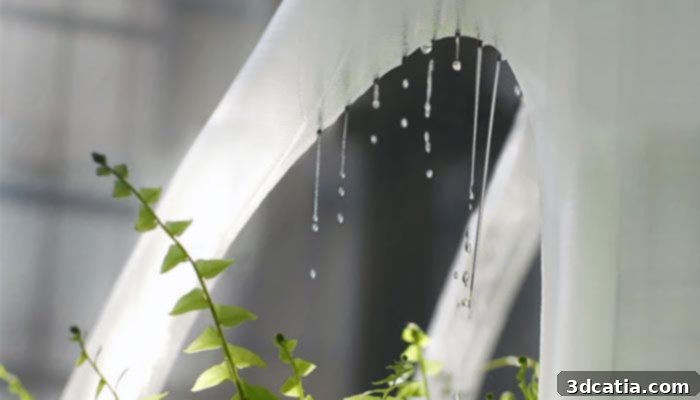
One of the most profound innovations within the BANYAN ECO WALL lies in its ingenious embedded water supply and drainage system. Traditionally, integrating such complex fluidic systems into architectural elements would involve a cumbersome process of assembling numerous separate components, often leading to inefficiencies, potential leaks, and increased installation costs. However, as BigRep CEO Stephan Beyer, PhD, explains, this project shatters those conventions: “Our BANYAN ECO WALL is adopting nature’s principle with a complex, smart, elegant design only achievable with AM. Traditional technologies such as milling or injection molding cannot deliver this level of complexity and dual functionality. For the first time, thanks to AM and advanced CAD software, it is now possible to create complex functional designs with a fully digitized process chain.” This statement highlights a paradigm shift. Additive Manufacturing (AM) allows the entire wall module, including its intricate internal channels for water distribution and drainage, to be printed as a single, cohesive unit. This integration not only streamlines the manufacturing process but also significantly enhances the system’s reliability and durability. The embedded nature ensures precise water delivery to the plants while efficiently removing excess water, preventing root rot and optimizing plant health.
Prior to the advent of such advanced prototyping capabilities, any attempt to integrate a drainage system into a green wall would necessitate complicated, multi-part setups, often pieced together in a secondary stage. Such traditional approaches are prone to design limitations, assembly challenges, and higher failure rates. The BANYAN ECO WALL circumvents these issues by embedding the entire water management infrastructure directly into the wall’s structure during the printing process. This monolithic design dramatically reduces the number of components, simplifies installation, and creates an optimal, self-regulating environment where plants can thrive effortlessly. This seamless integration ensures that every plant receives the precise amount of water it needs, minimizing waste and maximizing ecological benefits.
Bionic Design: Learning from Nature’s Blueprints
Credits: BigRep
The aesthetic and functional elegance of the BANYAN ECO WALL are deeply rooted in principles of bionic design. This approach involves studying natural forms and processes to inspire engineering solutions, mirroring nature’s efficiency, resilience, and adaptability. In the context of this green wall, bionic design manifests in the organic, flowing forms of its structure and, critically, in the intelligent routing of its internal channels. These miniature, intricate pathways are meticulously designed for optimal water flow, ensuring that irrigation is precise and localized exactly where the plants need it most. This biomimetic approach not only enhances the wall’s visual appeal, giving it a harmonious, organic look, but also significantly boosts its functional performance, making it highly efficient in resource management. The intricate internal geometries, reminiscent of vascular systems in plants or the branching patterns of banyan roots, are impossible to achieve with conventional manufacturing methods, further cementing additive manufacturing’s unique capabilities.
The Power of Large-Format Additive Manufacturing
The realization of the BANYAN ECO WALL would not have been possible without the capabilities of large-format 3D printers, particularly those developed by BigRep. These industrial-scale machines enable the printing of large, complex architectural components in a single piece, overcoming the size limitations often associated with traditional 3D printing. The ability to print substantial sections of the green wall at once reduces the need for multiple smaller parts to be joined, which minimizes potential weak points, enhances structural integrity, and accelerates assembly times. This is particularly crucial for architectural applications where seamless integration and structural robustness are paramount. Large-format 3D printing offers unparalleled design freedom, allowing architects and designers to create intricate geometries and integrated functionalities that were once confined to the realm of theoretical concepts. BigRep’s technology not only facilitates the creation of prototypes like the BANYAN ECO WALL but also paves the way for the production of full-scale architectural elements, pushing the boundaries of what is manufacturable in the construction and design industries.
Generative Design: Optimizing Form and Function
Behind the BANYAN ECO WALL’s sophisticated structure and efficient functionality lies the critical role of generative design software. This advanced computational tool was indispensable throughout the design process, allowing the NOWLAB team to explore countless design iterations rapidly and optimize the structure for a multitude of criteria simultaneously. Daniel Büning, BigRep CIO and NOWLAB Managing Director, emphasizes its importance: “Generative design software was crucial in the creation of the BANYAN ECO WALL to optimize the structure for printability and stability while allowing a rapid iterative design process. This prototype will push the boundaries of AM not only in irrigated plant systems, such as in vertical farming and green facades, but for any application requiring embedded functionalities.” Generative design algorithms can simulate various environmental conditions and structural loads, proposing optimized geometries that maximize material efficiency, ensure structural integrity, and perfect the intricate water flow paths. This iterative process, driven by data and computational power, significantly reduces development time and costs while leading to superior performance characteristics that would be challenging, if not impossible, to achieve through traditional manual design methods. It ensures that every aspect of the wall, from its overall shape to its internal capillaries, is perfectly tuned for its purpose.
Broadening Horizons: Applications and Environmental Impact
The implications of the BANYAN ECO WALL extend far beyond its immediate prototype. This innovation is poised to push the boundaries of additive manufacturing in numerous sectors. Its potential in irrigated plant systems, such as vertical farming and green facades, is immense. Vertical farming promises to revolutionize urban agriculture, bringing food production closer to consumers, reducing transportation costs and environmental footprints. Green facades contribute significantly to urban ecology by improving air quality, reducing the urban heat island effect, enhancing biodiversity, and providing aesthetic value. But the scope of this technology doesn’t stop there. Any application requiring complex embedded functionalities—from smart infrastructure with integrated sensors and cooling channels to bespoke medical devices with intricate fluidic pathways—stands to benefit immensely from this pioneering approach. The BANYAN ECO WALL demonstrates that 3D printing can create intelligent, multi-functional components that seamlessly integrate form and function, paving the way for a new generation of smart, sustainable products and architectural elements that actively contribute to a healthier planet. It offers a tangible solution to complex environmental challenges facing our cities today, fostering greener, more livable urban environments.
NOWLAB and BigRep: Visionaries in Additive Manufacturing
The BANYAN ECO WALL project is a testament to the collaborative ingenuity of NOWLAB, the BigRep Innovation Consultancy. Spearheaded by lead designers Mirek Claßen, Tobias Storz, and Lindsay Lawson, this team exemplifies the forefront of additive manufacturing research and development. NOWLAB, as BigRep’s dedicated innovation hub, consistently explores and pushes the capabilities of large-format 3D printing, striving to unlock its full potential for industrial and creative applications. BigRep, a global leader in large-format 3D printing solutions, provides the robust technology necessary to bring such ambitious projects to life. Their commitment to innovation, coupled with NOWLAB’s visionary design and engineering expertise, creates a powerful synergy that continuously redefines what is possible with advanced manufacturing. The BANYAN ECO WALL is a prime example of their shared vision to create sustainable, functional, and aesthetically captivating solutions that leverage the unique advantages of additive manufacturing, setting new benchmarks for integrated design and environmental performance in the architectural and urban development sectors.
Join the Conversation on the Future of Green Design
The BANYAN ECO WALL stands as a powerful symbol of how advanced manufacturing and visionary design can converge to create solutions that are not only aesthetically pleasing but also profoundly impactful on our environment and urban landscapes. Its intelligent integration of bionic principles, embedded systems, and large-format 3D printing marks a significant milestone in sustainable architecture. We are at the cusp of a future where buildings actively contribute to ecological balance, and the BANYAN ECO WALL is a compelling glimpse into that potential. What are your thoughts on this revolutionary 3D printed green wall and its implications for sustainable urban development? We invite you to share your insights and comments below, or engage with us on our Facebook and Twitter pages! To stay informed about the latest breakthroughs in additive manufacturing and sustainable innovation, don’t forget to sign up for our free weekly Newsletter, delivering all the essential news straight to your inbox. Be part of the conversation shaping the future of design and sustainability!