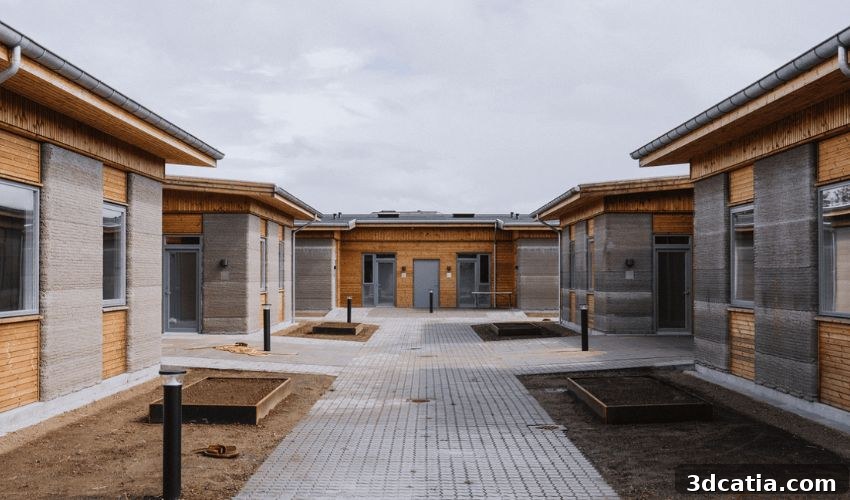
Denmark enforces one of Europe’s strictest cost caps on subsidized housing, a constraint that has suppressed new affordable construction for years. In Holstebro, a site-built 3D printing project has found a way around that barrier.
3DCP Group has completed Skovsporet (“The Forest Trail”), a 36‑apartment student village that is now Europe’s largest 3D‑printed housing development. Printed on site with a COBOD BOD3 construction 3D printer for housing association NordVestBO, the development came in comfortably under the statutory cost cap while delivering sculptural, curved buildings that would have been prohibitively expensive using conventional methods. The first students have already moved in.
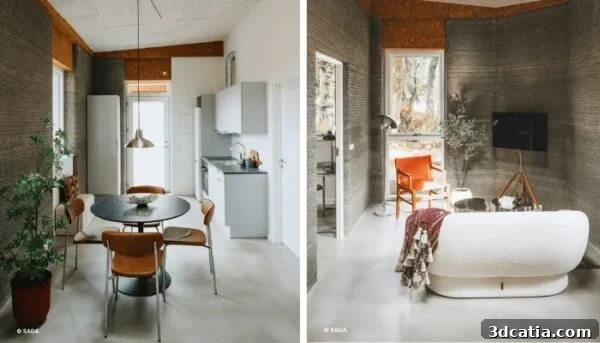
Skovsporet covers 1,650 m² (about 17,800 sq ft) across six buildings, arranged into clusters of six apartments each. Units vary from 38 to 50 m² (around 410 to 540 sq ft). The village, located adjacent to VIA University College, was designed by SAGA Space Architects in collaboration with MS+. The combination of site printing and compact design enabled an efficient footprint and a cohesive community layout.
3D Printing Housing: Beating the Cost Cap
The project achieved a delivered cost of €1,880 per m² (approximately $205 per sq ft), excluding design, engineering, utility connections, and landscaping. For residents, that means rents starting at about €670 (~$780) per month for a 50 m² apartment, making Skovsporet a noteworthy example of affordable student housing created with additive construction techniques.
A key economic advantage is the freedom to produce curved architectural forms without added expense. In traditional construction, curves often require custom brickwork, bespoke formwork, or expensive precast elements—each adding cost. With large‑scale 3D printing, a curve costs no more than a straight wall, allowing Skovsporet’s rounded, sculptural façades without a premium. The project also sourced materials locally, including a cement formulation with up to 30% lower CO₂ emissions in production compared with conventional cement, improving both cost and environmental performance.
A Three‑Person Crew Printed One Building in Five Days
All 36 apartments were printed on site using a single COBOD BOD3 printer, operated by a compact crew of three—a fraction of the labor required for a comparable conventional build. The team could print one building, containing six apartments (275 m², roughly 3,000 sq ft), in just five working days. Automating the heaviest and most repetitive tasks reduced physical strain on workers and improved site safety, while the digital workflow ensured consistent wall precision across each cluster.
“The technical breakthrough was not printing one successful structure,” said 3DCP Group Co‑Founder and CEO Mikkel Brich. “It was repeating the process across six clusters while improving speed, maintaining accuracy, and integrating the printed elements with conventional building systems.”
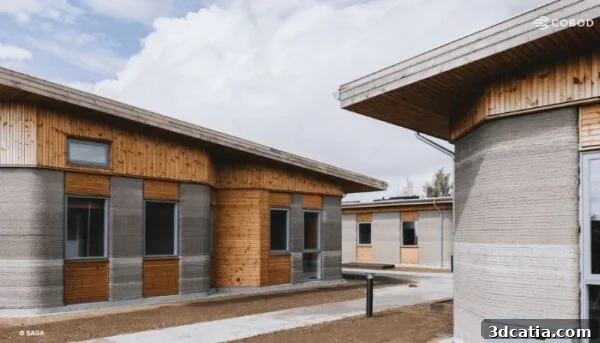
Interior Design and Materials
Each apartment is a fully functioning home with a kitchen, study area, lounge, bathroom, and sleeping space. Thoughtful daylighting—with roof windows and sloped ceilings—brings natural light deep into the units. Printed concrete is combined with timber, cork paneling, and glass to create a warm Scandinavian interior aesthetic. The six buildings frame shared courtyards with gardens, footpaths, and cycle parking, balancing private living spaces with communal outdoor areas that support student life.
Residents have responded positively to the new typology. One tenant, Amalie Hvas, described her first impression: “I like it. It gives the building character. When you think of 3D printing, you picture a little machine making something in plastic, not an entire apartment!”
Skovsporet demonstrates how large‑scale 3D printing can expand design freedom, cut construction time, and lower costs while meeting strict regulatory cost ceilings for subsidized housing. As the technology matures, projects like Skovsporet offer a model for affordable, sustainable student housing and a practical example of how additive construction can deliver both form and function within tight budgetary limits.
*Photo credits: COBOD