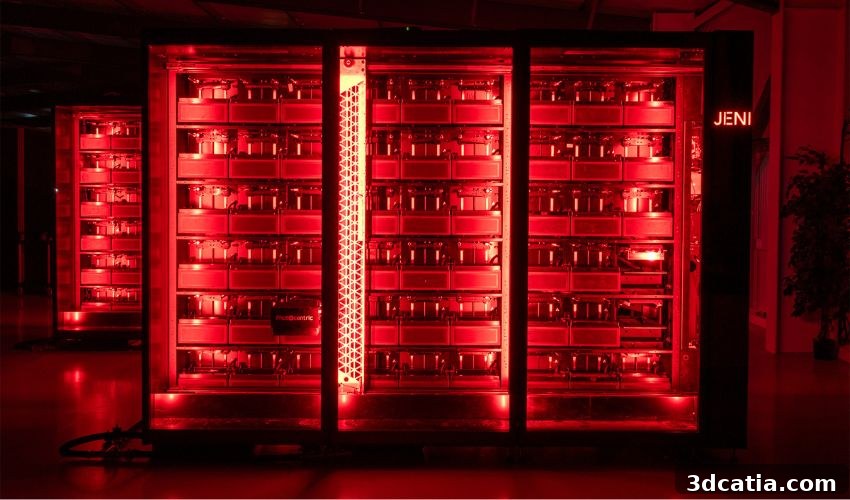
JENI does not look like a conventional 3D printer. It appears as a tall, internally lit tower with modular sections stacked like server racks. Add modules and capacity increases. Reconfigure a node and the system adopts a new process. A single installation can produce hundreds of thousands of parts per day, and in some configurations exceed a million.
Photocentric introduced JENI as an autonomous production platform that pairs high-resolution LCD 3D printing with automated post-processing. The platform is designed to manufacture plastic parts at volumes and costs that the company positions as competitive with injection molding.
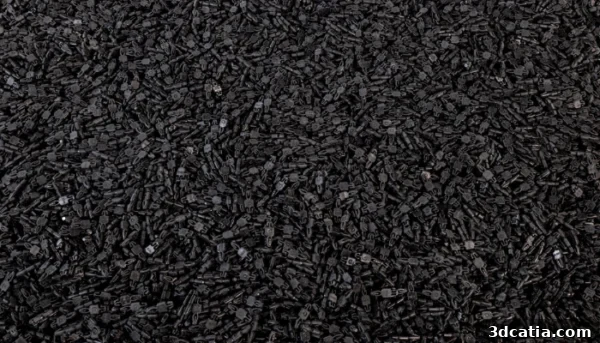
Standoffs 3D printed by JENI in the hundreds of thousands.
It’s Time to Use 3D Printing for Mass Production
Additive manufacturing has long excelled at prototyping and making complex or bespoke components, but it has rarely been considered viable for the simple, high-volume parts that keep many industries running: clips, caps, connectors and grommets produced in the millions. Photocentric argues that this limitation was not primarily a printing problem but an operational one—labor, part handling, batch inconsistencies and material cost held volumes back. JENI is built to run continuously and unattended, with each job carrying its own set of process parameters to remove those bottlenecks.
Highly automated, JENI eliminates much of the labor expense. For example, a single module can produce roughly 238,000 standoffs per day at a material cost below $0.02 each, making material the primary variable cost. Users can run Photocentric’s proprietary resins or other compatible 405 nm materials.

How JENI Works
Photocentric describes JENI as “injection molding without tooling.” It automates production by combining high-resolution LCD 3D printers with robotic post-processing nodes. Customers can start with a single robotic controller and one process module, then scale by adding modules as demand increases.
A digital job submitted to JENI includes both print instructions and the full post-processing sequence—wash cycles, cure times, and other parameters. The system monitors node availability, routes each job to the next appropriate node, and a gantry moves print platforms into position. Because every job is treated as unique, JENI can handle mixed geometries and different post-process sequences in the same production run. Machine learning is used to optimize jobs for cost, speed, carbon footprint or quality.
Good for the “Boring Parts”
Photocentric’s customers already use resin printing for dental models, footwear molds, jewelry and miniatures. JENI extends that viability to simple, high-volume components—what the company calls “the boring parts.” Internally, Photocentric prints housings, mounts, brackets, connectors, clips, knobs and more. Producing these parts in-house can be faster and cheaper: for example, cable grommets printed on JENI can cost about $0.07 each versus $0.34 each when purchased externally.
Because JENI is an open-materials platform, different nodes can run different resins simultaneously. A dental lab could, for example, print orthodontic models on several nodes, trays on others, and crowns or bridges on separate nodes in a single system.
Covid-19: A Moment of Realization
JENI’s development was informed by Photocentric’s Covid-19 experience operating a farm of 52 printers that produced more than a million face shields a month. That large-scale production revealed operational challenges—logistics, handling and scaling—that shaped JENI’s design.
“Over the last six years the mission for Photocentric has been to enable digital mass manufacturing as a practical alternative to injection molding,” said Paul Holt, Managing Director of Photocentric. “We called this project JENI after the Spinning Jenny. JENI brings the concept of digital file in, digitally made part out, to reality.”
Specifications and Part Quality
JENI’s pixel pitch measures 24.8 µm x 16.8 µm, delivering fine features, readable text and surface finishes that Photocentric says rival injection molded parts without need for secondary finishing. Layer thickness is adjustable per job—from common values like 25, 50 or 100 µm up to 250 µm—so parts in the same batch can print at different layer heights depending on required speed and surface quality. The current build envelope set by JENI’s 10-inch screen is 224 x 127 x 57 mm, a size chosen because parts produced in very high volumes are typically small.
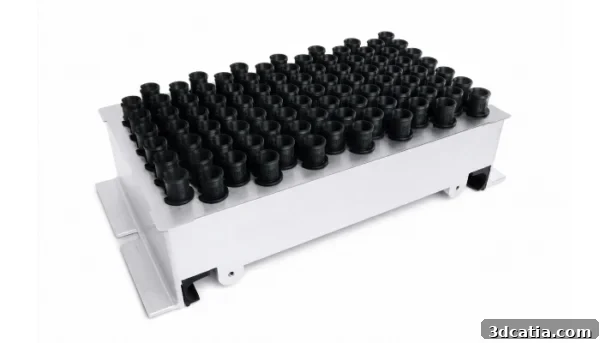
JENI is suitable for mass producing parts like grommets, pictured above.
Part complexity is effectively unconstrained: there are no draft angles, split lines or ejector pins to design around. Undercuts and internal geometry add no extra cost beyond their volume. Surface textures and decorative finishes can be included without tooling changes, unlike injection molding where textures are machined into a fixed tool at significant cost.
What Does Hands-Off Really Mean?
JENI is engineered for lights-out operation with minimal daily oversight. Most installations use intermediate bulk containers (IBCs) of resin that are swapped every few days, with occasional maintenance of nodes. The platform delivers finished parts ready for a short downstream step—sorting, packing or assembly—handled by standard automation matched to JENI’s output. With a platform completing roughly every 20 seconds, an unattended overnight shift can produce enough parts to stock a small warehouse if downstream processes are aligned.
The Sustainability Case: 85% Carbon Savings
Photocentric highlights three pillars of sustainability: material sourcing, process efficiency and end-of-life strategies. The company formulates its own photopolymers and increasingly uses monomers and oligomers synthesized from bio-waste, food waste and agricultural residues instead of petrochemicals. An example is Durable DL902 Plant-Based, an ABS-like engineering resin containing 52% bio-based raw material that, after curing, achieves engineering-grade mechanical properties.
Materials: Synthesized from Bio-Waste
DL902 is presented as an engineering resin with balanced strength and flexibility, demonstrating that modern photopolymers can overcome the brittleness associated with early-generation SLA resins.
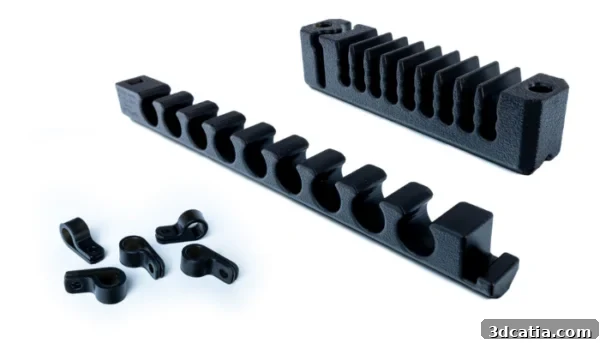
Parts made from DL902.
Process Efficiency: Tested by the MTC
Independent modeling by the UK’s Manufacturing Technology Centre compared injection molding to Photocentric’s LCD additive process for a mass-produced PCB spacer. The study reported a per-part greenhouse gas footprint of 8.809 gCO2e for the injection-molded part versus 1.322 gCO2e for the JENI-produced part—an 85% reduction driven largely by reduced material waste (no sprues, runners or start-up scrap). Photocentric notes this comparison is conservative and excludes mold machining and other factors that would further favor additive production.
End of Life
Cured photopolymers are thermosets and cannot be remelted like thermoplastics. Photocentric pursues three responses: minimizing scrap through dense packing and reclaiming uncured resin; energy recovery, leveraging the high calorific value of cured resins in energy-from-waste facilities; and chemistry development aimed at cleavable bonds that could allow cured networks to be broken back into reusable oligomers in the future.
The Business Case
When customers model the full production cost—materials, labor, energy, tooling, scrap, storage, obsolescence and stockout risks—JENI has repeatedly proven competitive, particularly for low-value, high-volume components where small cost differences determine feasibility. The types of parts now running on JENI—simple, cheap components produced in very high quantities—illustrate the platform’s economic relevance.
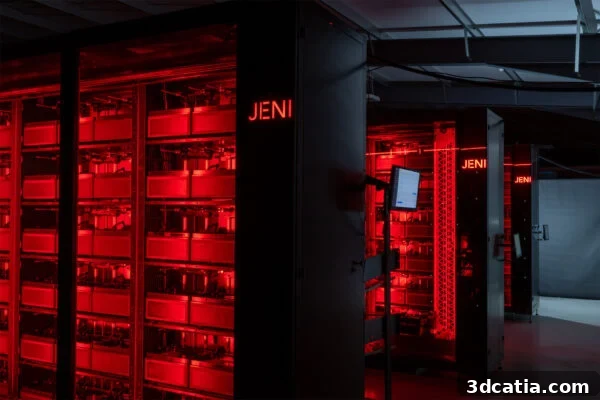
With multiple modules of JENI, users can print millions of parts per day.
JENI’s Availability
JENI is available to order. Photocentric quotes a lead time of approximately three months to Factory Acceptance Test, though the full timeline depends on part testing, material selection and validation performed before ordering. After delivery, a Site Acceptance Test verifies the system with the customer’s parts, the team receives training, and the installation moves to an ongoing service agreement.
“The next phase is to add more process nodes to expand applicability to different geometries and to demonstrate how digital manufacturing changes decisions, moving from prototype-then-tool to digital manufacturing at scale,” Holt added.
For decades, additive manufacturing was told it could not make the everyday parts that industry depends on. Photocentric’s JENI aims to challenge that assumption by delivering digital, tool-free production at scale with competitive costs and a smaller carbon footprint.
*All Photo Credit: Photocentric