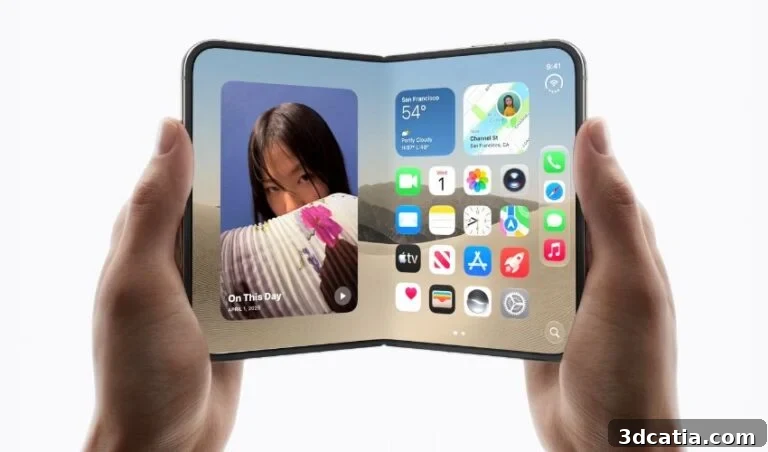
Last week, Apple introduced the iPhone Duo, its first foldable phone. While many comparisons online focus on how it stacks up against Samsung’s Galaxy Z Fold8, the most important advancement for the additive manufacturing industry is a single component: the hinge.
Apple’s hinge cover for the iPhone Duo is produced with 3D printing using 100% recycled Grade 5 titanium. The hinge cover receives a bead-blasted finish that contrasts with the mirror-polished surfaces of the rest of the chassis. The entire hinge assembly comprises more than 100 individual components, making it a complex and critical element of the device.
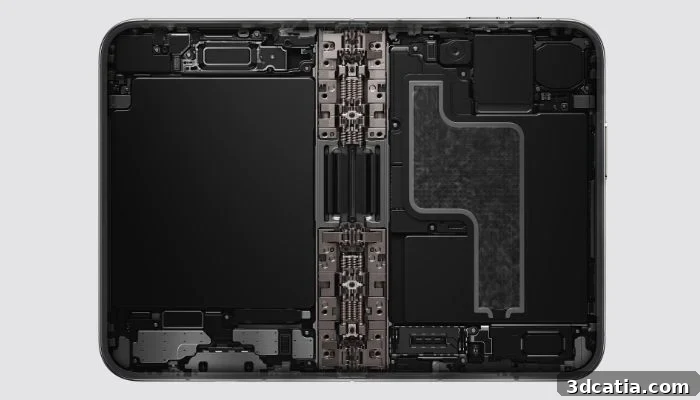
Inside the iPhone Duo, the hinge and its more than 100 components sit alongside the new A20 Pro chip and a vapor chamber that dissipates heat.
A noteworthy step in Apple’s process takes place after the initial printing and machining. During the product presentation, Johny Srouji, Apple’s Senior Vice President of Hardware Technologies, described how a confocal laser scans the surface topology of each hinge unit. The system then applies up to 25 micro-layers of a custom-developed photopolymer to eliminate residual waviness and refine the mating surfaces. AI-driven algorithms analyze the scanned geometry and match each hinge to the specific housing that yields the best mechanical fit and tolerance compensation.
Honor and OPPO Used Additive Manufacturing First
Apple’s method is not entirely without precedent. Earlier this year, OPPO announced a similar approach for its Find N6, using a process it calls Liquid 3D Printing. That technique combines laser scanning with ultra-small photopolymer droplets—on the order of five picoliters—and builds up a flat, precise base beneath the display through roughly 20 repeated passes. The result is a highly controlled interface surface optimized for folding displays.
Honor also employed additive manufacturing prior to Apple. In 2023, Honor’s Magic V2 featured a titanium hinge produced with laser powder bed fusion (LPBF), marking one of the first uses of additive manufacturing in series production for consumer electronics hinges. Those early moves by OPPO and Honor illustrated how additive techniques can address the unique challenges presented by foldable devices, such as tight tolerances, wear resistance, and complex geometries that are difficult to produce with traditional machining.
Samsung’s approach for the Galaxy Z Fold8 takes a different path: rather than use 3D-printed hinge components in its publicized designs, Samsung incorporates a titanium alloy film beneath the panel and relies on precision stamping and assembly methods for its folding mechanism.
For Apple, the adoption of 3D printing in the iPhone Duo represents the culmination of an extended internal effort. The company has disclosed that it has spent roughly a decade exploring additive manufacturing while evaluating how the technology could meet its rigorous quality and production-scale requirements. Apple previously transitioned to LPBF for the titanium cases of the Apple Watch Ultra 3 and Series 11, and later applied 3D printing to produce the iPhone Air’s USB-C port components. Those steps helped Apple build the expertise and process control needed to apply additive methods to a part as critical and wear-prone as the hinge.
Using recycled Grade 5 titanium, precision laser scanning, micro-layer photopolymer smoothing, and AI-guided part matching, Apple is positioning additive manufacturing at the heart of a high-volume consumer product where reliability and surface quality are essential. The hinge’s intricate design and the company’s layered finishing process show how additive manufacturing can be integrated with scanning, software, and finishing techniques to produce components that meet demanding functional and aesthetic standards.
This move signals a broader trend: manufacturers are increasingly willing to combine additive manufacturing with advanced inspection and digital matching workflows to solve real-world assembly and wear challenges. As foldable devices become more mainstream, hinge design will remain a focal point for innovation, and 3D printing is likely to play a growing role in making those innovations practical at scale.
What do you think about the use of 3D printing in the iPhone Duo hinge? Share your thoughts in the article comments or on social media pages. If you follow developments in additive manufacturing, you can subscribe to newsletters and channels that cover 3D printing news to stay informed.
*All photo credits: Apple