
If you follow 3Dnatives, you may already know Gil Lavi. We previously profiled him and his company, 3D Alliances, and have followed their activities as they launched programs to help additive manufacturing companies optimize their channel networks. This article focuses on a key part of 3D Alliances’ work: talent acquisition for the 3D printing and additive manufacturing (AM) industry.
3D Alliances partners with hardware, software, and materials manufacturers to support growth through channel recruitment, marketing and lead generation, revenue acceleration, strategic alliances, and targeted talent acquisition. In this interview, Gil Lavi explains why companies turn to 3D Alliances for hiring, how their approach differs from typical recruitment firms, and how two decades of industry experience inform their methods. He also highlights current hiring trends in AM and which roles are likely to be most important going forward.

Talent Acquisition as Part of the Bigger Picture
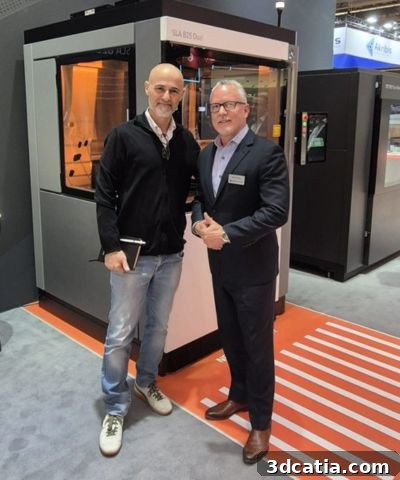
Gil Lavi, and Elvis Perez from 3D Systems.
3D Alliances maintains a global reseller network of more than 3,100 3D printing resellers across 81 countries, forming one of the industry’s largest AM ecosystems. The core team of 11 professionals is distributed across Asia, Europe, and the Americas, bringing local market knowledge and wide industry reach.
The company supports clients at every stage, from startups beginning international expansion to established players pursuing strategic initiatives. Resellers often represent multiple manufacturers in local markets, selling hardware, software, and materials on behalf of companies that cannot maintain a direct presence everywhere. When a manufacturer in the U.S. wants to sell in Germany or Japan, for example, partnering with a local reseller who understands the language, customers, and market dynamics is typically the most practical approach.
3D Alliances commonly begins by recruiting and onboarding channel partners for clients. Once partners are in place, companies need staff to manage those relationships and drive sales. Because 3D Alliances already understands the client’s products, challenges, and network, talent acquisition becomes a natural extension of their services. This integrated approach sets them apart from generic recruitment agencies.
A defining advantage is the team’s hands-on industry experience: of the ten people on the team, eight previously worked directly for 3D printing companies or resellers. That background gives them first-hand insight into roles such as channel management, internal dynamics, and the specific traits that predict success in AM positions. Combined with a network of over 8,000 AM professionals cultivated over a decade, 3D Alliances can identify candidates who fit both skill and culture.
Two Companies, Two Different Hiring Challenges
Two recent client engagements illustrate how channel development and hiring often reinforce each other.
XJET, an Israeli company focused on metal and ceramic 3D printing, engaged 3D Alliances to expand its partner network across Asia. As the regional channel footprint grew, XJET needed a Senior Regional Sales Manager to oversee partners and manage strategic accounts. Because 3D Alliances already knew the company, the products, and the local partners, they were well positioned to source a strong candidate quickly and effectively.
Mastrex, a younger U.S.-based company, faced a different challenge: building their first sales and pre-sales team in North America from scratch. They needed professionals who could engage early customers and thrive in a fast-moving startup environment. 3D Alliances’ industry-focused recruitment process and access to experienced AM professionals enabled Mastrex to staff those roles quickly, accelerating their entry into the market.
Finding People and Creating Roles
Most talent assignments begin with an open position from a client. But 3D Alliances also receives direct approaches from AM professionals through LinkedIn, email, and trade shows. When a candidate reaches out, the team either matches them to existing openings or proactively identifies companies and markets that would benefit from hiring that person.
For example, a candidate in South Korea contacted 3D Alliances seeking new opportunities. Instead of waiting for relevant job postings, the team reached out to European and American companies to explore whether they would consider expanding into South Korea. Some companies were not focused on that market, while others indicated they would be open to expansion if a strong candidate were available. Acting proactively in this way creates employment opportunities that might not otherwise exist.
What Makes a Position Difficult to Fill?
According to Lavi, many common AM roles—sales managers, channel managers, marketing professionals, and application engineers—are generally sourceable, even though searches can be time-consuming. The real challenges are often geographic and cultural. Hiring across regions such as Japan, South Korea, and China can be harder due to language barriers and different business customs. Beyond language, differences in working styles—such as the pace of decision-making and team dynamics between startups and established firms—also affect whether a hire will succeed.
In-Demand AM Jobs: Now and in the Future
Lavi notes a clear shift in the AM market away from pure prototyping and toward industrial production. As customers scale from prototypes to manufacturing, demand has grown for production-focused skills. Roles in production engineering, applications engineering, process engineering, and manufacturing engineering are currently among the most in demand because companies need expertise to produce parts reliably and cost-effectively at volume.
Lower-cost prototyping solutions are reshaping the market and pushing established AM vendors to emphasize production use cases. Looking ahead, Lavi expects continued growth in positions related to automation and robotics, AI and data analytics, digital manufacturing, and process monitoring—roles that support consistent, scalable production. Identifying candidates with these specialized skills and a clear understanding of manufacturing at scale will be increasingly important for companies seeking long-term success in additive manufacturing.
3D Alliances’ talent acquisition work reflects this forward-looking perspective: by understanding where the industry is headed, they can find people who will help clients grow and compete. If your team is planning to expand or professionalize its AM operations, a targeted, industry-specific recruitment approach can make the difference between a good hire and the right hire.
*Cover Photo Credit: Gil Lavi, 3D Alliances
