
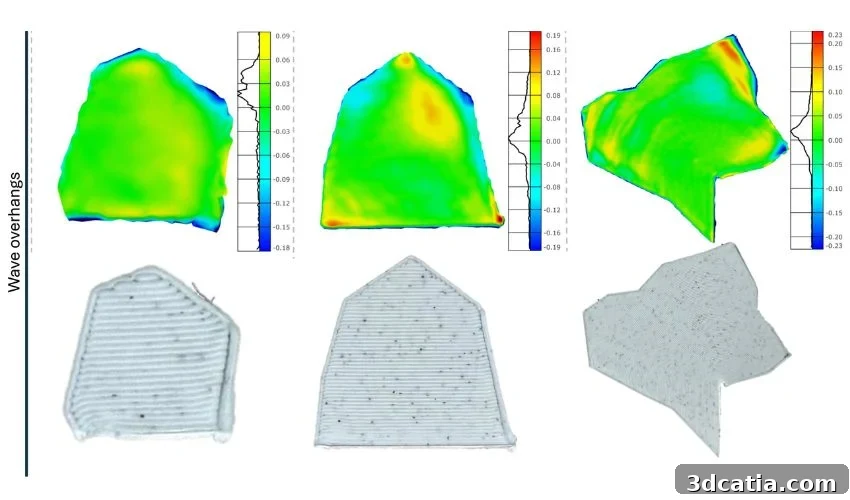
For years, users of standard 3-axis fused deposition modeling (FDM) 3D printers have worked around the same limitation: horizontal overhangs usually require support material. Without a sacrificial structure beneath the feature, the freshly extruded thermoplastic can droop, stretch, or collapse before it cools. This rule has shaped the way parts are designed, sliced, printed, and post-processed. However, a recent research breakthrough suggests that the limitation may not be as fixed as many makers and engineers once believed. A team of researchers has introduced a wave-inspired path-planning strategy that enables conventional FDM printers to produce cantilevered horizontal overhangs without support structures. The study, titled “Wave-inspired path-planning strategy for support-free horizontal overhangs in FDM,” was published in the July volume of Additive Manufacturing Letters.
The key idea behind this support-free 3D printing method is wave propagation theory. Instead of instructing the printer to deposit straight or simple arc-shaped lines, the approach generates continuous toolpaths that behave like spreading waves. These wave-based paths show diffraction-like behavior, allowing them to curve, expand, and move around complex shapes in a more controlled way. When the researchers tested the method using standard PLA filament on a regular open-frame 3D printer, the results were notably stronger than those achieved with traditional arc-based toolpaths. The wave-inspired toolpaths produced less sagging, improved surface coverage, and reduced gaps, even when the overhang geometry became more demanding. In a LinkedIn post, author Janis A. Andersons described the significance of the method: “The 45° rule was never really an inherent limitation of the FDM process. It’s a side effect of how we’ve always told printers to move. Change the slicing, and the limits move with it.”
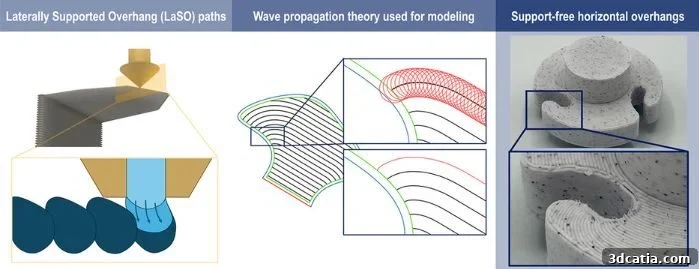
The study proposes that using wave propagation theory can help makers print overhangs without supports.
To validate the concept further, the team printed a multilayer demonstrator. This test showed that once the first unsupported wave-pattern base is successfully deposited, additional layers can be placed on top of it in a reliable manner. The measurements also indicated that, for the tested geometry, dimensional deviations were comparable to those found in conventionally supported parts. Some thermal warping was still observed near the edges of the overhangs, meaning the process is not yet free from all printing challenges. Even so, the results show that toolpath design can play a much larger role in FDM overhang performance than previously assumed.
The researchers also printed four additional 3D geometries that represent common industrial overhang configurations. These examples were used to demonstrate that the wave-inspired strategy is not limited to a single simple shape. Across the tested cases, the method showed that unsupported horizontal overhangs can be manufactured successfully when the extrusion path is designed according to wave propagation principles. This is an important shift for FDM 3D printing because it suggests that some geometries traditionally considered difficult or unprintable without supports may be achievable through more intelligent slicing rather than additional hardware or complex machine modifications.
The Impact of Support-Free 3D Printing
For everyday 3D printer users, as well as engineers and manufacturers, the practical benefits of support-free FDM printing could be significant. Support structures consume extra filament, increase print time, and often leave marks on the part surface after removal. Eliminating or reducing supports can lower material use, simplify the printing workflow, and reduce the amount of post-processing required. Instead of breaking away, cutting, sanding, or scraping support material from a finished part, users could potentially obtain cleaner overhangs directly from the printer. The study summarizes this point clearly: “Unsupported horizontal overhangs need not be treated as inherently unprintable geometries. In many cases, their manufacturability is governed by toolpath design instead of angle thresholds. By eliminating the need for sacrificial supports, the approach reduced material consumption by as much as 39% in the presented example.”
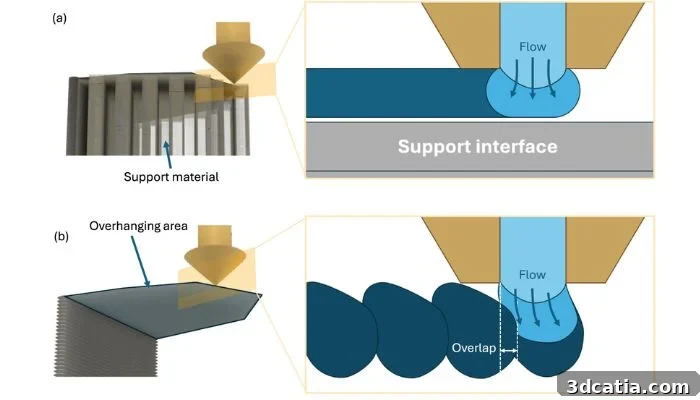
The top image (a) shows a typical overhang printed with deposition on support structures. The bottom image (b) depicts Laterally Supported Overhang (LaSO) printing, showing a teardrop bead shape.
Although the researchers note that more testing is needed to define the limits of the strategy across different materials, printer settings, and environmental conditions, this method is already challenging long-held assumptions about the limits of standard FDM 3D printing. The work suggests that better slicing and smarter path planning may expand what ordinary desktop printers can produce, especially for parts with horizontal overhangs and complex unsupported features. Readers who want to explore the research in more detail can read the paper here, published by Janis A. Andersons, Salomé Sanchez, and Tom Vaneker. The strategy has also been implemented in forks of PrusaSlicer and OrcaSlicer, allowing experienced users to experiment with wave-based overhang printing themselves.
If this support-free overhang strategy proves reliable across more materials and printer setups, it could influence how designers prepare models for FDM 3D printing. Instead of automatically adding supports to every difficult overhang, users may begin to consider whether the toolpath itself can provide enough stability during deposition. That change would make slicing strategy an even more important part of additive manufacturing, particularly for applications where reducing material waste, print time, and manual finishing is essential.
*Cover: Heatmaps showing the spatial distribution of surface deviation in the gravity direction, or sagging, for wave-overhang strategies across three shape difficulties, with photographs of the corresponding printed samples. The wave overhangs show a uniform deviation distribution. All image credits: Janis A. Andersons, Salomé Sanchez, and Tom Vaneker.