
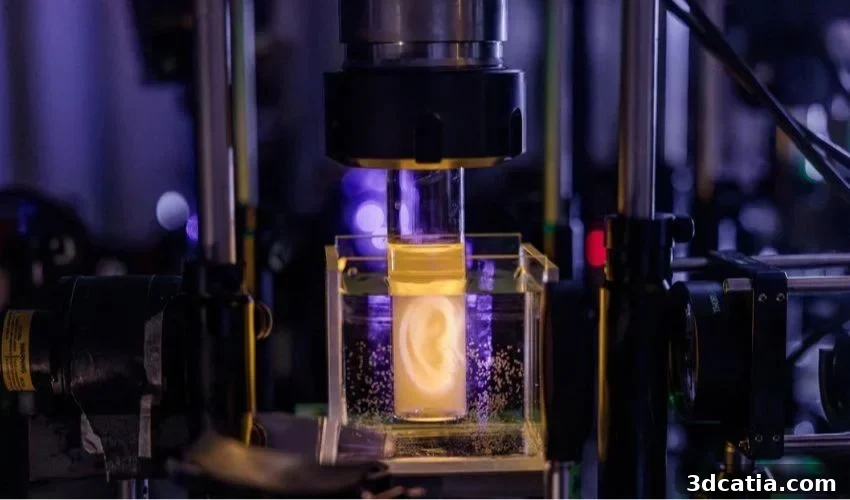
Researchers at the Swiss Federal Institute of Technology in Lausanne (EPFL) have reported a major advance in volumetric 3D printing, improving a technology that has been under development since 2017. The latest version of the method is significantly more energy-efficient than earlier approaches and, for the first time, has been used to print structures containing living human cells.
The most striking result of the new study is a life-size human ear printed in a gelatin-based hydrogel. The structure contains embedded human cells that remained alive six days after printing and had begun to organize into networks. This achievement marks an important step for bioprinting, where speed, precision and cell viability are all essential for creating tissue-like structures.
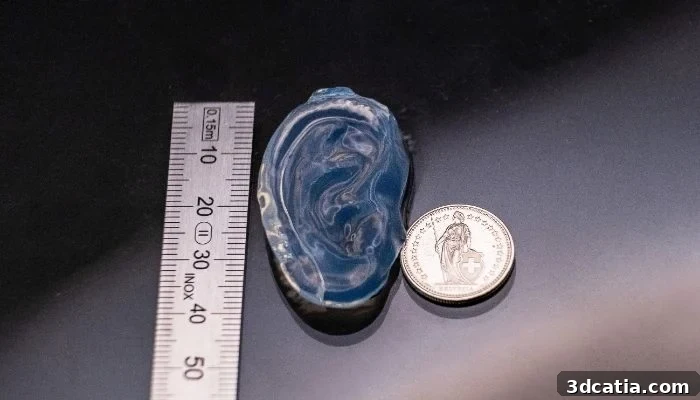
Ear printed using the TVAM process (Photo Credit: LAPD / EPFL).
What Is TVAM?
The technique is known as tomographic volumetric additive manufacturing, or TVAM. Unlike conventional 3D printing, which builds an object layer by layer, TVAM forms an entire object at once. The process works by projecting light from different angles into a rotating container filled with photosensitive resin. When enough light energy accumulates in specific areas, the resin solidifies, creating the desired 3D shape in a matter of seconds or minutes.
EPFL researchers have been refining this approach for several years. The first work on the method began in 2017, and Professor Christophe Moser’s group at the Laboratory of Applied Photonic Devices (LAPD) later continued its development. Since then, the team has introduced several important improvements aimed at making TVAM more useful for biomedical and bioprinting applications.
- 2022: The researchers addressed the challenge of printing with opaque resin. Traditional TVAM worked best with transparent resins because light could pass through them with minimal scattering. However, many materials used in biomedical research are opaque, causing light to scatter before reaching the intended point. The team solved this by using a camera to track the real path of light and applying computational corrections in real time, allowing opaque materials to be printed with nearly the same precision as transparent ones.
- 2025: The next improvement focused on energy consumption. Although the process had become fast and accurate, only a small portion of the projected light reached the resin effectively. To reduce the amount of optical power required, the researchers used holographic projection directly onto the rotating resin container. This approach made it possible to print the same types of objects with 25 times less optical power while also improving resolution.
- 2026: The latest advance focuses on scale and living cells. Earlier holographic systems still relied on hardware that controlled the amplitude of light rather than directly controlling its phase. In the new study, the team implemented a device capable of directly controlling the phase of the light beam. This increased efficiency by a factor of 70. Using a 150 mW diode laser, the researchers printed one-centimeter objects in minutes and one-millimeter objects in seconds, while confirming that cells remained viable after printing. Maria Alvarez-Castaño, a LAPD doctoral student and lead author of the study, said: “Our approach brings volumetric printing closer to real-scale implants, and biologically compatible manufacturing using low-power laser sources.”
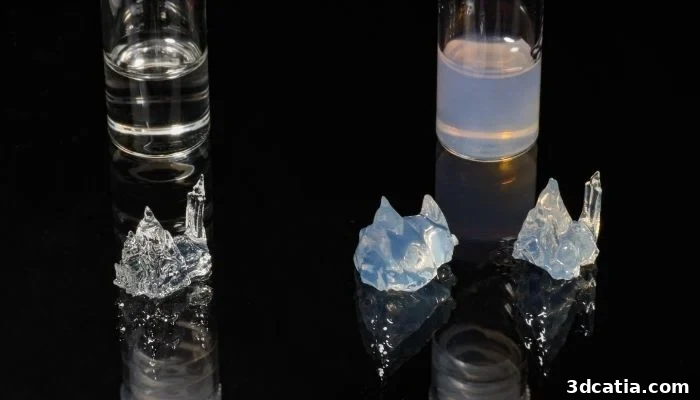
Objects 3D-printed using the 2022 TVAM process. On the left, transparent resin; on the right, opaque resin before and after correction (Photo Credit: EPFL/Alain Herzog).
Why the Energy Source Matters
The reduction in energy use is more than a technical improvement. It is essential for printing with living cells. Cells are sensitive to light exposure, and too much energy during the printing process can damage them irreversibly. By lowering the required energy by a factor of 70, the EPFL team made volumetric 3D printing more compatible with cell-laden materials and tissue-like structures.
“Our method’s demonstrated efficiency and precision finally makes it possible to bioprint tissue-like structures at near-clinical scale,” LAPD head Christophe Moser said. “We have printed structures substantially larger than those achieved with previous holographic approaches, despite increased light scattering caused by the embedded cells.”
This is particularly important because embedded cells increase light scattering inside the material. In many bioprinting processes, maintaining accuracy becomes more difficult as cell density increases. EPFL’s improved TVAM method shows that it is possible to print larger, more complex structures while still preserving the conditions needed for living cells to survive.
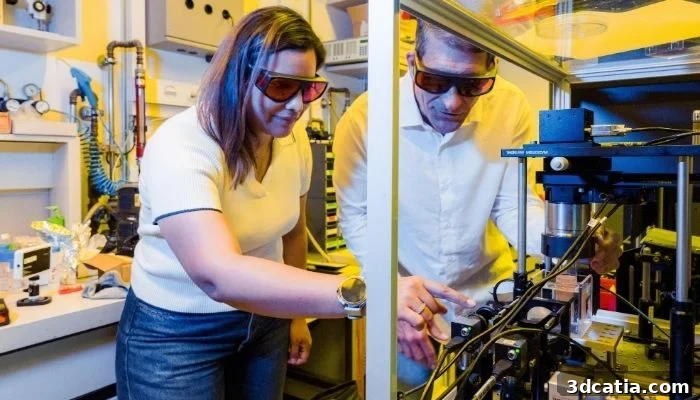
Ph.D. student María Álvarez-Castaño and LAPD Director Christophe Moser (credit: Adrien Buttier/EPFL).
What Still Needs to Be Improved?
Although the printed ear is a major milestone, it is not yet ready for implantation in a patient. The researchers still need to improve printing accuracy, work with bio-resins that contain higher cell densities, and refine methods for printing onto existing objects. The team has also described a future version of the system that would remove the need to rotate the container, which could simplify the process further.
Even with these remaining challenges, the progress made by EPFL highlights the growing potential of volumetric 3D printing in medical research and bioprinting. By combining faster fabrication, lower optical power and living-cell compatibility, TVAM could become an important tool for creating tissue-like structures at larger scales. The printed ear demonstrates that the technology is moving beyond simple prototypes and toward more biologically relevant applications.
*Cover photo: holographic projection of a model of a human ear onto a sample container (Photo Credit: Adrien Buttier/EPFL).