
3D Printing in Space: SpaceX Launches Mission to Revolutionize Orbital Construction
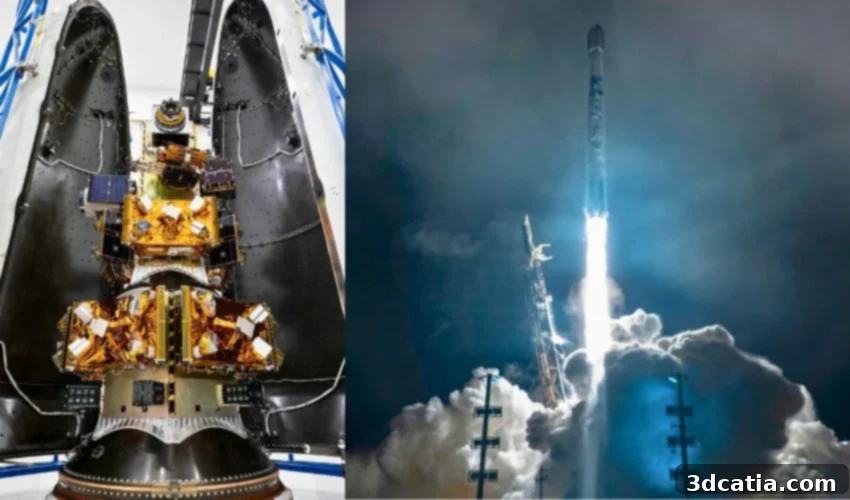
In a groundbreaking endeavor that could reshape the future of space exploration and construction, SpaceX launched its first Twilight rideshare mission of 2026. This mission included a pioneering experiment designed to test the feasibility of manufacturing structures directly in space using the transformative technology of 3D printing. This marks a significant step toward overcoming the limitations of traditional spacecraft design and opening up new possibilities for building and deploying large-scale structures in orbit.
The Twilight rideshare mission, which commenced on January 11, 2026, at 5:44 a.m. PST from Vandenberg Space Force Base, utilized a Falcon 9 rocket to deploy 40 small payloads into a dawn-dusk sun-synchronous orbit. This unique orbit ensures that the satellites remain in the line separating day and night on Earth. Following the successful stage separation, the Falcon 9 booster executed a flawless return to land at Vandenberg, while the deployment of the satellites commenced shortly thereafter. The Twilight mission represents the dawn of a new era of dedicated small satellite rideshare missions, offering more frequent and flexible access to orbit for a wider range of organizations and projects.
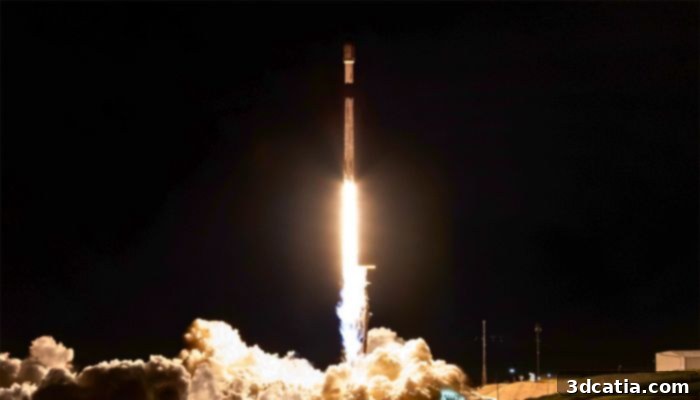
(Photo Credit: SpaceX)
Pioneering 3D Printing Beyond Earth’s Atmosphere
Among the diverse payloads onboard the Twilight mission was ARAQYS-D1, a project developed by Dcubed, a company specializing in deployable space structures and in-space manufacturing technologies. Unlike traditional missions that deploy pre-built components, the ARAQYS-D1 mission aims to manufacture a 60-centimeter boom directly in the vacuum of space using cutting-edge additive manufacturing techniques. This innovative approach has the potential to revolutionize how we build and deploy structures in orbit, paving the way for larger, more complex space systems.
Following the successful launch and deployment of the Dcubed-1 / ARAQYS-D1 satellite, Dcubed confirmed that the satellite would undergo a commissioning phase before commencing on-orbit manufacturing operations. In a statement released on LinkedIn, the company highlighted the mission as its inaugural in-space manufacturing demonstration, with the primary goal of validating technologies crucial for future space-based power generation. This demonstration could lead to more efficient and scalable ways to power space stations and future off-world colonies.
“This flight is about proving a capability that matters for the future of how we generate and scale power in space, enabled by in-space manufacturing.”
The core objective of this experiment is to address a long-standing challenge in spacecraft design: the need to meticulously fold, stow, and protect large structures during the turbulent launch phase. By manufacturing the boom after the satellite has been successfully deployed into orbit, Dcubed aims to evaluate whether future space systems can be progressively built in space, rather than being entirely pre-fabricated on Earth. A successful demonstration of this technology could significantly reduce mass and packaging constraints, enabling spacecraft to exceed the size limitations imposed by conventional manufacturing methods on Earth.
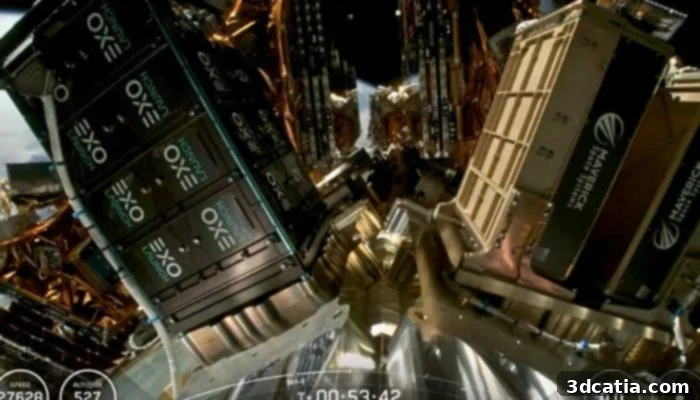
(Photo Credit: SpaceX)
From Theoretical Demonstration to Practical Operational Testing in Orbit
While 3D printing has previously been tested within the controlled environment of the International Space Station (ISS), including experiments involving bioprinting human tissue and printing metal parts during NASA’s SpaceX-33 mission, missions such as ARAQYS-D1 represent a fundamental shift in focus. Instead of merely demonstrating that additive manufacturing is viable in a microgravity environment, this new wave of experiments emphasizes repeatable, operational testing conducted directly in the harsh environment of orbit. This is a significant step forward in maturing the technology for real-world applications.
The increasing accessibility of rideshare launches is a key factor driving this transition. The Twilight mission, for instance, utilized shared launch services provided by Exolaunch, enabling 22 of the 40 payloads to reach their intended orbits. This highlights the crucial role that rideshare platforms are playing in lowering the barriers to entry for experimental and small satellite missions, opening up opportunities for a wider range of organizations to participate in space exploration and development.
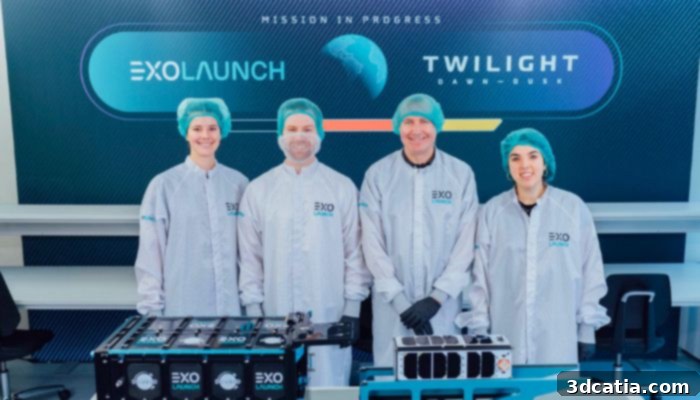
(Photo Credit: Dcubed)
The Implications of In-Space Manufacturing for the Future of Space Exploration
Beyond the pioneering 3D printing experiment, the Twilight mission also carried a diverse array of other payloads, including Pandora, a small satellite from NASA designed to study exoplanets and their host stars. Also onboard were two NASA-supported CubeSat missions, SPARCS and BlackCat, alongside commercial satellites focused on Earth observation and Internet-of-Things (IoT) connectivity. This diverse collection of payloads underscores the growing importance of small satellites in a wide range of scientific and commercial applications.
As additive manufacturing technology continues to mature, its potential role in space is becoming increasingly tangible and practical. The question is no longer whether 3D printing can function beyond Earth, but rather how reliably it can be deployed, scaled, and integrated into future space systems. With initiatives like ARAQYS-D1, 3D printing is evolving from a supporting technology used on the ground to enable space missions to a core component of orbital construction. This shift opens the door to a new era of in-space manufacturing, potentially revolutionizing how we build and operate in space. The ability to manufacture structures and components directly in orbit could lead to larger, more complex, and more capable space systems, enabling us to explore the solar system and beyond in ways that were previously unimaginable.
In-space manufacturing has the potential to drastically reduce the cost of space missions by minimizing the need to transport large and heavy components from Earth. It could also enable the creation of custom-designed structures tailored to specific mission requirements. Furthermore, in-space manufacturing could utilize resources found on the Moon, Mars, or asteroids, reducing our reliance on Earth-based materials and making long-duration space missions more sustainable.
The successful demonstration of in-space manufacturing technologies like those being tested on the ARAQYS-D1 mission will be crucial for realizing the full potential of space exploration and development. As we continue to push the boundaries of what is possible in space, 3D printing and other in-space manufacturing techniques will undoubtedly play a vital role in shaping the future of our endeavors beyond Earth.
What role do you think in-space manufacturing could play in the future of space missions? Share your thoughts and ideas!