
3D Printing Innovations: Sub-Micron Optoelectronics, Affordable Metal Printers, and Copyright Protection
This week’s advancements in 3D printing showcase a diverse range of innovations, from groundbreaking research in Hong Kong to the accessibility of metal printing and the protection of intellectual property. We’ll delve into the creation of the smallest 3D printed sub-micron optoelectronics, explore a Kickstarter launch for an affordable LPBF printer, examine Bambu Lab’s new copyright protocol, and cover ADDMAN’s strategic acquisition of Forecast 3D.
Revolutionary 3D Printed Infrared Photodetectors at the Nanoscale
Researchers at the University of Hong Kong, under the leadership of Professor Leo Tianshuo Zhao from the Department of Electrical and Electronic Engineering, have achieved a significant milestone by developing a room-temperature nano-printing platform. This platform is capable of fabricating the smallest, fully-printed infrared photodetectors ever created. Infrared photodetectors play a crucial role as sensors that detect heat and convert it into measurable electrical signals. This capability allows us to “see” beyond the limitations of visible light.
Near-infrared (NIR) technology is indispensable for a wide array of applications, including:
- Autonomous systems, enabling self-driving cars and robots to navigate their environments.
- Biomedical sensing, facilitating non-invasive diagnostics and monitoring of health conditions.
- High-speed optical communications, driving faster and more efficient data transmission.
However, conventional silicon-based CMOS technology faces inherent limitations in directly detecting NIR wavelengths. The innovative nano-printing platform developed by the HKU team overcomes these limitations by assembling solution-phase colloidal nanocrystals (NCs) and modifying their properties in situ. This process enables the construction of advanced optoelectronic devices with unprecedented precision and control.
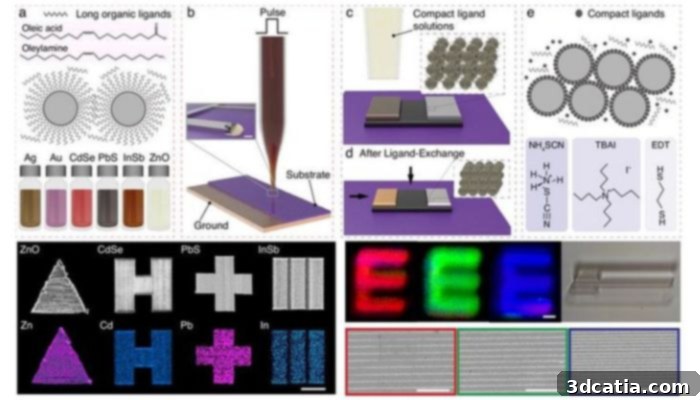
The versatile nano-printing platform assembles solution-phase colloidal nanocrystals (NCs) and modifies their properties in situ (Image Credit: Tianshuo Zhao et al.)
The team employed electrohydrodynamic printing (EHDP) in conjunction with surface chemical treatment to achieve remarkable precision. This technique allowed them to print silver nanocrystal lines as narrow as 70 nanometers and create dense films with conductivity comparable to bulk silver. Notably, all of this was achieved without the need for high-temperature processing, which can be detrimental to delicate materials and devices.
The researchers successfully demonstrated sub-10-micrometre all-printed IR photodiodes for the first time, marking a significant advancement in the field. This research represents a major leap forward in high-resolution, multi-layer printing for electronic device integration, paving the way for more compact, efficient, and versatile electronic devices.
Affordable Metal 3D Printing: Metal Base’s Kickstarter Launch
Metal Base is poised to disrupt the metal 3D printing market with the pre-launch announcement of its Metal 1.0 Laser Powder Bed Fusion (LPBF) metal 3D printer. This system is scheduled to debut on Kickstarter with a starting price of €8,500, making it an attractive option for labs, startups, and advanced users seeking to explore the capabilities of metal additive manufacturing without breaking the bank.
The Metal 1.0 is a floor-standing LPBF system that features a modest build area and operates on a standard power outlet, simplifying installation and operation. The company claims that it can process a range of materials, including 316L stainless steel, Inconel 718, and bronze. The development of copper processing is currently underway, further expanding the printer’s versatility.
According to Metal Base, the machine utilizes a single laser, resulting in a compact footprint that is ideal for space-constrained environments. Furthermore, the Metal 1.0 is compatible with open-source firmware and Orca Slicer, providing users with greater flexibility and control over the printing process. By offering a lower-cost entry point into powder bed fusion metal additive manufacturing, Metal Base aims to democratize access to this transformative technology.
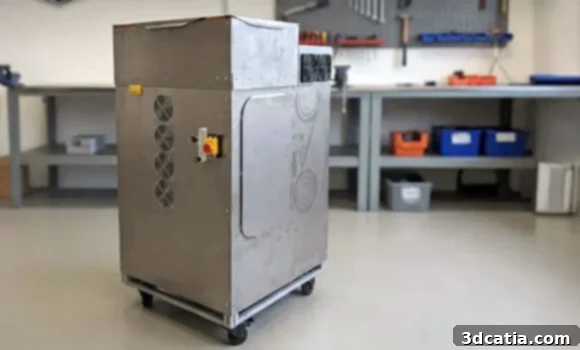
Photo Credit: Metal-Base
Bambu Lab Tackles 3D Model Theft with New Copyright Program
Bambu Lab is taking a proactive stance against the pervasive issue of 3D model theft by launching a new Creator Copyright Support program on its MakerWorld platform. This initiative aims to provide designers with the resources and support they need to respond to instances of 3D model theft and unauthorized reuploads.
The program is currently in a closed beta phase and offers assistance in preparing and filing copyright infringement complaints on third-party platforms, typically at no cost to the creator. This service can be invaluable for designers who may lack the legal expertise or resources to navigate the complexities of copyright law.
According to MakerWorld, more than 200 copyright protection requests were submitted in the two months following its October 2025 notice on unauthorized use. This statistic underscores the widespread nature of the problem and the urgent need for effective solutions. Access to the beta program is currently limited to creators with at least 500 followers and applies only to original models that are exclusive to MakerWorld, with a cap on weekly submissions.
This move reflects a growing recognition within the 3D printing community that model piracy is a serious issue that threatens the livelihoods of designers and stifles innovation. By offering hands-on support and resources, Bambu Lab is demonstrating its commitment to protecting creators and fostering a more ethical and sustainable ecosystem for 3D model sharing.
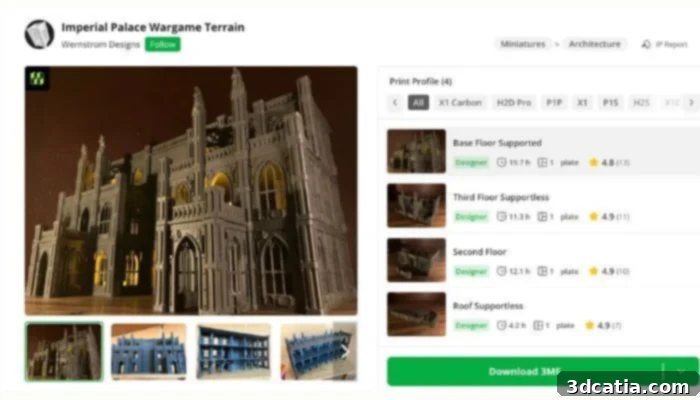
Photo Credit: Bambu Lab
ADDMAN Acquires Forecast 3D: Expanding Additive Manufacturing Capabilities
The additive manufacturer ADDMAN has strategically acquired Forecast 3D, a renowned provider of polymer 3D printing services. This acquisition represents a significant expansion of ADDMAN’s manufacturing solutions network and strengthens its position as a leading player in the additive manufacturing industry.
The integration of Forecast 3D will significantly expand ADDMAN’s polymer additive manufacturing capacity, combining Forecast 3D’s facilities in Carlsbad, California, with ADDMAN’s existing location in Irvine. Forecast 3D brings over 30 years of experience in additive manufacturing to the table, adding substantial capacity in powder-based polymer technologies, including Selective Laser Sintering (SLS) and Multi Jet Fusion (MJF).
These capabilities enhance ADDMAN’s ability to support partners throughout the entire product development lifecycle, from prototyping to full-scale production. By offering a wider range of materials, technologies, and expertise, ADDMAN can better serve the evolving needs of its customers.
“Our strategy has always been about scale and capability,” said Joe Calmese, CEO of ADDMAN. “We are building the largest additive manufacturing service provider in the market, designed to support any part, any process, at any stage of the customer’s journey. Bringing Forecast 3D into ADDMAN makes that vision real today, and we will continue to raise the bar for what customers should expect from an advanced manufacturing partner.”
What are your thoughts on the 3D printed photodetectors and other advancements discussed in this article? Share your opinions in the comments below or connect with us on our LinkedIn and Facebook pages! Stay informed about the latest 3D printing news by subscribing to our free weekly Newsletter. You can also explore our comprehensive video library on our YouTube channel.
*Cover Image Credit: Tianshuo Zhao et al.