
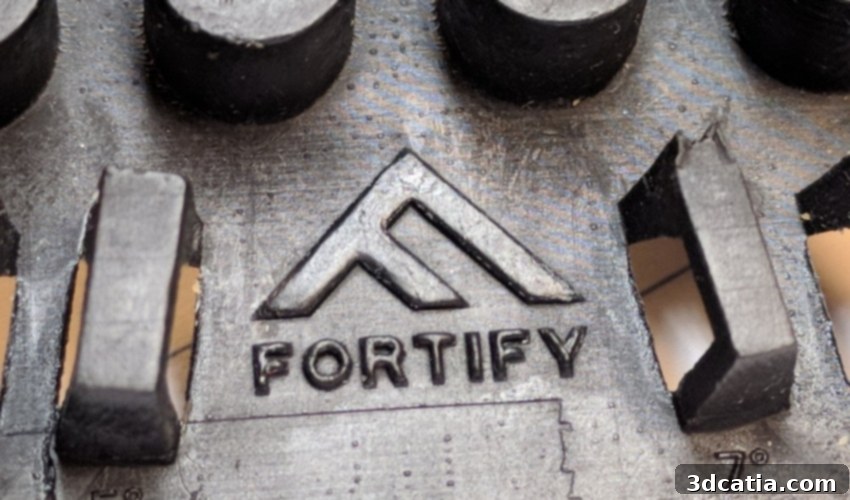
Fortify Secures $20 Million Series B Funding: Revolutionizing 3D Printing with Advanced Composite Materials
Fortify, a pioneering 3D printing startup based in Boston, Massachusetts, has announced a significant achievement, successfully closing a $20 million Series B funding round. This substantial investment is set to accelerate the company’s ambitious plans within the additive manufacturing landscape, particularly in the realm of high-performance composite materials. The equity round was spearheaded by Cota Capital, a prominent venture capital firm known for its strategic investments in technology innovators. Joining Cota Capital were several existing and notable investors, including Neotribe Ventures, Prelude Ventures, and Accel Partners, all of whom had previously contributed to Fortify’s Series A funding round in 2019, which raised $10 million. This latest infusion of capital brings Fortify’s total funding to an impressive $30 million, underscoring strong investor confidence in its proprietary technology and market potential.
Founded in 2016, Fortify has rapidly established itself as a leader in leveraging advanced materials science to overcome conventional limitations in 3D printing. The company’s innovative approach centers around its patented Digital Composite Manufacturing (DCM) platform, which made its official debut in March 2020. This platform represents a paradigm shift in additive manufacturing, allowing users to unlock unprecedented performance levels for their 3D printed components. The core innovation lies in the ability to introduce functional additives directly into photopolymers, creating composite materials with tailor-made properties. Shortly after the platform’s launch, Fortify began shipping its flagship product, the Flux One 3D Printer, marking a crucial step in bringing its cutting-edge technology to commercial markets.
The Digital Composite Manufacturing platform is not merely an incremental improvement; it is a sophisticated system built upon a deep understanding of complex material science principles. Fortify’s engineers and material scientists expertly integrate high-performance mixing techniques, precise magnetic alignment, and advanced polymer physics to achieve their desired results. This comprehensive approach enables the production of custom microstructures within high-resolution 3D printed parts. By meticulously controlling the internal architecture of materials at a microscopic level, Fortify’s technology can significantly enhance key mechanical properties such as strength, stiffness, wear resistance, and heat deflection temperature (HDT), making these parts suitable for demanding industrial applications that were previously out of reach for traditional 3D printing methods.
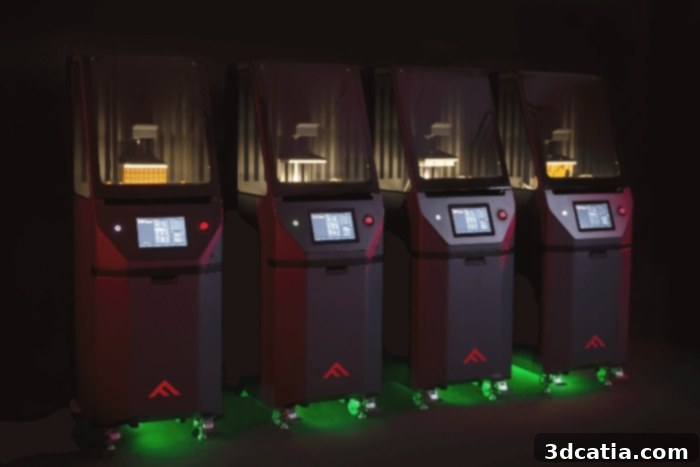
Fortify recently began shipping its 3D printer, the Flux One, to customers, marking a new era for composite 3D printing. (Photo Credits: Fortify)
Joshua Martin, CEO and Cofounder of Fortify, expressed immense satisfaction with the company’s progress and the successful funding round. “Fortify has been focused on proving the viability of our product and market opportunity over the past 18+ months, and exceeded our goals set at the beginning of 2020,” Martin stated. His remarks highlight the company’s dedicated efforts in demonstrating the real-world applications and commercial viability of its advanced 3D printing solutions. Looking ahead, Martin elaborated on the strategic allocation of the new capital, emphasizing an aggressive expansion plan. “This next round will expand our go-to-market footprint in key verticals such as injection mold tooling while enabling us to capture market share in end-use electronic devices.” This vision underscores Fortify’s dual focus: disrupting established manufacturing processes in industrial sectors and enabling innovative solutions in emerging high-tech product categories. The potential for Fortify’s technology to transform the landscape of manufacturing, from tooling to final product components, is immense, promising efficiency gains and performance enhancements across various industries.
Strategic Allocation of Funds: Accelerating Growth and Market Penetration
Beyond expanding its market presence in critical verticals, Fortify has outlined a comprehensive strategy for utilizing the $20 million Series B funding. A significant portion of the investment will be directed towards bolstering its already talented team. This includes hiring top-tier engineers, material scientists, sales professionals, and operational staff to support the company’s aggressive growth trajectory. Expanding the team is crucial for scaling research and development efforts, enhancing customer support, and efficiently managing increased production demands. Furthermore, the funding will be instrumental in accelerating the development and expansion of high-value application spaces. This means exploring and validating new uses for Fortify’s technology beyond its current core offerings, potentially opening doors to entirely new markets where high-performance composite parts are in high demand.
Another key objective for Fortify is to transition to volume manufacturing of its Flux Series 3D printers. The company initiated shipments of the Flux One, the first in the series, in September of last year, marking its official entry into the commercial market. Scaling up manufacturing operations is vital to meet the growing demand for its innovative printers and to make its technology more accessible to a wider range of industrial clients. The Flux One 3D Printer, specifically, is exceptionally well-suited for creating 3D printed mold tools, a critical application for rapid prototyping, low-volume production runs, and high-performance applications where traditional tooling is either too costly or time-consuming. This capability alone offers a compelling value proposition to industries such as automotive, aerospace, and consumer electronics, where the agility of producing custom tooling can significantly reduce development cycles and costs.
Revolutionary Technologies: CKM and Fluxprint Magnetic Alignment
The superior performance of Fortify’s Flux One 3D Printer stems from two proprietary technologies: Continuous Kinetic Mixing (CKM) and Fluxprint magnetic alignment. Continuous Kinetic Mixing (CKM) is a groundbreaking process that ensures a homogeneous dispersion of functional additives within the photopolymer resin during printing. Unlike conventional methods where additives might settle or clump, CKM dynamically mixes the material throughout the print process, guaranteeing consistent material properties and eliminating defects caused by uneven distribution. This continuous mixing is vital for achieving the high-performance characteristics promised by composite materials, ensuring that every layer of the printed part benefits from the enhanced properties of the blended resin. The precision and consistency offered by CKM are central to Fortify’s ability to produce reliable, high-quality industrial parts.
Complementing CKM is Fortify’s innovative Fluxprint magnetic alignment technology. This feature utilizes precisely controlled magnetic fields to orient the functional additives within the photopolymer as each layer is printed. For instance, in applications requiring anisotropic properties (where material strength varies with direction), Fluxprint can align reinforcing fibers or particles along specific axes, optimizing the microstructure of the part for maximum strength, stiffness, or other desired characteristics. This level of granular control over material microstructure is unprecedented in many additive manufacturing processes. By strategically aligning these internal structures, Fluxprint dramatically enhances the mechanical performance of the final printed parts, improving attributes such as strength-to-weight ratio, wear resistance, and thermal stability (HDT). These combined technologies allow Fortify to unlock new possibilities for manufacturing highly engineered components that can withstand extreme conditions and outperform parts made with traditional materials or conventional 3D printing techniques.
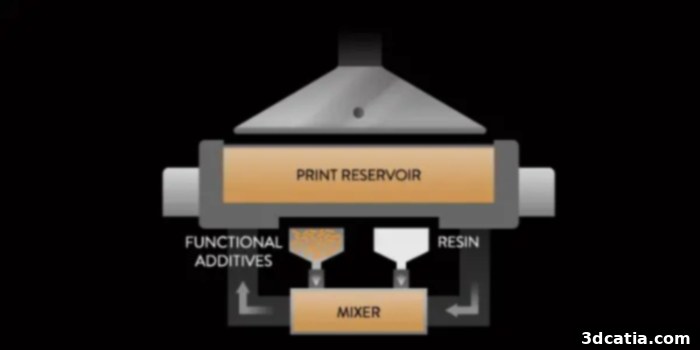
A diagram of Fortify’s proprietary Continuous Kinetic Mixing (CKM) technology, a key innovation for homogeneous composite material printing. (Photo Credit: Fortify)
Fortify’s Impact on the Future of Manufacturing
The successful Series B funding round for Fortify is more than just a financial milestone; it signals a growing recognition of the transformative potential of advanced composite 3D printing. The ability to produce high-performance parts with customizable microstructures addresses a critical gap in the additive manufacturing market, where many existing technologies struggle to meet the stringent demands of industrial applications. Fortify’s focus on areas like injection mold tooling offers a direct solution to persistent manufacturing challenges. Traditional injection molds are expensive, time-consuming to produce, and often require multiple design iterations. By leveraging 3D printed molds with enhanced durability and thermal properties, manufacturers can rapidly prototype new designs, conduct small-batch production runs more economically, and significantly accelerate time-to-market for new products. This agility is a game-changer in competitive industries.
Furthermore, Fortify’s ambition to capture market share in end-use electronic devices highlights the versatility of its DCM platform. The miniaturization and increasing complexity of electronics demand materials with precise dielectric properties, superior thermal management, and robust mechanical integrity. Fortify’s ability to embed functional additives and control microstructures allows for the creation of components that meet these exact specifications, opening up new design freedoms for electronic device manufacturers. From advanced sensors to specialized connectors and housing units, the potential applications are vast. This expansion into high-value sectors positions Fortify not just as a printer manufacturer, but as a key enabler of next-generation product development and advanced manufacturing processes. The company’s vision extends to empowering industries to innovate faster, produce more efficiently, and create products with unparalleled performance characteristics.
The confidence shown by investors like Cota Capital, Neotribe Ventures, Prelude Ventures, and Accel Partners, all seasoned venture capitalists with a keen eye for disruptive technologies, reinforces Fortify’s strong position in the additive manufacturing ecosystem. This investment will not only fuel Fortify’s internal growth and technological advancements but will also contribute to the broader evolution of the 3D printing industry. As the demand for high-performance, custom-engineered parts continues to grow across various sectors, Fortify’s Digital Composite Manufacturing platform and Flux Series printers are poised to play a pivotal role in shaping the future of manufacturing, pushing the boundaries of what is achievable with additive processes and composite materials. For more detailed information on this significant funding round, the full press release is available for review here.
What are your thoughts on Fortify’s recent success in securing this substantial Series B funding? How do you foresee their advanced 3D printing technology impacting various industries? Share your insights in a comment below or join the conversation on our Facebook, Twitter, and LinkedIn pages! Don’t miss out on the latest advancements and news in the additive manufacturing world. Sign up for our free weekly Newsletter here to receive the most current 3D printing news directly in your inbox!