
Local Motors Unveils Olli 2.0: The Future of 3D Printed Autonomous Mobility
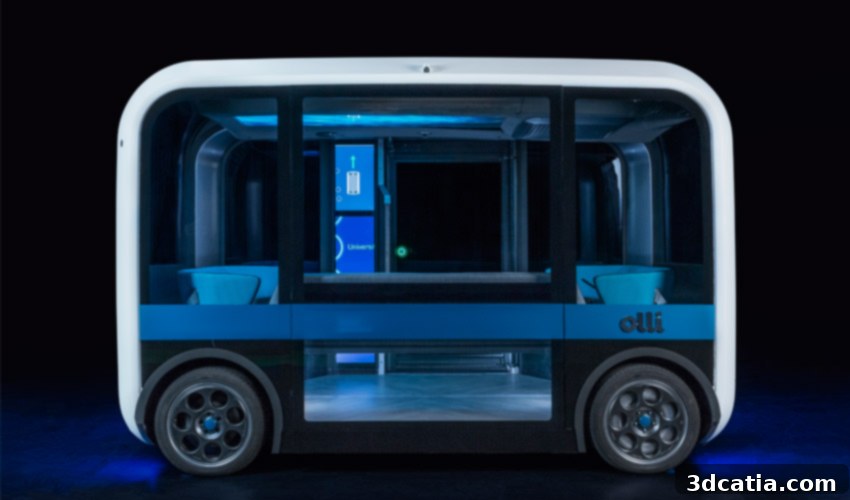
The world of smart mobility is constantly evolving, driven by innovation in areas like electrification, autonomy, and advanced manufacturing. Few companies have embodied this spirit of innovation quite like Local Motors, particularly with their groundbreaking Olli autonomous shuttle. You likely recall Olli, the pioneering 3D printed minibus that first captured global attention. It represented a significant stride in the automotive sector, unequivocally demonstrating the immense potential of additive manufacturing within this demanding industry. Today, this revolutionary vehicle is once again in the spotlight as Local Motors proudly introduces Olli 2.0 – an extensively enhanced and optimized iteration of the original concept presented in 2016. This new version boasts an even greater number of 3D printed components, offers increased seating capacity with two additional seats, and features innovative programmable lighting, setting new benchmarks for intelligent, sustainable urban transport.
The Genesis of Olli: A Vision for Intelligent Mobility
In 2016, Local Motors captivated the industry with its audacious vision for an autonomous shuttle, simply named Olli. This innovative concept was designed to comfortably transport approximately a dozen people, providing not just transportation but also interactive experiences. Equipped with an array of sophisticated sensors, Olli was capable of understanding its environment, answering passengers’ questions, and analyzing real-time information to navigate safely and efficiently. The construction of this small yet powerful vehicle leveraged cutting-edge Big Area Additive Manufacturing (BAAM) technology, allowing for the rapid production of large, complex parts. Olli 1.0 was swiftly deployed across various locations in the United States, including vibrant university campuses—where it provided students with convenient and eco-friendly travel—as well as essential healthcare facilities and secure military bases. While the initial solution proved highly effective and garnered considerable acclaim, Local Motors, true to its innovative spirit, recognized opportunities for further refinement and advancement. These valuable insights and continuous desire for improvement paved the way for the development and unveiling of Olli 2.0.
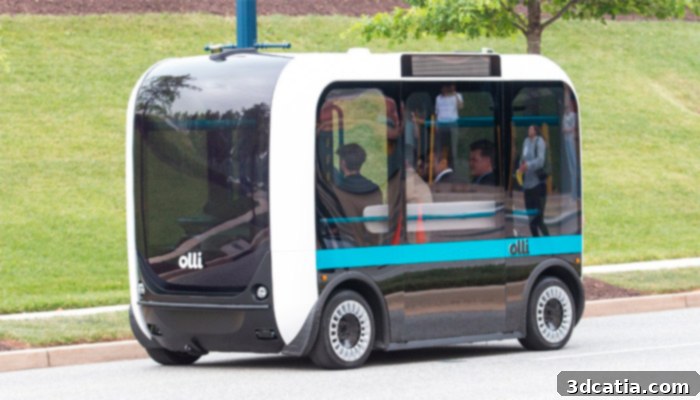
The first version of Olli
Olli 2.0: A Quantum Leap in Autonomous Transport Innovation
Olli 2.0 isn’t merely an update; it represents a significant evolutionary leap in autonomous transportation, heavily propelled by the advancements in additive manufacturing. Local Motors proudly states that a remarkable 80% of Olli 2.0’s components are now 3D printed, further cementing the role of this technology in mainstream vehicle production. This extensive use of 3D printing employs the same proven BAAM technology utilized three years prior, with the core printing process for major components still taking approximately 10 hours. The primary advantage of 3D printing for Local Motors extends beyond just rapid prototyping; it enables unparalleled flexibility for quick iterations, allowing engineers to swiftly test and implement different design versions. This agility dramatically shortens development cycles and facilitates continuous improvement, a critical factor in rapidly evolving tech sectors like autonomous vehicles. By embracing additive manufacturing, Local Motors can more easily customize vehicles for specific applications or regions without incurring the massive tooling costs associated with traditional manufacturing methods.
Enhanced Performance and Specifications
Still entirely electric, Olli 2.0 boasts substantially improved performance metrics compared to its predecessor. The new minibus now offers an impressive range of 160 km (approximately 100 miles) on a single charge, a significant increase from the original version’s 60 km. This extended range greatly enhances its operational flexibility, making it suitable for longer routes and broader service areas without frequent recharging interruptions. Furthermore, Olli 2.0 can achieve a maximum speed of 40 km/h (approximately 25 mph), making it a practical solution for urban environments, university campuses, and corporate parks where moderate speeds are appropriate and safe. The vehicle maintains an autonomy capacity of Level 4, which signifies its ability to operate fully autonomously without any human intervention within a defined operational design domain (ODD). This level of autonomy represents a major step towards truly driverless mobility, promising enhanced safety, efficiency, and accessibility.
Revolutionary Propulsion System and Interior Enhancements
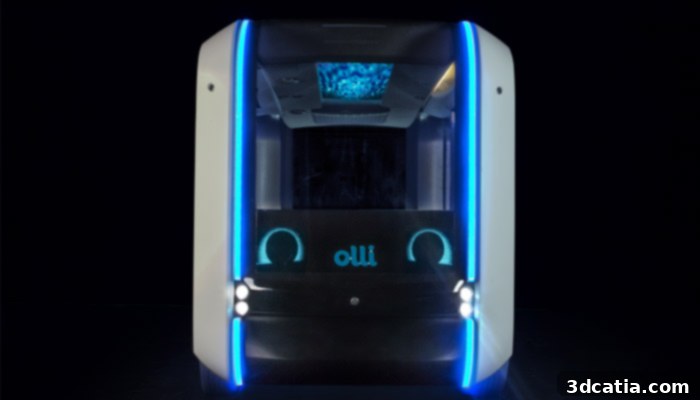
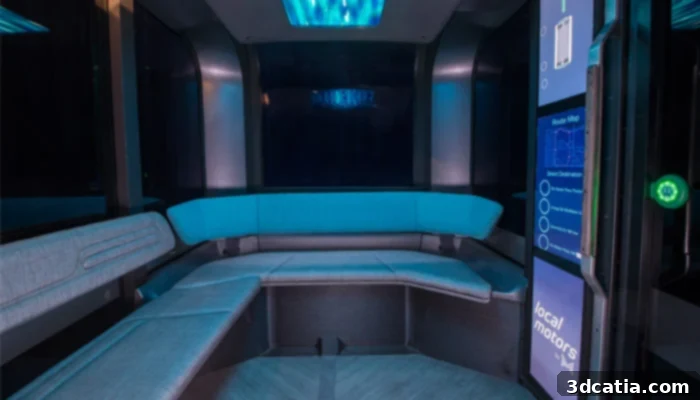
One of the most significant mechanical innovations in Olli 2.0 is the repositioning of its electric motors. Unlike the previous design where motors were located on the axles, they are now integrated directly into each of the four wheels. This design choice offers multiple advantages: it frees up valuable interior space, contributes to a smoother and quieter ride, and potentially improves overall efficiency and maneuverability by allowing for independent control of each wheel. In terms of passenger experience, Olli 2.0 features an improved user interface and a superior sound system, enhancing comfort and interaction. Furthermore, a concerted effort has been made to “humanize” the shuttle and make it more approachable. This includes the integration of several screens at both the front and rear of the vehicle, which are visible to pedestrians. These external displays can communicate Olli’s intentions, such as stopping or turning, thereby fostering a safer and more intuitive interaction between the autonomous vehicle and its human surroundings. Inside, a large, intuitive touch screen serves as the primary interface, connecting passengers directly to Olli 2.0. This intelligent autonomous minibus is also designed to communicate orally with its occupants, providing information, answering questions, and creating a truly interactive and engaging travel experience. With two additional seats compared to its predecessor, Olli 2.0 can now accommodate up to 14 passengers, making it even more versatile for group transport.
The Future of Smart Mobility: Production and Global Ambition
The production of Olli 2.0 commenced in July, marking a pivotal moment for Local Motors and the future of autonomous transportation. Initial deliveries are anticipated to roll out by the end of the year, starting with key markets across the United States. This phased rollout ensures that the most rigorous testing and feedback can be gathered from real-world deployments. Looking beyond its home market, Local Motors harbors ambitious plans for global expansion, with a strategic goal to establish a dedicated production center in Europe. This move would not only cater to the burgeoning European market for smart mobility solutions but also facilitate localized production and distribution, reinforcing the company’s commitment to sustainable and accessible transportation worldwide. The ability to leverage 3D printing for a significant portion of the vehicle’s components also streamlines global production, allowing for more flexible manufacturing footprints and quicker adaptation to regional demands. The continuous advancements in material science for additive manufacturing further promise lighter, stronger, and more customizable parts for future iterations of Olli, ensuring Local Motors remains at the forefront of automotive innovation.
Olli 2.0 stands as a testament to Local Motors’ unwavering commitment to pushing the boundaries of what’s possible in the automotive industry through the power of additive manufacturing and advanced autonomy. It represents not just a vehicle, but a vision for smarter, more sustainable, and more accessible urban mobility. With its enhanced capabilities, improved user experience, and strategic production plans, Olli 2.0 is poised to redefine public transportation and accelerate the adoption of autonomous shuttles in various environments globally. We encourage you to share your thoughts on the innovative new features of Olli 2.0! Let us know what you think in a comment below or join the conversation on our Facebook and Twitter pages. For all the latest news and developments in the world of 3D printing, remember to sign up for our free weekly Newsletter, delivered straight to your inbox!