
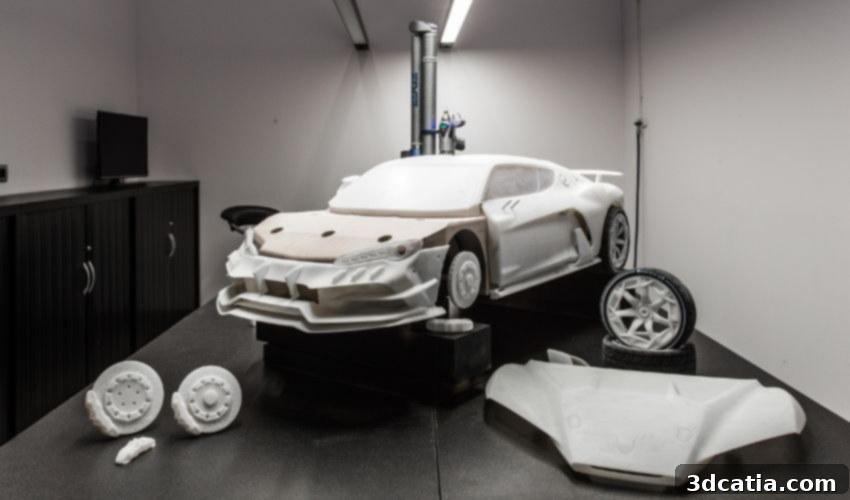
Revolutionizing Automotive Design and Manufacturing: Italdesign’s Journey with 3D Printing Innovation
The automotive and transportation industries are experiencing a significant transformation, driven by advancements in 3D printing technology. This innovative approach to manufacturing is rapidly gaining ground, unlocking unprecedented possibilities for part optimization, performance enhancement, and truly cost-effective customization. Today, additive manufacturing plays an indispensable role in streamlining production lead times, facilitating critical lightweighting initiatives, and significantly accelerating rapid prototyping cycles across the entire vehicle development process. Among the pioneering companies at the forefront of this industrial shift is Italdesign, a globally renowned leader in comprehensive design, engineering, and manufacturing solutions specifically tailored for the intricate demands of the transportation sector. With its primary headquarters strategically located in Turin, Italy, and a dedicated, forward-thinking additive manufacturing office established in Barcelona, Spain, Italdesign has already successfully executed an impressive portfolio of innovative projects, ranging from intricate car interiors to sophisticated exterior components. We had the distinct privilege of engaging with the company’s international team to gain deeper insights into how additive manufacturing is not only reshaping their current workflow but also profoundly influencing the future trajectory of automotive design and production.
3DN: Hello! Can you introduce yourselves and your roles at Italdesign?
Daniel Agullo: Hello, my name is Daniel Agullo. I have had the privilege of serving as the General Manager of Italdesign Barcelona since 2010. In this capacity, I oversee our operations, particularly focusing on how cutting-edge technologies like 3D printing can enhance our design and manufacturing capabilities for the global automotive market.
Giorgia de Silva: My name is Giorgia de Silva. Since 2023, I have been leading the Color & Trim team at Italdesign. My core responsibility involves exploring and integrating innovative materials and aesthetic solutions into our designs, with a primary focus on driving material innovation for the demanding automotive sector. This includes leveraging new manufacturing techniques to achieve unparalleled finishes and functional integrations.
3DN: When was Italdesign founded, and what is its overarching mission within the industry?
Giorgia de Silva: Italdesign was founded in 1968, originally conceptualized as a specialized service company dedicated to supporting the major players within the automotive industry. From its inception, our mission has been to offer comprehensive and innovative solutions that span the entire product development lifecycle. We operate extensively in the critical areas of Style, Design, Production, and, increasingly, in the emerging field of new mobility solutions. The breadth of services we provide covers all essential phases, commencing from the initial product definition and conceptualization, right through to the complex process of initiating series production for what we term “turnkey” projects. This means we can take a concept from a sketch to a production-ready vehicle. However, our expertise is also flexible; companies within the sector can benefit from our specialized knowledge for individual, discrete phases of their vehicle development cycle, allowing for tailored support. Since the mid-1970s, Italdesign has strategically expanded its activities into the Transport Design sector, applying our innovative approach to a diverse array of transportation means. This includes not only commercial and industrial vehicles like tractors and buses, but also trains, airplanes, and even helicopters, showcasing our versatility. Furthermore, we’ve made significant strides in the Industrial Design sector, undertaking projects for a wide range of consumer goods, sophisticated packaging solutions, corporate identity initiatives, and comprehensive Graphics, Multimedia & Communication strategies. Our commitment to innovation and holistic design thinking has also led us to invest substantially in expertise and state-of-the-art facilities within the fields of interior design and urban street furniture, demonstrating our broad capabilities beyond traditional automotive. A pivotal moment in our history came in 2010 when we became an integral part of the prestigious VW/Audi group, which further amplified our global reach and technological capabilities. While our headquarters remain firmly rooted in Moncalieri, in the province of Turin, Italy, we maintain a robust international presence with key offices in Spain, China, and the United States, collectively employing a dedicated team of over 1,000 highly skilled professionals committed to pushing the boundaries of design and engineering.
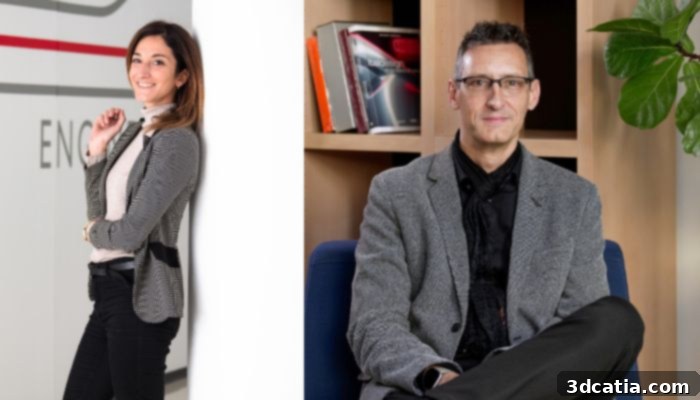
Giorgia de Silva, left, and Daniel Agullo, right
3DN: When did Italdesign first integrate 3D printing into its operations, and how has its role evolved?
Daniel Agullo: Our journey with 3D printing began in earnest in 2011. At that time, we made a strategic decision to invest in Polyjet technology, primarily due to its remarkable precision and the exceptional variety of materials it offered. This included flexible rubbers, crystal-clear transparent materials, and crucially, the ability to seamlessly mix different material properties within a single, integrated part. For us, leveraging this additive manufacturing technology to produce intricate model parts was nothing short of revolutionary. Prior to this, many of these components were laboriously crafted using traditional subtractive methods, predominantly milling. These conventional techniques were not only inherently wasteful of valuable material but also notoriously time-consuming, significantly impacting our project timelines. The immediate benefits of 3D printing were undeniable: faster iterations, reduced material waste, and the ability to achieve geometries previously impossible. Just a year later, by the end of 2012, the success of our initial investment prompted us to acquire our second 3D printer, leading to the formal establishment of a fully-fledged, dedicated 3D printing department. This expansion underscored our commitment to integrating additive manufacturing deeply into our design and engineering processes. By 2013, the operational hours accumulated on these two pioneering 3D printing machines had already surpassed those of our three milling machines, unequivocally proving the sagacity of our investment. We had not only dramatically reduced production times for complex parts and increased the overall quality of our prototypes but also achieved substantial cost savings, marking a significant leap forward in our operational efficiency.
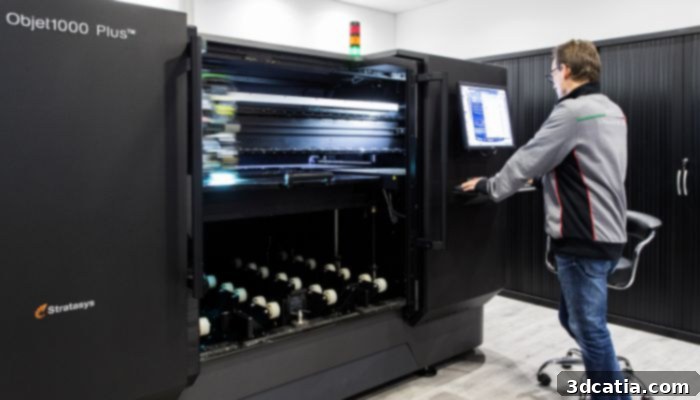
3D printing of automotive components in the Italdesign laboratory
Beyond the tangible operational improvements, we achieved something even more critical: exceptional customer satisfaction. Our clients immediately recognized the superior quality, precision, and speed with which we could deliver prototypes and design iterations. This positive feedback fueled further investment. In 2015, we executed our most significant investment in additive manufacturing to date, purchasing a substantially larger Polyjet 3D printer. This monumental acquisition dramatically expanded our capabilities, allowing us to print single parts up to an impressive one meter in length. Furthermore, its generously sized print bed enabled us to produce numerous smaller parts concurrently, optimizing workflow by allowing us to initiate printing processes overnight or even throughout an entire weekend. Consequently, when our team returned to work on Monday, a significant volume of parts was already completed and ready for the final finishing processes, drastically cutting lead times. With this large-format 3D printer, producing complex 3D printed parts became significantly more cost-effective and efficient compared to traditional milling methods. This success led to the growth of our department, welcoming more skilled personnel and requiring a larger, dedicated physical space, which officially solidified the presence of Italdesign’s Barcelona 3D printing lab as a center of excellence. Our most recent significant acquisition further pushed the boundaries of aesthetic possibilities: an exclusive 3D printer capable of printing in full color. This revolutionary additive manufacturing system provides the capability to print across the entire Pantone range, offering unparalleled possibilities for creating parts with integrated colored textures. This allows us to convincingly imitate complex natural materials, such as wood grain or marble patterns, directly onto the printed part. A notable example of this groundbreaking application was demonstrated in the interior air intakes of our DaVinci show car, where we achieved a stunning, realistic marble effect through direct 3D printing.
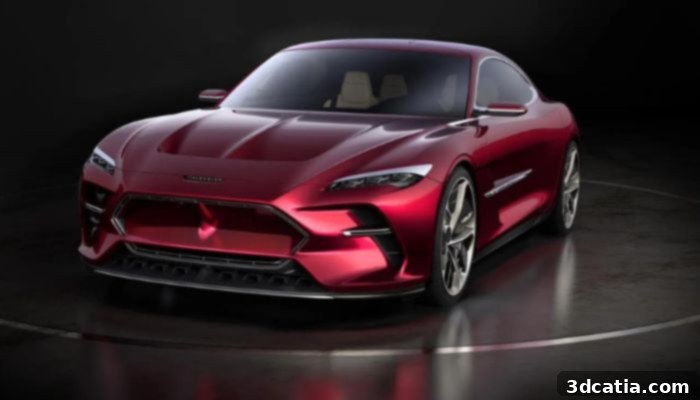
The DaVinci concept car
Giorgia de Silva: My first extensive, direct experience with 3D printing technology came during the ambitious 2019 DaVinci concept car project. The DaVinci was envisioned as a grand tourer that was 100% electric and proudly 100% Italian, representing a pinnacle of future mobility and design. On that specific occasion, we strategically utilized 3D printing to craft a crucial aesthetic element: the interior vents. The goal was to imbue these components with a sophisticated, marble-like appearance, a visual detail that would typically be very challenging and expensive to achieve with conventional manufacturing. This innovative approach allowed us to harmoniously blend cutting-edge aesthetics with advanced technology, all while meticulously preserving the component’s inherent lightness and ensuring a truly impactful visual presence within the vehicle’s interior. It showcased how additive manufacturing could elevate both the form and function of design elements.
3DN: For what specific applications do you currently leverage 3D printing within your business operations?
Daniel Agullo: At Italdesign, we extensively employ 3D printing technology for a remarkably diverse range of applications. We print almost all types of exterior spare parts that are crucial for both prototyping and functional testing. This includes essential components such as realistic mirrors, functional door handles, intricate light housings, aerodynamic spoilers, various air vents for cooling and aesthetics, distinctive emblems, and detailed grilles. For interior components, the application is equally broad and impactful, covering virtually all buttons, ergonomic handles, stylish air vents, precise climate controls, the driver’s instrument cluster, various steering wheel add-ons, intuitive HMI (Human-Machine Interface) controls, and even conceptual seat covers. The ability of 3D printing to create highly detailed and dimensionally accurate parts is critical for these applications. Many of these printed parts undergo meticulous post-processing, including painting or other specialized finishing techniques, to achieve a highly realistic final appearance that closely mimics production-ready components. This level of fidelity is essential for design reviews and ergonomic assessments. Furthermore, this versatile technology also enables us to rapidly produce complex kinematic parts, such as functional gears, robust hinges, and reliable latches. These components are vital for providing basic functionality, allowing our engineers and designers to conduct critical testing for ergonomics, assess the tactile quality of handling, and validate mechanical movements within the vehicle’s various systems, significantly accelerating our development cycles.
Giorgia de Silva: This advanced technology offers much more than just optimizing time and costs; it fundamentally transforms our design capabilities by providing the possibility of offering incredible aesthetic customization. This significantly influences the world of CMF (Color, Materials, Finish), a critical discipline across diverse sectors ranging from high fashion to product design and, most notably, the automotive industry. The inherent flexibility of 3D printing allows us to freely experiment with a vast array of materials and finishes, empowering us to create truly unique and distinctive components that perfectly align with the specific vision of each of our projects. We can explore novel textures, integrate intricate patterns, and achieve complex geometries that would be cost-prohibitive or impossible with traditional manufacturing methods. Moreover, 3D printing provides an unparalleled opportunity to explore different tactile experiences, allowing us to prototype and refine how users physically interact with surfaces. We can also experiment with varying levels of transparencies and intricate three-dimensional effects, pushing the boundaries of visual and sensory design to create automotive interiors that are not only functional but also deeply engaging and visually stunning.
3DN: Could you elaborate further on the innovative Climb-E project and 3D printing’s role in it?
Giorgia de Silva: The Climb-E concept represented a groundbreaking opportunity for Italdesign to rigorously optimize our production processes and maximize the inherent benefits of additive manufacturing in a truly innovative context. In this specific and pioneering case, we applied 3D printing technology directly onto existing fabrics, once again successfully combining cutting-edge aesthetics with enhanced functionality in an entirely novel manner. This direct-to-fabric printing allowed us to create intricate and highly customized patterns that were not merely decorative. For instance, the very pattern created through 3D printing directly onto the fabric was engineered to provide an effective anti-slip surface, demonstrating a perfect synergy between form and practical utility. This approach opens up vast possibilities for intelligent textiles and integrated functions within automotive interiors, where surfaces can adapt and perform multiple roles.
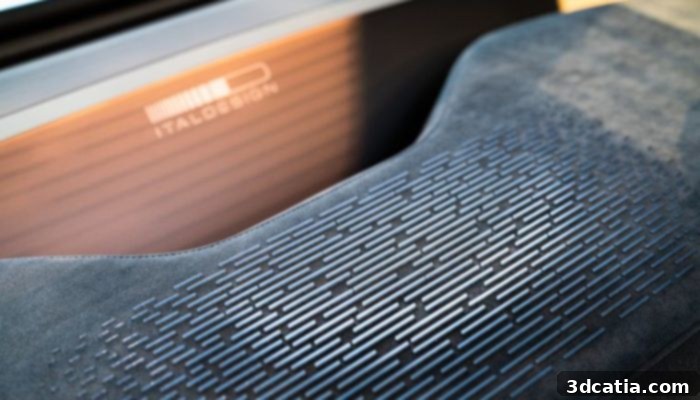
By 3D printing directly onto the fabric, Italdesign was able to play with colors, textures, and functionality.
3DN: How do you envision the future of 3D printing within the design and manufacturing of automotive interiors and beyond?
Daniel Agullo: 3D printing is a technology in a state of relentless evolution, constantly pushing the boundaries of what is possible. Over the past decade, this transformative technology has made truly significant advances, introducing an impressive array of new capabilities. We’ve seen the emergence of robust metal printing, allowing for structural components with intricate geometries; the development of high-rigidity materials, expanding the functional scope of printed parts; sophisticated full-color printing capabilities that enhance aesthetic realism; and even the certification of specialized materials for demanding sectors like aeronautics, demonstrating its reliability and performance. This manufacturing process is inherently ideal for small-scale production runs and rapid prototyping, as it completely bypasses the traditional requirement for expensive and time-consuming molds or dies. These conventional tools typically necessitate very large production volumes to recoup their substantial initial investment, making them unsuitable for bespoke or limited-edition projects. 3D printing liberates us from these constraints, offering unparalleled design freedom and economic viability for lower volumes. Another incredibly exciting and impactful application lies in the ability to print spare parts on demand to replace damaged components. This innovation eliminates the need for vast warehousing facilities and complex, energy-intensive logistics chains, as the necessary parts are produced precisely when and where they are required. This just-in-time manufacturing model has a profound and positive impact on sustainability, significantly reducing waste, inventory, and carbon footprint associated with traditional spare parts management.
As I’ve underscored throughout our discussion, 3D printing has become absolutely fundamental to the entire design and construction process of our styling models, functional prototypes, and small-scale concept models. Therefore, there is no doubt that this indispensable technology will continue to be a cornerstone in all our future projects, concept cars, and groundbreaking show cars, driving innovation and efficiency across every facet of our work at Italdesign.
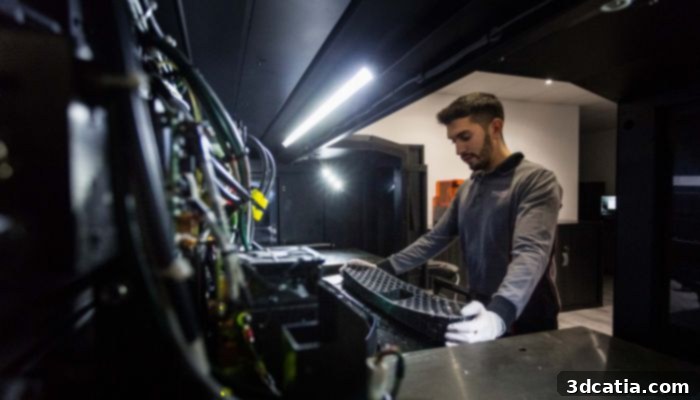
Italdesign regularly uses 3D printing in its projects.
Giorgia de Silva: Looking ahead to the exciting future of 3D printing in automotive interior design, I personally continue to view it as an unparalleled opportunity to significantly accelerate both prototype development and the production of small-series components. My strategic focus for the next generation of interior solutions is even more centered on integrated and single-material designs, aiming for greater simplicity, recyclability, and functional integration. I am particularly enthusiastic about the potential of touch-interactive polymers, where printed surfaces can respond to human touch, offering new levels of user experience and intuitive controls. Furthermore, the development of 3D-printed biopolymers that can transform and adapt over time presents fascinating possibilities for sustainable, evolving interior elements. The critical aspect of weight reduction resulting from 3D printing is paramount, not solely for the structural components of the vehicle, but also, for instance, for lightening and dramatically reducing the layering of seats. By integrating functions and minimizing material, we can create seats that are substantially lighter through a more aesthetically integrated and efficient design, contributing to overall vehicle performance and energy efficiency. This holistic approach ensures that 3D printing continues to drive both functional and aesthetic innovation in vehicle interiors.
3DN: Do you have any final words or insights you would like to share with our readers?
Giorgia de Silva: Finally, I would like to extend a warm invitation to all your readers to actively follow our ongoing developments in the dynamic field of 3D printing applications and material innovation. At Italdesign, we are passionately committed to continuously exploring new frontiers in additive manufacturing to shape not only the future of the automotive industry but also to influence design and production beyond traditional boundaries. For those eager to delve deeper into Italdesign’s diverse and innovative projects, we encourage you to visit our official website and explore the incredible work we are doing. You can find more information HERE.
What are your thoughts on Italdesign’s pioneering activities in integrating 3D printing into automotive design and manufacturing? We encourage you to share your insights in a comment below or engage with us on our LinkedIn or Facebook pages! Additionally, don’t miss out on the latest advancements in additive manufacturing by signing up for our free weekly Newsletter, delivered straight to your inbox. You can also discover all our compelling video content on our dedicated YouTube channel. If your interest lies specifically in more news and developments related to 3D printing within the automotive and transportation sectors, please visit our specialized page HERE for comprehensive coverage.
*All Photo Credits: Italdesign