
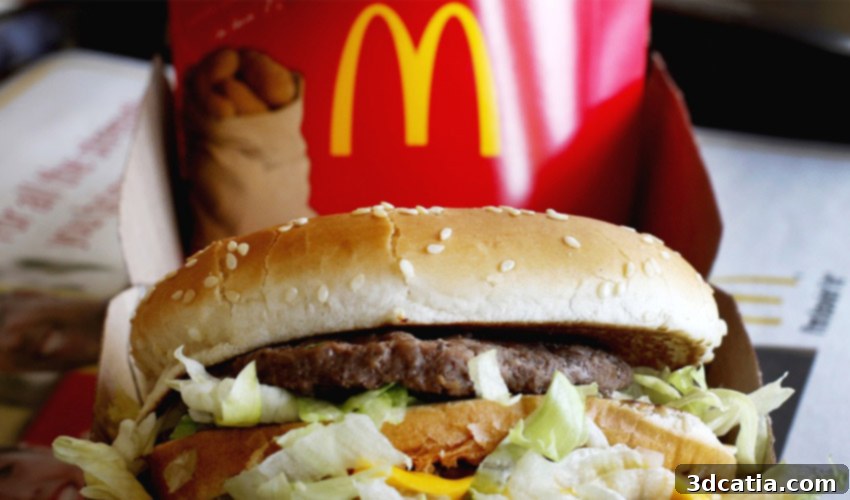
McDonald’s Unveils the 3D Mic Mac: The Future of Customizable, Sustainable Fast Food
In a groundbreaking move set to redefine the fast-food landscape, global giant McDonald’s announced a revolutionary addition to its menu: the 3D Mic Mac. This innovative 3D printed burger promises to transform the way consumers experience their favorite fast food, offering unparalleled customization, extended freshness, and a significant step towards sustainability. The company’s ambitious plan aimed to equip restaurants with advanced 3D printers by the end of 2020, making this customizable hamburger a reality for diners. The 3D Mic Mac is not just about novelty; it’s engineered for longevity, designed to be preserved for a longer duration than traditional burgers. This extended shelf life dramatically reduces kitchen waste, addressing a critical concern in the food industry, all while meticulously preserving the iconic flavor profile of the original Big Mac. Furthermore, in a nod to evolving dietary preferences, the 3D Mic Mac was slated to be offered with either a classic meat patty or a plant-based tofu alternative, catering to the burgeoning demand from vegetarian and flexitarian consumers.
This venture into edible 3D printing is not McDonald’s first dance with additive manufacturing. Several years prior, the company had explored printing its Happy Meal toys in 3D, providing children with the exciting opportunity to personalize their playthings. This earlier experiment laid the groundwork for a more profound integration of 3D technologies directly into its culinary operations. The American fast-food chain’s vision extended beyond toys, aiming to leverage the precision and flexibility of 3D printing in the kitchen to create a burger that is not only easy to prepare and highly customizable but also fundamentally more sustainable. The primary advantage lies in the 3D printed burger’s extended shelf life, a crucial factor in combating the pervasive issue of food waste. Many restaurants unfortunately discard substantial amounts of food that don’t sell quickly enough. McDonald’s, a brand often under scrutiny for its environmental impact, is acutely aware of this problem. By embracing 3D printing, the company envisions a complete overhaul of its supply chain, moving towards a more efficient, demand-driven production model.
3D Mic Mac: A Meticulously Developed Culinary Innovation
The development of the 3D Mic Mac has been a journey spanning several years, as detailed in an official press release. John Catfish, Global Technology Senior Auditor at McDonald’s, revealed insights into this ambitious project. “We have been studying 3D food printing in our restaurants for the last three years,” Catfish stated, highlighting the extensive research and development invested. “Our goal was to equip our kitchens in the United States by the end of 2020 and introduce a fully customizable burger.” The path to innovation, however, was not without its challenges. Catfish elaborated on some of the technical hurdles encountered, particularly concerning the printing of meat. “We faced some difficulties with the printing of the meat, especially in the preservation of amino acids and myoglobins, which are crucial for taste and nutritional value,” he admitted. Despite these complex obstacles, the development teams remained confident and ultimately successful in printing other essential ingredients. “Our teams are confident – we have succeeded in printing the rest of the ingredients, including tofu, in 3D,” Catfish proudly confirmed, underscoring the resilience and ingenuity of McDonald’s R&D department in pushing the boundaries of food technology.
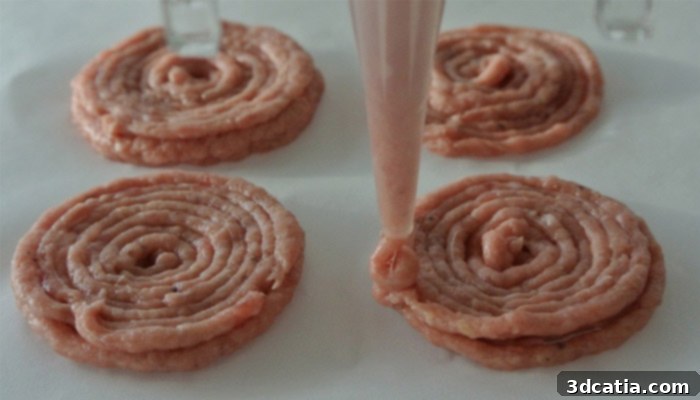
McDonald’s elaborated on the scope of the 3D Mic Mac project, confirming that nearly all components of the burger would be 3D printed. This comprehensive approach includes everything from the meat or tofu patty to the onions, tomatoes, and even the burger bun itself. The sole exception to this advanced printing process would be the sauce. “The sauce will be the only component to be added by hand,” the company explained, citing its particular viscosity as the reason it could not be extruded optimally by current 3D printing technology. While McDonald’s has remained tight-lipped about the specific technology and 3D printer manufacturer involved, they did reveal a crucial partnership. The company confirmed it has collaborated with one of the leading manufacturers of food-based 3D printers in the market, a testament to the specialized expertise required for such an endeavor. Leslie Trout, Product Manager at McDonald’s, shed more light on this collaboration: “We are working with a European manufacturer of food 3D printers who has developed various machine prototypes for us, specifically adapted to our current needs.” She further detailed the complex engineering challenges involved: “The primary challenge was the consistency of our ingredients, which varied significantly. Our partner designed a specialized nozzle capable of efficiently extruding these diverse mixtures and, critically, developed a printing tray that ensured optimal adhesion of the materials during the printing process. This attention to detail ensured consistent quality and texture across all 3D printed components.”
3D Printing: A Strategic Solution to Reduce Food Waste
At first glance, the adoption of 3D printing might seem counterintuitive for a fast-food chain, especially given that some additive manufacturing processes can be slower than traditional production methods. However, McDonald’s strategic decision to embrace this technology is deeply rooted in its potential to revolutionize supply chain management and significantly mitigate food waste. The core principle lies in the ability of 3D printing to enable on-demand, precise production. By creating only the necessary amount of each burger component, McDonald’s can drastically reduce the volume of unused ingredients and prepared items that typically end up in the bin. This is a game-changer for a sector frequently criticized for its contribution to global food waste. The company has invested heavily in developing specific formulations for its 3D printed burgers, ensuring they retain their authentic flavor and texture while also boasting an extended preservation window. This means that unlike traditional burgers, which often must be consumed within minutes of preparation to maintain quality, 3D printed versions can be prepared in advance without compromising their taste or freshness. This operational flexibility not only minimizes waste but also enhances efficiency, allowing kitchens to better manage peak demand periods without over-preparing.
The implications of this technology extend beyond simply throwing away fewer burgers. It represents a fundamental shift in how McDonald’s manages its inventory, procurement, and overall kitchen operations. By moving towards a “print-on-demand” model, the chain can optimize its raw material usage, reduce storage needs for perishable items, and potentially even personalize each order more deeply than ever before. This level of precision and control is unprecedented in the fast-food industry. Mike Turbot, Quality Engineer at McDonald’s, articulated the broader vision behind this initiative. “3D printing will enable us to meet the significant challenges of our modern consumer society, particularly regarding sustainability,” Turbot explained. “We will be able to produce the exact right amount of food, thereby minimizing waste, all while meticulously preserving the exceptional flavor that our customers expect.” He further emphasized the transformative potential of the technology: “It is a fascinating technology with truly significant advantages in the food industry, opening doors to efficiencies and innovations previously unimaginable. We are incredibly proud to be at the forefront, the first fast-food chain to widely offer such an advanced culinary solution.” This commitment underscores McDonald’s dedication to leveraging technological advancements for both operational excellence and environmental responsibility, setting a new benchmark for quick-service restaurants globally.
The Impact of 3D Food Printing on Consumer Choice and Industry Trends
The introduction of the 3D Mic Mac goes beyond waste reduction; it also significantly enhances consumer choice and represents a major stride in catering to diverse dietary needs. The commitment to offering both a traditional meat patty and a tofu alternative from the outset highlights McDonald’s responsiveness to growing trends in plant-based eating. This move positions the company not just as an innovator in technology but also as a forward-thinking brand that understands and adapts to the evolving preferences of its global customer base. The ability to customize a burger with individually printed components means that theoretically, consumers could have unprecedented control over their meal, choosing specific ingredients, shapes, or even nutrient profiles in the future. While the initial launch in 2020 in the US was focused on the core offering, the long-term potential for hyper-personalization is immense, promising a truly bespoke fast-food experience.
Beyond McDonald’s, this initiative could spark a revolution across the entire quick-service restaurant (QSR) sector. If successful, other major chains might be compelled to explore 3D food printing, leading to a broader adoption of sustainable and customizable food production methods. This could accelerate advancements in food science, material development for edibles, and the engineering of more efficient and affordable food 3D printers. Challenges, of course, remain. Public perception of 3D printed food, the speed required for fast-food service, and the initial investment in printer infrastructure are all factors that will influence the ultimate success and widespread adoption of such technologies. However, McDonald’s bold step with the 3D Mic Mac indicates a clear vision for the future: one where technology, sustainability, and personalized dining converge to create a smarter, more responsible, and exciting fast-food experience.
McDonald’s was expected to launch its first 3D Mic Mac with meat or tofu in 2020 in the US, marking a pivotal moment in culinary innovation. For more information on this groundbreaking announcement and the company’s vision, please find additional details on the official website of the company HERE.
Would you try McDonald’s 3D printed burgers? We’re eager to hear your thoughts on this exciting development! Let us know what you think in a comment below or join the conversation on our Facebook and Twitter pages! Don’t forget to sign up for our free weekly Newsletter, to stay updated with all the latest news and innovations in 3D printing, delivered straight to your inbox!