

Revolutionizing Manufacturing: Phillips Corporation’s Hybrid AM Solution with Haas and Meltio DED
The manufacturing landscape is undergoing a profound transformation, with additive manufacturing (AM) rapidly moving from niche applications to mainstream industrial adoption. A key driver of this shift is the emergence of hybrid manufacturing solutions, which ingeniously combine the strengths of both additive and traditional subtractive manufacturing methods like CNC machining. These integrated systems offer unparalleled versatility, efficiency, and capability, addressing a wider range of production and repair challenges than either technology could alone. Leading this innovative charge is Phillips Corporation, a premier provider of manufacturing technology products and services to commercial markets and federal governments alike.
Phillips has recently unveiled an advanced hybrid machine, a powerful fusion of Haas Automation’s world-renowned subtractive CNC machine tool technology with an cutting-edge additive laser head from Meltio. This strategic integration marks a significant leap forward in metal additive manufacturing, promising to redefine how complex parts are fabricated and repaired across various sectors. To delve deeper into this groundbreaking development, its diverse applications—including its critical role in the maritime sector—and the strategic rationale behind Phillips’ expanded foray into the additive manufacturing market, we had the distinct pleasure of sitting down with John Harrison, the esteemed Director of Additive Manufacturing for Phillips Corporation. His insights shed light on the vision, technical prowess, and collaborative spirit driving this exciting venture.
Phillips Corporation’s Journey into Additive Manufacturing: An Interview with John Harrison
“I am John Harrison, Director of Additive Manufacturing for Phillips Corporation,” he began, introducing himself and his profound connection to the evolving world of 3D printing. Phillips Corporation boasts a significant legacy in the 3D printing industry, having been actively involved for 16 years. John recounted one of his early and most impactful experiences with the technology at Walter Reed Hospital, where the transformative potential of additive manufacturing was strikingly evident.
“Doctors there were utilizing 3D printing to assist soldiers recovering from traumatic head injuries,” he explained. “They would perform advanced 3D scans of the damaged areas of a soldier’s skull, and then precisely print custom plates designed for implantation to repair the damaged bone.” This powerful example underscored the technology’s capacity for creating highly personalized, life-changing medical devices, showcasing its precision and adaptability in critical situations.

As additive manufacturing technology has progressively matured and advanced, its applications have diversified exponentially. What once seemed futuristic is now commonplace in numerous industries. John highlighted this evolution, stating, “New opportunities in production, human adaptation – such as knee implants, intricate dental repair solutions, and advanced hearing aids – as well as robust supply chain support, have all emerged as significant areas of impact.” Phillips Corporation is strategically positioned at the forefront of this innovation, with a clear mission: “Our company is intensely focused on placing additive technology and its associated know-how directly into the hands of the innovators who are poised to change the world.” This commitment underscores Phillips’ dedication not just to selling technology, but to fostering a future driven by advanced manufacturing capabilities.
The Genesis of Phillips’ Hybrid AM Solution: A Customer-Driven Innovation
Phillips’ entry into the hybrid additive manufacturing space was not a top-down mandate but a direct response to customer demand, beginning as early as eight years ago. “Phillips was brought into the hybrid AM space by our customers,” John affirmed. As a long-standing and trusted partner with Haas Automation, a globally recognized leader in high-performance CNC manufacturing solutions, Phillips was ideally positioned to address these emerging needs. “A customer specifically approached us and asked if we could integrate a wire arc additive head directly into a CNC mill,” he explained. This pivotal request marked Phillips’ very first foray into hybrid manufacturing, acting as a crucial proof of concept. Over the subsequent years, Phillips proactively experimented with integrating various additive technologies into CNC milling platforms, continuously refining their approach and expanding their expertise.
The strategic importance of hybrid solutions gained further momentum a few years back when Phillips initiated discussions with the Department of Defense (DoD) regarding the development of an “expeditionary hybrid solution.” The DoD’s requirement for robust, on-demand manufacturing and repair capabilities in remote or forward-deployed environments highlighted a critical gap that hybrid AM could fill. Shortly thereafter, an original equipment manufacturer (OEM) approached Phillips with a similar vision, specifically seeking to integrate additive capabilities onto a Haas UMC-1000, a highly versatile 5-axis universal machining center. These converging inquiries served as a powerful catalyst, ultimately leading to the formal establishment and rapid development of the dedicated Phillips Hybrid team. This team was tasked with bringing these complex, integrated manufacturing visions to fruition, solidifying Phillips’ commitment to the future of hybrid production.
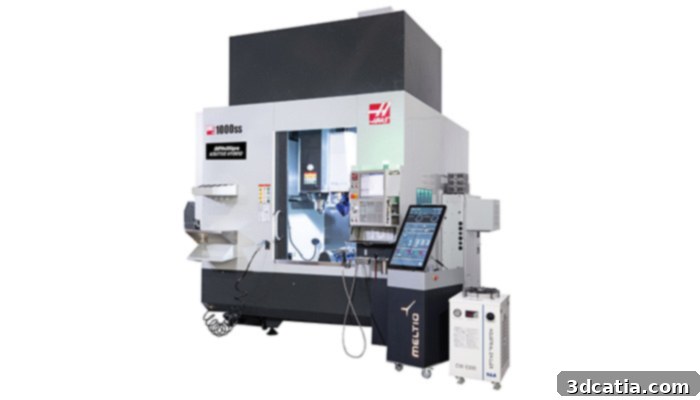
The new hybrid machine from Phillips and Meltio (photo credits: Phillips)
Partnering with Meltio: Harnessing the Power of Direct Energy Deposition (DED)
The selection of Meltio’s Direct Energy Deposition (DED) technology for this pioneering hybrid solution was a meticulously considered decision, rooted in Phillips’ extensive experience with various additive methods. “We had some experience with several technologies and experimented with wire arc, and powder blown solutions,” John noted. While these offered valuable insights, it was the discovery of Meltio that proved to be the ideal fit for Phillips’ vision and customer requirements. “We stumbled upon Meltio and think we have a good fit,” he confidently stated, highlighting the synergy between the two companies.
Meltio had developed the innovative M450, a unique wire-fed DED solution that distinguishes itself through the clever use of multiple lasers. John elaborated on its advantages: “The design utilized multiple, low-power lasers that made the solution remarkably affordable, broadening its accessibility.” Beyond cost-effectiveness, the head’s ingenious design allowed for exceptional operational flexibility. “The head was designed to introduce power from multiple sides, which enables the machine to produce additive layers in virtually any direction,” he explained. This multi-directional deposition capability is a significant differentiator, offering greater geometric freedom and material control. Furthermore, the use of lasers in Meltio’s DED process is highly advantageous: “The use of lasers minimizes the heat input into the work area and significantly reduces the amount of Argon assist gas required,” leading to better material integrity, reduced post-processing, and more economical operation.
A crucial factor that accelerated the integration process was Meltio’s prior expertise. “Meltio was already integrating their print engines on robotic arms, which gave us a significant head start in developing the process to integrate the technology onto a Haas machine,” John revealed. This existing modularity and experience with integration streamlined Phillips’ efforts. The initial project focused on demonstrating capability for expeditionary environments, starting with a 3-axis machine, the Haas TM-1. The success of this demonstration quickly garnered attention: “The word got out that we were working on this project, and an OEM subsequently asked us to build a hybrid unit based on the more advanced Haas UMC-1000,” showcasing immediate market interest and validation. John lauded the collaboration: “The Meltio team has been incredibly supportive throughout the process and continues to improve on an already robust print engine. We are genuinely happy with the enthusiastic interest from our customers in the resulting product.” This partnership exemplifies how combining specialized expertise can lead to transformative manufacturing solutions.
The Unrivaled Advantages of Hybrid Manufacturing: Beyond Additive or Subtractive Alone
The core philosophy behind Phillips’ new solution lies in the synergistic advantages of integrating both subtractive and additive manufacturing into a single machine. John Harrison articulated this powerful proposition: “The hybrid machine can be used effectively for both manufacturing entirely new parts and for repairing existing components.” This dual capability is where its true value lies, offering efficiencies and possibilities that neither technology could achieve in isolation. The question isn’t “why not just one or the other?” but rather, “why not both?”
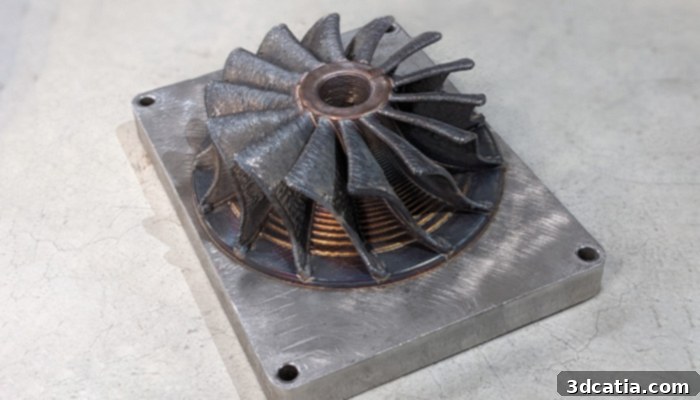
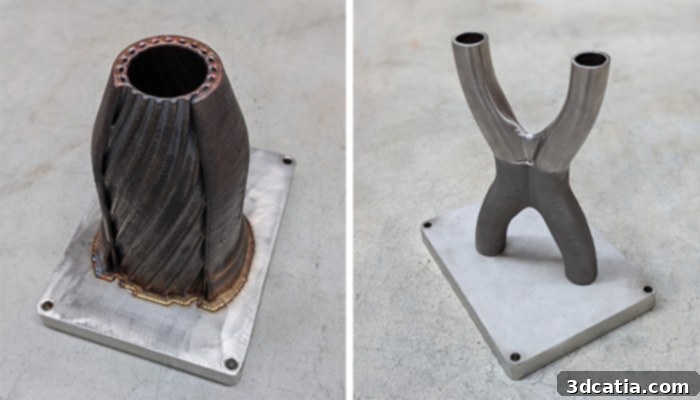
For new part creation, the benefits are particularly pronounced in challenging scenarios, such as expeditionary environments. “If you do not have readily available feedstock or a specific spare part, you can effectively ‘grow a part’ using the additive process and then utilize the integrated CNC capabilities to finish it to precise specifications,” John explained. This on-demand manufacturing capability drastically reduces lead times and logistics complexities in remote locations. Other significant applications for new parts include those that are traditionally cast or would necessitate the removal of a substantial amount of material from a large billet. By adding material only where needed, the hybrid approach significantly reduces waste, material costs, and machining time, making complex geometries more economically viable and environmentally friendly.
Where the hybrid solution truly shines is in its predictable and highly efficient repair capabilities for damaged or worn components. “If a component is damaged or has experienced wear, the hybrid system offers a highly predictable repair process,” John emphasized. This involves a precise, multi-stage operation: “The worn area can be repeatably and accurately removed using the subtractive CNC capabilities. Then, the laser DED head can precisely add material back into the void, effectively rebuilding the part. Finally, the CNC re-finishes the repaired area to its original tight tolerances, ensuring functionality and longevity.” This process revitalizes expensive, complex parts that would otherwise be scrapped, extending their lifespan and reducing replacement costs. Beyond expeditionary repair needs, a wide array of industrial sectors stands to benefit immensely. “Manufacturing lines, facing constant wear and tear on critical tooling or machinery components, and mold-making shops, requiring intricate repairs or modifications to high-value molds, could significantly benefit from the hybrid solution’s precision and efficiency,” John concluded. This ability to repair and restore components to their original specifications represents a paradigm shift in maintenance and operational sustainability.
Diverse Applications and Key Industries Benefiting from Hybrid AM
The versatility and robustness of Phillips’ hybrid AM solution unlock a wide spectrum of applications across numerous industries, with particular resonance in demanding environments. John Harrison offered a vivid illustration of its expeditionary utility: “Whenever I think about the usage case for expeditionary environments, I’m reminded of the Discovery Channel show ‘Deadliest Catch.'” He elaborated on the analogy: “The show follows crab fishermen as they harvest seafood in the treacherous Bering Sea. In most episodes, a boat inevitably experiences a critical breakdown of a vital component. They typically lack a spare part on board and are forced to make immediate decisions – either find a way to fix it or face a costly and dangerous return to port, potentially losing their entire season’s catch.”
This scenario powerfully underscores the immense value of having the immediate ability to create or repair a part directly at the point of need. The implications for industries operating in remote, critical, or challenging conditions are profound. “Think about the urgent needs of large Naval vessels operating far at sea, where a breakdown can jeopardize a mission, or a soldier supporting essential equipment in remote, austere environments,” John urged. In such contexts, waiting for parts to be shipped is often not an option; on-demand fabrication and repair become mission-critical. “The application of hybrid manufacturing in these scenarios is absolutely evident,” he stated. Beyond these immediate, high-stakes situations, the solution offers significant advantages to traditional industrial settings. “Relative to established manufacturing facilities, the capability for predictable, efficient repair of components that experience regular wear and tear is rapidly emerging as a truly great application,” John emphasized. This includes everything from heavy machinery parts in mining or construction to specialized tooling in aerospace, automotive, or general fabrication plants, where minimizing downtime and extending equipment life are paramount.
Looking Ahead: The Game-Changing Potential of the Phillips Hybrid
As our discussion drew to a close, John Harrison conveyed a palpable sense of enthusiasm for the future impact of this technology. “We are incredibly excited to be a integral part of bringing the innovative Meltio technology to the robust and widely adopted Haas platform,” he shared. This collaboration represents more than just a technical integration; it signifies a strategic move to democratize advanced manufacturing capabilities. John firmly believes that the combined attributes of this solution will have a profound effect on the industry: “We are confident that the unparalleled affordability and the exceptional serviceability of the Phillips Hybrid solution will enable countless manufacturing shops, both large and small, to truly unlock the immense potential of this game-changing technology.”
The blend of cost-effectiveness and ease of maintenance inherent in the Phillips Hybrid is set to break down traditional barriers to entry for metal additive manufacturing, allowing a broader spectrum of businesses to adopt these cutting-edge processes. For those eager to explore the specifics and delve deeper into how this solution can transform their operations, more comprehensive information is readily available on Phillips’ dedicated website. Interested parties can find further details HERE.
We invite our readers to engage with this exciting development. What are your thoughts on Phillips’ strategic integration of additive manufacturing? How do you foresee hybrid solutions impacting your industry or the broader manufacturing landscape? We encourage you to share your insights and comments below, or join the conversation on our Facebook and Twitter pages. Stay informed about the latest breakthroughs in 3D printing by signing up for our free weekly newsletter, delivering all the essential news directly to your inbox!