
Pioneering Durable Maritime Parts: Renishaw and Metalpine Advance 3D Printing with Corrosion-Resistant Copper-Nickel Alloys
In a significant stride towards enhancing the resilience and efficiency of marine operations, Renishaw, a global leader in metal additive manufacturing systems, has forged a strategic alliance with Metalpine, an esteemed Austrian producer of high-quality metal powders. This groundbreaking collaboration is specifically aimed at developing advanced 3D printing solutions meticulously tailored for the demanding maritime sector. The joint venture is dedicated to engineering and producing exceptionally durable components capable of withstanding the formidable conditions prevalent in marine environments, where relentless exposure to saltwater, extreme pressures, and varying temperatures typically accelerate corrosion, wear, and overall degradation of materials.
The core of this innovative project revolves around the sophisticated application of copper-nickel (CuNi) alloys in powder form for advanced 3D printing processes. These specialized alloys are highly celebrated across various industries for their remarkable anti-corrosion properties and inherent strength. When precisely processed through laser fusion, these CuNi powders form an incredibly robust and protective layer, substantially reinforcing the resistance of manufactured parts against the aggressive elements characteristic of oceanic and coastal settings. The research meticulously investigated two distinct compositions: CuNi 10 (comprising 10% nickel and 90% copper) and CuNi 30 (featuring 30% nickel and 70% copper). Each of these alloys presented unique characteristics and performance profiles, particularly concerning their interaction with laser energy during the additive manufacturing process and their ultimate mechanical performance under stress.
Photo Credits: Renishaw/Metalpine
Advancing Durability: 3D Printing for Enhanced End-Use Parts in Marine Environments
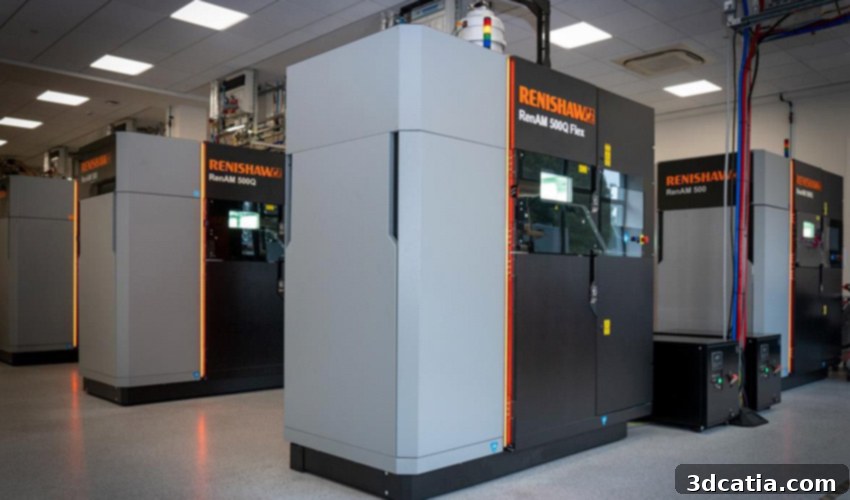
The development phase saw the components meticulously manufactured using Renishaw’s cutting-edge RenAM 500Q Flex system. This state-of-the-art metal 3D printer is specifically engineered for research and development applications, offering unparalleled flexibility and precision. A key advantage of the RenAM 500Q Flex for this project was its exceptional ability to facilitate rapid powder changes, a critical feature when experimenting with multiple material compositions like CuNi 10 and CuNi 30. This capability, synergized with the machine’s Reduced Build Volume (RBV) accessory, allowed the Renishaw and Metalpine teams to conduct extensive trials with remarkably small quantities of powder – as little as 0.25 liters. Crucially, this setup enabled the simulation of large-scale production conditions, providing invaluable data and insights while significantly minimizing material waste and expediting the iterative optimization of printing parameters. This agile and efficient approach proved decisive in fine-tuning the manufacturing process for optimal part quality and performance.
One of the most significant technical hurdles faced during the project was the processing of copper-rich alloys in a 3D printing environment. Copper, by its very nature, exhibits exceptionally high reflectivity to laser energy, making it notoriously difficult to achieve consistent and complete fusion during the additive manufacturing process. This characteristic can lead to issues such as insufficient melt pool formation, uneven material distribution, and ultimately, parts with compromised mechanical integrity. To effectively overcome this formidable obstacle, Renishaw’s expert team undertook a meticulous and exhaustive adjustment of several critical printing parameters. These included fine-tuning the laser power output, optimizing the scanning speed across the powder bed, and precisely controlling the trajectory spacing of the laser path. Through iterative experimentation and advanced diagnostics, these careful adjustments led to groundbreaking success, resulting in homogeneous powder fusion and the consistent production of parts that boasted outstanding mechanical properties and structural integrity. Notably, the CuNi 30 alloy, attributed to its higher nickel content, demonstrated superior processability compared to CuNi 10, likely due to altered laser absorption characteristics and improved melt pool stability.
Photo Credits: Metalpine
This pioneering collaboration between Renishaw and Metalpine not only underscores the immense potential of additive manufacturing to produce components that are simultaneously robust, precise, and highly customized but also represents a pivotal strategic solution for naval forces and maritime industries globally. By leveraging advanced 3D printing capabilities, these organizations can significantly reduce their reliance on complex, often vulnerable, and extended global supply chains. The ability to opt for on-demand, in-house production of critical components directly via 3D printing offers a transformative advantage. This paradigm shift empowers naval fleets and commercial vessels to drastically limit operational interruptions, guarantee the immediate availability of essential parts even in remote locations, and fundamentally enhance the long-term sustainability and operational readiness of their assets at sea. Furthermore, the capacity for rapid prototyping and localized manufacturing of spare parts can lead to faster repairs, reduced downtime, and potentially extended service life for valuable equipment.
The implications of this partnership extend far beyond military applications, promising to revolutionize various facets of the broader marine industry. Commercial shipping, offshore energy platforms, underwater exploration vehicles, and even sustainable aquaculture infrastructure can all benefit immensely from durable, corrosion-resistant parts that are lighter, more complex in design, and produced with greater agility than traditional manufacturing methods allow. The capacity to create bespoke parts optimized for specific functions and environments, coupled with the reduced lead times inherent in additive manufacturing, positions this technology as a cornerstone for future innovation in marine engineering. Moreover, the environmental benefits are considerable, as additive manufacturing typically generates less material waste and can enable the production of lighter components, which in turn leads to improved fuel efficiency for marine vessels, contributing to a greener maritime future.
Reflecting on the technical achievements and the broader impact of this project, Alex Garcia, AM Design and Applications Engineer at Renishaw, stated, “We meticulously adjusted the RenAM 500Q Flex’s laser power, scan speed, and hatch distance to fully optimize the process for manufacturing with these challenging materials. Through these precise and iterative settings, we have successfully overcome the material’s inherent difficulties, thereby ensuring the production of high-quality, exceptionally durable parts that are specifically engineered to withstand the harshest marine environments. This extensive optimization not only significantly enhances part strength and longevity but also guarantees consistently reliable results, which is paramount for our naval customers who require components to perform flawlessly under the toughest conditions.” For more comprehensive details about this impactful collaboration and its findings, please follow the link provided HERE.
What are your thoughts on this innovative collaboration between Renishaw and Metalpine for developing more durable maritime parts through additive manufacturing? We encourage you to share your insights in a comment below or engage with us on our LinkedIn, Facebook, and Twitter pages! Don’t forget to sign up for our free weekly Newsletter here to receive the latest 3D printing news directly to your inbox! You can also find all our compelling videos on our YouTube channel. If you are interested in more 3D printing news specifically within the automotive and transportation sector, we invite you to visit our dedicated page HERE.
*Cover Photo Credits: Renishaw